
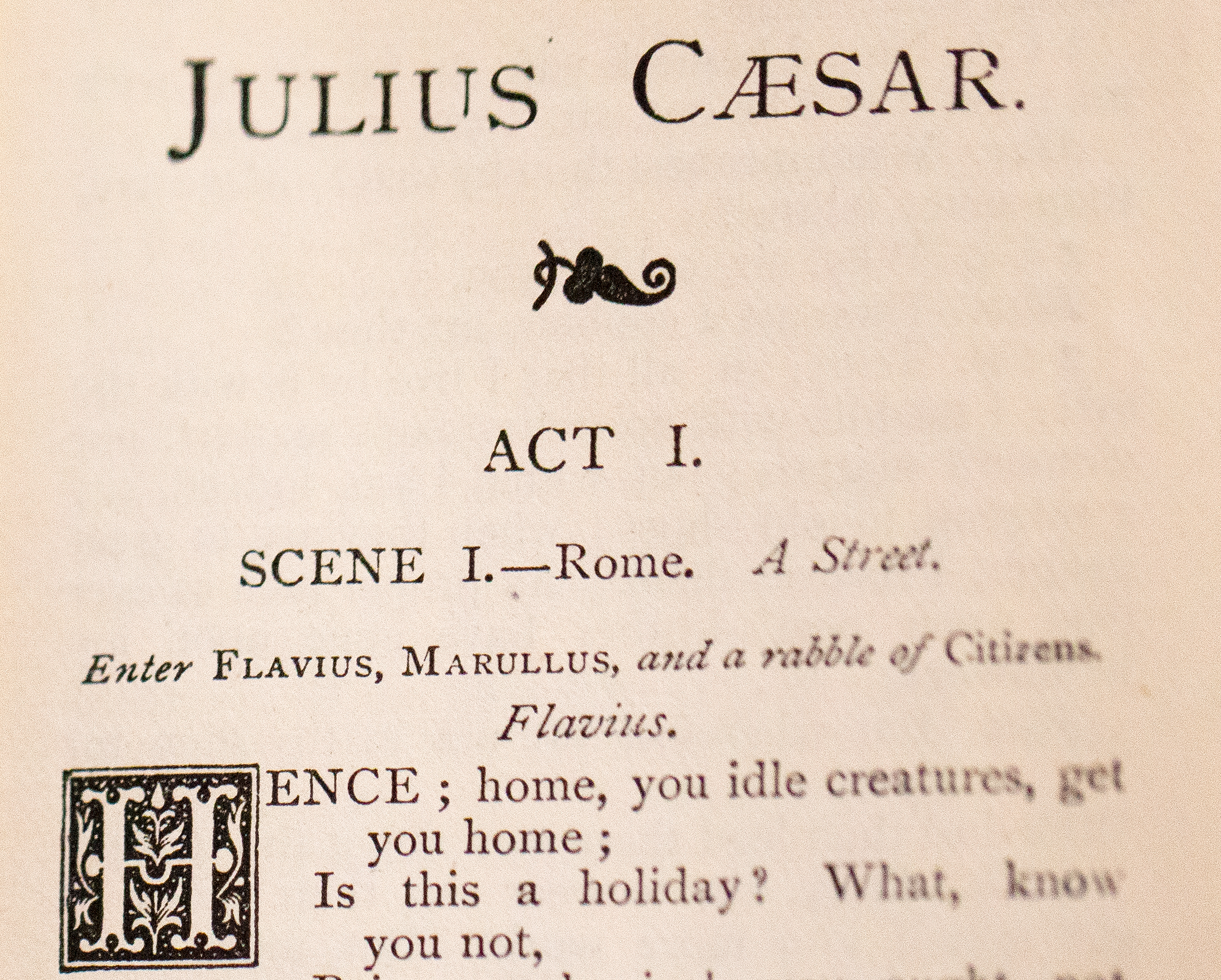
 Julius Caesar is a 425 year-old modern play about how political leaders are corrupted and in turn, manipulate and mislead the public for their own selfish motives. Its Realpolitik reminds us that Rome still speaks to present times. In SPQR – A History of Ancient Rome, Mary Beard writes “[t]he alleged corruption, incompetence and snobbish exclusivity of leading senators were important topics in wide political debates throughout the last century of the Republic.” The statesman and philosopher Cicero wrote of his times that “the political situation alarms me more each day.”
William Shakespeare’s play was likely written in 1599, just before Hamlet, and covers the period after Caesar crossed the Rubicon and defeated Pompey in a four-year civil war, to his assassination in the senate in 44 BCE, causing another civil war resulting in the collapse of the Roman Republic and the beginning of the rule of emperors in 30 BCE.
Brutus, earlier pardoned by Caesar, will be coerced into joining the assassination conspiracy by Cassius and others. Mark Antony, who narrowly avoids the day of the long knives in the senate, will seize the opportunity, turn the tables on the conspirators and win the hearts of the public, only to later betray Rome. Sociopaths are beautiful and charming.
Julius Caesar opens with the mob (plebeians), celebrating the return of Caesar from his military victories. Flavius, a tribune, berates the mob asking “Is this a holiday?” (1.1.2) (in Elizabethan times, holiday was indistinguishable from a holy-day). But it is actually Lupercalia – a festival of fertility where naked men romp through Rome whipping any women they find. Caesar is concerned with his wife’s infertility and asks Mark Antony, one of the rompers, to “touch” her in hopes of a cure.
Antony, knowing that one must render unto Caesar whatever is Caesar’s, and perhaps too eager to please, replies: “When Caesar says ‘Do this,’ it is performed” (1.2.10). Later, Antony’s famous oratory will demonstrate how easily citizens bow to the whims of those in power, and how easily and unknowingly the public will abandon their own interests. However, at this point, Antony is merely following orders – the hollow excuse of men who forsake morality in pursuit of power. During his funeral oration, Antony will speak of Caesar’s will which promised money and property to the citizens. Immediately after consolidating his power, Antony will coldly revoke this bequest and rob Rome of its inheritance “…we shall determine how to cut off some charge in legacies” (4.1.8-9).
But immediately from the crowd comes the soothsayer’s famous warning “Beware the Ides of March.” Brutus and Cassius privately discuss their worries, and Brutus expresses “I do fear the people choose Caesar for their king” (1.2.78-9). Cassius then goads Brutus:
Men at some time are masters of their fates.
The fault, dear Brutus, is not in our stars
But in ourselves, that we are underlings (1.2.138)
Caesar has his eye on these two and observes:
Yond Cassius has a lean and hungry look:
He thinks too much: such men are dangerous (1.2.193-4)
While addressing the crowd Caesar suffers a seizure and Cicero, speaking Greek and never one to shy from public speaking, steps in for Caesar. Greek was understood by the educated but not by the plebeians. Thus Caska, who can’t follow Cicero’s speech, utters the phrase:
…but for my own part, it was Greek to me (1.2.282-3)
The next scene takes place during a “dreadful night” which “opens graves and roars” (1.3.74). Such omens make Cicero apprehensive, who understands too well that men loose their ability to reason when presented with the two-thousand year-old equivalent of fake news – “…but men may construe things after their fashion clean from the purpose of the things themselves” (1.3.34-5). Meanwhile, the conspirators, Brutus, Caska, Cassius and Cinna, resolve to assassinate Caesar in the senate.
The next act opens with Brutus expressing misgivings about joining the conspirators:
Th’ abuse of greatness is when it disjoins
Remorse from power…
Between the acting of a dreadful thing
And the first motion, all the interim is
Like a phantasma or a hideous dream (2.1.18-19 and 63-5)
As dawn breaks on the Ides, Cinna observes “…yon grey lines that fret the clouds are messengers of the day” (2.1.102-3). Like Horatio in Hamlet “…the morn in russet mantle clad walks o’er the dew of yon high eastward hill” (Ham 1.1.171-2) the feeling of something rotten hangs in the morning air.
Momentum builds, and Ligarius is welcomed to the growing crowd of conspirators proclaiming “Now bid me run and I will strive with things impossible…” (2.1.323-4) as ominous prophecies continue – “…graves have yawned and yielded up their dead” (2.2.18). A favorite image of Shakespeare’s used by Hamlet as well “‘Tis now the very witching time of night, when churchyards yawn and hell itself breathes out contagion to this world.” (3.2.379-381).
Caesar’s wife urges him not to venture into the senate, and he is inclined to heed her warning:
Caluhurina –
When beggars die there are no comets seen;
The heavens themselves blaze forth the death of princes.
Caesar –
Cowards die many times before their deaths;
The valiant never taste of death but once.
Of all the wonders that I have yet heard,
It seems to me most strange that men should fear,
Seeing that death, a necessary end,
Will come when it will come (2.2.30-7)
Decius (as you guessed, another conspirator) persuades Caesar otherwise and takes him to the senate where Caesar is distracted by Metellus who asks for a pardon of his banished brother. But Caesar will not yield:
But I am constant as the northern star,
Of whose true-fixed and resting quality
There is no fellow in the firmament (3.1.60-63)
The conspirators stab Caesar who utters the famous line “Et tu Brute? – Then fall, Caesar” (3.1.77). Covered in Caesar’s blood, Brutus quietly observes “ambition’s debt is paid” (3.1.83).
The play pivots to Antony who, confronting the conspirators, says he is willing to die alongside Caesar:
O mighty Caesar! Dost thou lie so low?
Are all thy conquests, glories, triumphs, spoils,
Shrunk to this little measure?…
Live a thousand years,
I shall not find myself so apt to die (3.1.148-150 and 159-160)
Even in grief, Antony senses opportunity and realizes he must play along, because he is not really ready to die for a cause. When confronted by men with bloody knives, this is no time to stand on principle:
That I did love thee, Caesar, O ‘tis true…
Friends am I with you all, and love you all,
Upon this hope, that you shall give me reasons
Why and wherein Caesar was dangerous (3.1.194 and 220-2)
Brutus is satisfied and willing to allow Antony to speak at Caesar’s funeral so long as Antony does not blame the conspirators. In an aside, realizing a grave mistake, Cassius warns Brutus “You know not what you do” (3.1.233).
Left alone, Antony’s inner voice reveals his intentions to seize power and rain destruction on the land:
Thou are the ruins of the noblest man
That ever lived in the tide of times…
Cry havoc and let slip the dogs of war,
That this foul deed shall smell above the earth
With carrion men, groaning for burial (3.1.256-7 and 273-5)
At the funeral, Antony begins by praising the conspirators. In a brilliant piece of rhetoric, he turns the crowd against the assassins who realize they must flee Rome, because the gig is up:
Friends, Romans, countrymen, lend me your ears:
I come to bury Caesar, not to praise him.
The evil that men do lives after them:
The good is oft interred with their bones…
But Brutus says, he was ambitious,
And Brutus is an honourable man…
When that the poor have cried, Caesar hath wept:
Ambition should be made of sterner stuff.
Yet Brutus says, he was ambitious,
And Brutus is an honourable man…
If I were disposed to stir
Your hearts and minds to mutiny and rage,
I should do Brutus wrong…
I fear I wrong the honourable men
Whose daggers have stabbed Caesar: I do fear it…
If you have tears, prepare to shed them now…
For Brutus, as you know, was Caesar’s angel.
Judge, O you gods, how clearly Caesar loved him.
This was the most unkindest cut of all…
I am no orator, as Brutus is,
But, as you know me all, a plain blunt man
That love my friend…
For I have neither wit, nor words, nor worth,
Action, nor utterance, nor the power of speech
To stir men’s blood (various lines 3.2.74-216)
In an aside, Antony is pleased with himself. He has fooled everyone and overthrown the government:
Now let it work. Mischief, thou art afoot: Take thou what course thou wilt (3.2.251-2)
Like any crowd incited to riot, they storm the senate.
Revenge! About! Seek! Burn! Fire! Kill! Slay!…
Pluck down forms, windows, anything (3.2.198-9 and 250)
Battles ensue as Antony and the conspirators raise armies. Brutus quarrels with Cassius about ideals, because Cassius has seen the conspiracy as a means of accession to wealth.
Brutus –
I had rather be a dog and bay the moon than such a Roman (4.3.27)
Cassius –
Do not presume too much upon my love:
I may do that I shall be sorry for (4.3.63-4)
The two reconcile when Brutus learns of the death of his wife – “In this I bury all unkindness, Cassius” (4.3.157).
A great sense of remorse sets in. Not for nothing that the phrase caveat emptor is Latin. Brutus laments his actions and is resigned to his fate:
There is a tide in the affairs of men
Which, taken at the flood, leads on to fortune:
Omitted, all the voyage of their life
Is bound in shallows and in miseries (4.3.216-9)
Which echos Caesar’s apprehension at 2.2.30, and Hamlet in Shakespeare’s next play:
We defy augury. There is special providence in the fall of a sparrow. If it be now, ‘tis not to come; if it be not to come, it will be now; if it be not now, yet it will come. The readiness is all (Ham 5.2.215-8)
Brutus will take his life in the Roman manner:
…for Brutus’ tongue
Hath almost ended his life’s history:
Night hangs upon mine eyes: my bones would rest,
That have but labored to attain this hour (5.5.39-42)
Finding the body of Brutus, Antony praises him:
This was the noblest Roman of them all…
So mixed in him that nature might stand up
And say to all the world, ‘This was a man!’ (5.5.69 and 75-6)
In the end, this is not Caesar’s tragedy, who is no longer the noblest Roman, but the tragedy of Brutus.
——–
This is the first in a series of essays on the plays of William Shakespeare. I’ll highlight my favorite passages within the context of the Shakespearean canon. Line references are to The Arden Shakespeare, Third Series, which is my preferred text, due to their excellent scholarly analysis and commentary.
My Grandfather was a proud, self-educated, Ulsterman. There was a shelf in his home which was lined with beautiful books bound in red with guilded edges. Morning light would hit them and warm the room. Thus began a fascination with Shakespeare before I even knew who he was. I am immensely thankful.
Falstaff “Is not the truth the truth?” (1H4 2.4.233-4)
 Richard Watson