• Antarctica
  • Book Reviews
  • Economics and Taxation
  • Photographs
  • Political Commentary
  • Running
  • Science
  • Short Stories
  • Travel
  • About Richard Watson

Richard Watson

~ Commentary

Richard Watson

Category Archives: Economics and Taxation

J’accuse…Lehman Brothers

12 Friday Mar 2010

Posted by Richard Watson in Economics and Taxation

≈ Leave a comment

In 1898, Émile Zola exposed a military conspiracy of sorts in a letter addressed to the French president which was published on the front page of the Parisian newspaper, L’Aurore.  J’accuse, the title of the letter, has come to symbolize the expression of outrage against abuses by those in power.

The court appointed Examiner of Lehman Brothers, which sought Chapter 11 bankruptcy protection on September 15, 2008, has issued his scathing, 4,105 page report (including the appendices). Today, the phrase J’accuse should be aimed at Dick Fuld and Lehman Brothers. The Financial Times has reported that credible evidence exists “…that top executives, including the former chief Dick Fuld, approved misleading financial statements and used an ‘accounting gimmick’ to flatter results” (Lehman report lays wide blame for failure, March 12, 2010). In the words of Anton Valukas, the bankruptcy court’s Examiner…

Lehman’s failure to disclose the use of an accounting device to significantly and temporarily lower leverage, at the same time that it affirmatively represented those “low” leverage numbers to investors as positive news, created a misleading portrayal of Lehman’s true financial health. Colorable claims exist against the senior officers who were responsible for balance sheet management and financial disclosure, who signed and certified Lehman’s financial statements and who failed to disclose Lehman’s use and extent of Repo 105 transactions to manage its balance sheet…Lehman’s own accounting personnel described Repo 105 transactions as an “accounting gimmick” and a “lazy way of managing the balance sheet as opposed to legitimately meeting balance sheet targets at quarter end.”

Repo 105 was the phrase used internally by Lehman Brothers to describe their chicanery. Taking a play right out of the Enron book, Repo 105 transactions were accounted for as sales rather than financing transactions. The Examiner explains that a “colorable claim” has been defined by the Second Circuit Court of Appeals as one “that on appropriate proof would support a recovery.” In other words, grounds exist for prosecuting Lehman executives.

Does Dick Fuld end up pulling a Kenneth Lay by joining the “choir invisible” to avoid serving jail time (Enron CEO Ken Lay’s timely heart attack kept him out of prison)? Although perhaps things are not looking up for Mr. Fuld. After Hamlet has killed Polonius, the King asks “where is Polonius?” Hamlet responds…

In heaven. Send thither to see. If your messenger find him not there, seek him in the other place yourself.

Fair is Foul, and Foul is Fair

18 Monday May 2009

Posted by Richard Watson in Economics and Taxation

≈ 1 Comment

Congress is being heavily lobbied by the banking and insurance industries. Witness the recent relaxation of the “mark-to-market” accounting rules which now allow banks to use significant judgement in revaluing their assets.

And now, in a new letter to Congress dated May 13, 2009, the American Banker’s Association seem to want to go back to the heady days of the S&L crisis, scrapping fair value accounting in all but name (see earlier post).

This is unfair to healthy banks and those that have adhered to regulatory guidelines. Representative Alan Grayson (D-FL) is quoted as saying…”what healthy banks tell me, not just in Orlando, is that they’re facing unfair subsidized competition from bad banks who are excused from capital requirements and borrow seemingly unlimited amounts of money from the government at advantageous rates…When mark-to-market becomes mark-to-whatever-you-feel-like, you can’t tell anymore whether banks are meeting their capital requirements or not.”

Geithner and the Treasury Department must stop re-capitalizing bad banks with taxpayer dollars and allow the healthy banks to step in and pick up the pieces. This is, after all, the proper capitalist approach.


(Source: WG&L Accounting & Compliance Alert: “Bankers make another plea to dump fair value”)

The Shadow Government

18 Monday May 2009

Posted by Richard Watson in Economics and Taxation

≈ Leave a comment

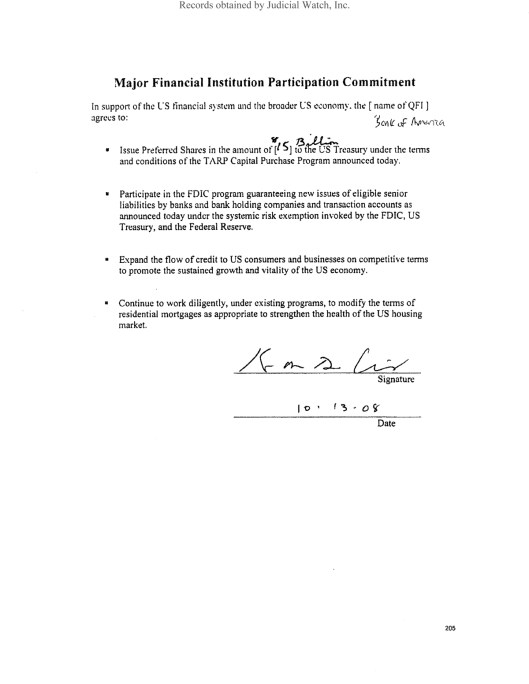
Judicial Watch filed a Freedom of Information Act request to obtain documents from the Treasury Department concerning the October 2008 bailout meeting with our country’s nine largest banks. Apparently, the bankers were made an offer they couldn’t refuse.

The critical meeting on October 16, 2008, included Hank Paulson, Ben Bernanke, Tim Geithner and the heads of the aforementioned banks, among others. The documents uncovered by Judicial Watch indicate that the Treasury Department gave the banks no choice but to take government funds.

One of the key sentences in the government’s talking points – “If a capital infusion is not appealing, you should be aware that your regulator will require it in any circumstance.” So there you have it.

The banks then literally filled in the blanks on a half sheet of paper and billions of dollars were offered up. The claim for Bank of America’s $15bn is shown below.

The quote that comes to mind when I see the heavy-handedness of this is from The Tragedy of King Richard The Third. After killing her husband (Edward, Prince of Wales), Richard makes a play for Lady Anne’s affections

Was ever woman in this humour woo’d?

Was ever woman in this humour won?   (Act I, ii, ln 229)

Treasury-ParticipationCommitment

Casino Capitalism

21 Saturday Mar 2009

Posted by Richard Watson in Economics and Taxation

≈ Leave a comment

The Financial Times recently used the phrase “casino capitalism” in an article which is part of a series on the “future of capitalism.” This particular piece examined the Asian approach to capitalism. The dean of Singapore’s Lee Kuan School of Public Policy is quoted as saying Asians have added the following lessons to the capitalist mix – “…borrow in moderation, save in earnest, take care of the real economy, invest in productivity, focus on education.”

The “casino” phrase is relevant to American capitalism I think because of credit default swaps (CDS). I have been trying to think of a an analogy to describe swap agreements, and the closest I can get is to discuss the game of blackjack. If a dealer turns up an ace as the face card, you will be offered insurance against the dealer having a twenty-one at the price of up to one-half of your original bet. If the dealer has a blackjack, you lose your original bet (unless you also have a blackjack), and the net effect is that you break even (assuming you bet the full one-half bet for insurance). If the dealer does not have a blackjack, you lose the insurance and still have to play the original hand. In this sense, placing an insurance bet in blackjack is like entering into a hedging transaction.

But what if instead of buying insurance from the dealer you buy it from one of the other players at the table. And then what if the other player buys insurance from yet another player (a “counterparty”) to offset the possibility of having to pay you if the dealer has a blackjack. This is staring to look like a CDS.

Consider an investor that has lent money to a corporation. The investor may turn to Bank A and buy protection against a default on the part of the corporation by entering into a CDS. Bank A may then decide that it wants to “hedge” its exposure to your CDS by entering into another CDS with Bank B. And so it goes. Ultimately, there is only one “real” asset – the loan the investor has made to the corporation. But several parties have placed many bets on whether the loan gets repaid.

A hedging transaction is rather like buying a little insurance, and a CDS is a type of hedge. Suppose I invest $100 and stand to get $200 back if all goes well. Depending on my risk tolerance, I may let it ride, or I may buy “insurance” for $50 (a “hedge”). If the investment tanks, I get my $100 back from the insurance but am out the $50 for the cost of the insurance. I have limited my possible downside. Of course I’ve also reduced my possible profit as well.

Hedging began as a way of reducing price risk on agricultural products. The farmer who plants a crop now, would like to lock in a price that will be paid when the crops are taken to market. This is done by entering into a “futures contract.” These contracts are traded on the Chicago Mercantile Exchange which is described on their website as “…the world’s largest and most diverse derivatives exchange and clearinghouse.”

“Hedge funds” are actually limited investment partnserships which are exempt from registering with the Secutities and Exchange Commission and are part of what is called the “shadow banking” system. As an industry, hedge funds have grown from $35 billion in 1992, to $1.5 trillion in 2007. What that means is that investors have been moving a lot of money out of a regulated financial system into an unregluated system. We shall explore the shadows in a subsequent blog…

Sweep, Swap or Swindle?

21 Saturday Mar 2009

Posted by Richard Watson in Economics and Taxation

≈ Leave a comment

In today’s editorial, the Financial Times states that the bill passed in the House of Representatives this week regarding taxation of AIG bonuses is a “bad law.” Concerning the rage over the bonuses, the FT notes that “understandable or otherwise, the response smacks more of banana republic than good government.” The paper also states that “…these bonuses were paid not as a reward for past performance, which would indeed be absurd, but to retain people deemed necessary to the unwinding of its mistakes.”

First off, how do you reconcile the FT’s statement that the bonuses were paid to “retain” staff when a report in this week’s Economist (Cranking up the Outrage-O-Meter ) states that “…$57m of its ‘retention’ payments were earmarked for staff it [AIG] planned to lay off”?

Secondly, note the use of the phrase “its mistakes.” If we recognize that “it” is AIG, doesn’t the sentence say “…these bonuses were paid to keep the people who screwed up so they could have a go at putting things right.” How absurd is that?

Congress really needs to see the outrage over AIG bonus payments as symbolic. “Main Street” finally has something it can understand that doesn’t involve a swap, sweep or swindle. Although Main Street must be careful that it doesn’t lose sight of the trillion dollars or so that are being spread around far too liberally for the sake of $165m in bonuses. This would be like seeing the trees but missing the forest. And like Macbeth, when Great Birnam wood marches to high Dunsinane hill, that would not be a good thing.

So Bank of America and Citigroup Go To It?

15 Sunday Mar 2009

Posted by Richard Watson in Economics and Taxation

≈ Leave a comment

“Why man, they did make love to this employment.” So says Hamlet to Horatio as he describes how he foiled the king’s plot to assassinate him, instead sending Rosencranz and Guildenstern to their deaths (Hamlet, V, ii, ln 55). It seems like the U.S. government is on the verge of nationalizing the two largest banks in the world. But who is being saved and who “goes to it?”

In the early 1990s, Sweden successfully nationalized two banks, wiping out shareholder positions, but at the same time guaranteeing investors who extended loans to Swedish banks. According to the head of the Swedish National Debt Office, Bo Lundgren, this allowed banks to continue to do business while giving the government several years to sort them out and re-privatize them. Mr. Lundgren will be in Washington this week to advise Congress. Let’s hope they listen.

According to The Local – Sweden’s News in English, “…Washington’s rescue package appears to favour stock holders without much prospect of the tax payer-spent money ever being reimbursed. ‘What’s happening in the United States now entails a big risk that stock holders will win. If the banks survive, the stock holders’ holdings will still be there but the tax payers will have to foot the bill,’” Lungren is quoted as saying.

The U.S. approach seems not unlike the kind of Ponzi scheme that would have Bernie Madoff smiling quietly to himself. Money is taken from the taxpayers to payoff the shareholders. Or perhaps it is like the former UBS banker who testified to helping a client smuggle money out of the U.S. by stuffing diamonds into a tube of toothpaste?

Or even like today’s report that our government continues to bail out AIG so that it can pay lavish bonuses. The Sacramento Bee quotes Obama’s top economic adviser as saying “the easy thing would be to just say … off with their [AIG] heads, violate the contracts. But you have to think about the consequences of breaking contracts for the overall system of law, for the overall financial system.” This shows a remarkable lack of imagination on the part of the Obama administration. The easier thing to do is to not provide AIG with additional taxpayer funds. It would be hard for those economic terrorists at AIG to collect their bonuses wouldn’t it?

My advice to Obama is simple – yes you can!


Terrorism

On the matter of “economic terrorism,” the Oxford English Dictionary defines a terrorist as “a person who uses and favors violent and intimidating methods of coercing a government or community,” and also as “a person who tries to awaken or spread a feeling of fear or alarm.”

 
Democracies


Plato’s Republic was mentioned in a prior blog. One of Plato’s positions was that morality is beneficial to its possessor. Using metaphor and allegory, Plato constructs an imaginary community for the purpose of understanding individual psychology. In this sense, he did not really believe that “the Republic” was actually attainable. According to author Robin Waterfield, “Plato…saw democracies enact sensible laws, but he knew the system was capable of terrible abuse.”

Neither A Borrower Nor A Lender Be

09 Monday Mar 2009

Posted by Richard Watson in Economics and Taxation

≈ 3 Comments


If you’ve seen It’s a Wonderful Life, you know about “building and loans,” the precursors to savings and loans, or what are also called “thrifts.” In order to help the thrifts out with a liquidity crisis, not unlike what is happening now, President Hoover established the Federal Home Loan Bank Board (FHLBB) in 1932 for the purpose of lending money to thrifts so that they could lend money to people like you and I.

Savings and loans did a fairly respectable business and saw their assets rise from $10bn in 1945 to $600bn in 1979. According to Paul Clikeman in Called to Account – Fourteen Financial Frauds that Shaped the American Accounting Profession (which is the source of information for this blog), “…savings and loan executives thrived by following the simple ‘3/6/3 rule’ – take in deposits at 3 percent interest, make loans at 6 percent interest, and be on the golf course by 3:00 every afternoon.” The loans were secured by real estate and borrowers needed a reasonable down payment or a federally insured loan. Not much in the way of risk.

Although, those in the business of making loans can be exposed to something known as “interest rate risk.” You probably know that if you put $10,000 in a bank, the money doesn’t actually sit in the vault night and day humming a Cole Porter tune and waiting for you to visit. The bank lends most of it to others at a higher interest rate than it pays you, pocketing the difference. This is fine so long as what the bank pays you is less than what it can get on its loans. Someone in the government apparently figured that bankers couldn’t follow the basic math and passed the Interest Rate Control Act in 1966 which limited the rates that banks and thrifts could pay depositors.

I mentioned above that there wasn’t much in the way of risk connected with savings and loans. But what happens when the markets start paying depositors 10%? If, as a banker, I don’t come close to the prevailing rate, people will take their money elsewhere to get a better return. And here’s where it starts to get difficult. All my loans are for 30 years fixed at 6%, but I now have to pay 10% to the people whose money I’ve lent. It sounds like I’m going to come up 4% short on my green fees. This is “interest rate risk.” It is compounded (pardon the pun) by the fact that I have “borrowed short and invested long.” That is, I’ve borrowed from my depositors for perhaps one or two years (in a certificate of deposit) and lent it out for 30 years.

You’re probably thinking Rick’s been reading too much of the tax code lately – banks don’t pay 10% on savings accounts! Well, they couldn’t because of the Interest Rate Control Act. But in 1980, treasury bills were paying 15.6%, and people could invest in treasuries through something called a money market fund. So, when their certificates of deposit termed out, vast amounts were pulled out of S&Ls by depositors and moved into money markets (never mind that money market accounts were never really insured until recently when a new phrase enter the vernacular – “break the buck”).

Regulatory Cascade

In 1980, President Carter signed the Depository Institutions Deregulation and Monetary Control Act which allowed S&Ls to increase the rates paid on depository accounts. So far so good. At least S&Ls could stem the tide of cash flowing into money markets. But what about that “borrowing short and investing long” problem? The solution was found in something called the adjustable rate mortgage (ARM). In 1982, President Reagan cut the shackles on the S&L industry in the form of the Depository Institutions Act and allowed S&Ls to issue ARMs which alleviated interest rate risk. But like all good legislation, more is better. S&Ls could now issue unsecured loans and invest in something called “junk bonds” (think Michael Milken).

Interest rates were rising in the late 1970s, and it would be some time before accounting standards moved away from the historical cost principle and adopted “Mark-to-Market.” Remember all those loans made at 6% under the “3/6/3” rule mentioned above? Well, if I can now get 12% on a loan, my 6% loan isn’t worth as much any more. It has decreased in value. Thanks to the historical cost principle, however, S&Ls were not required to report losses on these loans – causing the value of the assets on their balance sheets to be overstated.

Compounding matters yet again, in 1982, the FHLBB allowed S&Ls to use what are called Regulatory Accounting Principles (RAP) rather than Generally Accepted Accounting Principles (GAAP). According to Clikeman, “RAP inflated savings and loans’ assets and hid the severity of the industry’s problems…Using RAP, only 73 savings and loans were insolvent in 1984.” Using GAAP, however, 449 S&Ls were insolvent.

The worry among economists in the current crisis is that by not allowing large banks to fail and instead tinkering with regulatory and reporting requirements, the U.S. will duplicate the mistakes made by Japan with its banks in the 1990s which resulted in a decade of no growth. Rather than studying the Great Depression, the government should probably be studying the S&L crisis instead.

Remember the saying – a rising tide floats all boats. It’s only when the tide goes out that you see who’s been swimming naked.

Don’t Worry About Bernie

04 Wednesday Mar 2009

Posted by Richard Watson in Economics and Taxation, Political Commentary

≈ Leave a comment

The US District Court is sending Ms. Madoff on a shopping spree! Page 16 news in yesterday’s Financial Times (“Madoff Freeze Partially Lifted, March 3, 2009) states that Bernard Madoff’s wife gets to keep the $62m in her bank accounts because it is “unrelated” to her husband’s alleged $50bn fraud. We must thank the Court for providing us with a useful legal blueprint for would-be alleged fraudsters. Just transfer it to the wife’s “housekeeping” account and all will be forgiven.

The law requires us to use the term “alleged” in front of the term “fraud,” because only a court of law possesses the wisdom to declare whether a fraud has been committed…even though people are out $50bn and some change…and we all know what that is – a good weekend at Bernie’s!

Hit the Road Ike

28 Saturday Feb 2009

Posted by Richard Watson in Economics and Taxation, Political Commentary

≈ 1 Comment

Ninety years ago, then U.S. Army captain Dwight D. Eisenhower went on a recce across the country. Joining a convoy comprising various trucks, passenger cars, mobile field kitchens and repair shops, the caravan departed from near the White House lawn on July 7, 1919, and arrived in San Francisco two months later on September 6. Its purpose was “…to demonstrate the potential of motor transportation and to dramatize the need for better highways” writes author Daniel Yergin in The Prize – The Epic Quest for Oil, Money & Power. Yergin notes that this trip “…signified the dawn of a new era – the motorization of the American People.”

If its birth was 1919, the adolescence of the “motorization of the American people” has to be the 1953-54 recession. It seemed to Eisenhower, now President, that the economy needed stimulating. No doubt recalling his youthful road trip, he signed the Interstate Highway Bill in 1956, providing for 42,500 miles of new highways. The big losers at that time were the railroads, perhaps much like the automobile industry is destined to become the big loser this time around. Although in their case it is more like an assisted suicide.

Today’s Financial Times discusses the fallout from the 1956 stimulus in “Highway to Hell Revisited,” pointing out that massive government spending has unforseen consequences years down the road. Noting that “road lobbyists and real estate developers colluded against meaningful regulation and planning…the result was a distorted market and tax system.” In 1958, according to the FT, journalist William Whyte “…warned that sprawl was not just bad aesthetics but bad economics. A subtler and more serious problem than blight was that, for local authorities, the cost of providing utilities and other services was exorbitant. ‘There is not only the cost of running sewers and water mains and storm drains out to Happy Acres…but much more road, per family served, has to be paved and maintained.'”

Just think how different our country would now be with an efficient rail and transportation system and no reliance on foreign oil. Decisions made in the present can have dramatic repercussions 90-years on…Obama’s largest building project in the American Recovery and Reinvestment Act is $27bn for roads.

The Wisdom of Governments

Then as now, fear was used to convince the public. Monty Python fans know that the three – sorry four – weapons of the Spanish Inquisition  “…are fear, surprise, and ruthless efficiency…and an almost fanatical devotion to the Pope.” Invoking the Cold War, President Eisenhower told the populace that “…in the case of atomic attack on our cities, the road net must permit quick evacuation of target areas.” And here I can’t resist another digression.
You may recall that part of President Reagan’s missile defense program apparently involved plenty of shovels. In 1981, a Pentagon official told reporters that nuclear strikes were survivable and that the country would fully recover within four years if people took to digging lots of holes – covering them, of course, with wooden doors. According to the Pentagon, “if there are enough shovels to go around, everybody’s going to make it.”

The Department of Homeland Security followed this line of reasoning twenty-two years later by recommending that Americans stock up on duct tape, suggesting that it would help keep you safe in the event of a biological attack. I’m sure science will bear out the efficacy of such precautions, and we will eventually learn that the Bush administration actually held a high regard for science and education – you’ll recall his deft use of the intransitive plural subjunctive tense in his sentence “rarely is the question asked, is our children learning?”

So let’s close with FDR’s quote “…the only thing we have to fear, is fear itself.” It causes us to follow leaders blindly.

National Thrift Week

1919 also saw the Treasury Department encouraging civic organizations to promote National Thrift Week. The purpose of National Thrift Week, according to the New York Times (01/15/1922) was “…to help the individual to think straight and act wisely about money matters…” A ten-point financial creed was espoused that advised, among other things, to “pay your bills promptly – the curse of debt has put the goal of success beyond the reach of many men.” Contrast this with the message coming out of Washington today that banks need to start lending again to stimulate consumer spending and you see that the politicians are unable to grasp the fundamental problem of this economic crisis. Remember that “mortgage” is Latin for “death-grip!”

Sed quis custodiet ipsos Custodes?

19 Thursday Feb 2009

Posted by Richard Watson in Economics and Taxation

≈ Leave a comment

This Latin phrase was brought to mind today as I read a piece in the Financial Times about Sir Allen Stanford and his alleged $8bn fraud scheme involving certificates of deposit in Antigua. The phrase is loosely translated as “who will guard the guards?” and is from a Roman poet by the name of Decimus Junius Juvenalis (c. 50 – c. 130). Plato used it for one of his dialogues in the Republic which addresses the problem of determining the ideal state.  The phrase is profoundly relevant to our financial crisis thanks to the Securities and Exchange Commission (SEC). I told you they would be a frequent guest in these blogs, and they have yet to disappoint.

Following a routine examination, the SEC began a more formal probe of Stanford Financial Group and Stanford International Bank in October 2006. However, according to the Financial Times, the “SEC ‘stood down’ on its investigation at the request of another federal agency in the spring of 2008.” The SEC has declined to provide the name of the federal agency. As Congress begins weaving a new regulatory framework, it is essential that “unnamed” federal agencies be brought to light and held to account.

Remember Sir Walter Scott’s quote… “oh what a tangled web we weave when first we practice to deceive.”

← Older posts
Newer posts →

Recent Posts

  • The Right to be Heard June 11, 2025
  • Julius Caesar, a Case of Realpolitik April 5, 2025
  • “Against stupidity, the gods themselves fight in vain.” December 6, 2023
  • A Harrowing Tale of Trash September 15, 2023
  • The Rubbish of Martin v. Boise August 5, 2023

Pages

  • About Richard Watson
  • Photographs

Archives

Unknown's avatar

Enter your email address to subscribe to this blog and receive notifications of new posts by email.

Join 117 other subscribers

Blog at WordPress.com.

  • Subscribe Subscribed
    • Richard Watson
    • Already have a WordPress.com account? Log in now.
    • Richard Watson
    • Subscribe Subscribed
    • Sign up
    • Log in
    • Report this content
    • View site in Reader
    • Manage subscriptions
    • Collapse this bar
 

Loading Comments...