• Antarctica
  • Book Reviews
  • Economics and Taxation
  • Photographs
  • Political Commentary
  • Running
  • Science
  • Short Stories
  • Travel
  • About Richard Watson

Richard Watson

~ Commentary

Richard Watson

Author Archives: Richard Watson

Begging a Penny

09 Thursday Sep 2010

Posted by Richard Watson in Economics and Taxation

≈ 1 Comment

The federal budget deficit was an estimated $1.265 trillion for the first 11 months of fiscal year 2010, the Congressional Budget Office reported on Sept. 7. Relative to the size of the economy, the deficit for the entire fiscal year will likely be the second-largest in the past 65 years, coming in at 9.1% of gross domestic product (GDP). Which just missed the record set by last year, when the deficit was 9.9% of GDP.

From Conrad Aiken:

And youth, that’s now so bravely spending,

Will beg a penny by and by.

L’addition

22 Sunday Aug 2010

Posted by Richard Watson in Economics and Taxation

≈ Leave a comment

This weekend’s Financial Times contained an interesting interview in its weekly “lunch with the FT” column. Adam Fergusson’s book When Money Dies is soon to be republished. The book was first published in the 1970s and discusses the hyperinflation of Weimar Germany in the 1920s.

His comment at the beginning of lunch provides wise advice to our budget challenged politicians:

“Milton Friedman said the most efficient way of spending money is to spend your own, and the least efficient way is to spend other people’s…If you go out to lunch and have to pay your own bill,you have what you want and can afford. If someone else is paying, you may as well have the lobster.”

Et tu, Bruté?

25 Tuesday May 2010

Posted by Richard Watson in Political Commentary

≈ 1 Comment

A warning. This blog contains adult content….that is, I am about to talk about government regulators.

The ongoing expansion of government regulation will likely represent an indirect stimulus of the multi-billion dollar pornography industry. Here’s why…

Today’s Wall Street Journal (“Regulators Accepted Gifts From Oil Industry,” May 25, 2010) reports that regulators may have been confused by the meaning of the phrase “monitoring offshore drilling.” The Interior Department’s Inspector General has released a report that states “[e]mployees of a federal agency that regulates offshore drilling—including some whose duties included inspecting offshore oil rigs—accepted sporting-event tickets, meals, and other gifts from oil and natural-gas companies and used government computers to view pornography…”

You’ll remember from my previous blog (“Lugubrious Drollery”) that SEC attorneys were spending hours surfing pornography on the internet while they should have been protecting us from those Economic Terrorists on Wall Street. Now we find that the Interior Department has been equally lacking in rigor with respect to the oil industry (although not in the medical definition of “rigor” which means “rigidity of a muscle”).

Who’s Next?

Lugubrious Drollery…Doing God’s Work

26 Monday Apr 2010

Posted by Richard Watson in Economics and Taxation

≈ 2 Comments

As you know, the Securities and Exchange Commission (SEC) filed securities fraud charges against Goldman Sachs alleging that the company “…caused investor losses of more than $1bn….” The tale goes like this…

Goldman Sachs had a client, Paulson & Co., which wanted to bet against assets linked to sub-prime mortgages. So the question was, how could one create a product designed to fail? More importantly, who could you find to buy such a product?

The unfortunate bank which took the bet was IKB, described by The Economist as “…a German state bank with a seemingly inexhaustible capacity for self harm1.” Paulon & Co. ended up pocketing around $1bn from the wager, while IKB lost $150m. An insurance firm, ACA, lost a further $900m and went out of business. For these services, Goldman earned a $15m fee.

But what’s more shocking, is the National Public Radio report2 about the SEC stating that “…senior agency staffers spent hours surfing pornographic websites on government-issued computers while they were supposed to be policing the nation’s financial system… A senior attorney at the SEC’s Washington headquarters spent up to eight hours a day looking at and downloading pornography.” While largely ineffective against corporate greed, the SEC attorneys are at least masters of their domain.

This brings to mind a scene from Joseph Conrad’s The Heart of Darkness. During his cruise down the west coast of Africa, Marlow comes upon a French man-of-war which is indiscriminately firing it’s guns into the dense jungle. Shot after shot drops into foliage without a leaf stirring. The enemies, Marlow reports, were “…hidden out of sight somewhere.”

In the empty immensity of the earth, sky, and water, there she was, incomprehensible, firing into a continent…There was a touch of insanity in the proceeding, a sense of lugubrious drollery in the sight.

The Financial Times observed that Goldman Sachs chief executive Lloyd Blankfein once said that “Goldman Sachs did God’s work.”3 Of course, it was Enron’s Kenneth Lay who also said ” I did nothing criminal, and I also believe my God will get me through this.” And God obliged him.4

1. Greedy until proven guilty, April, 24, 2010.

2. GOP Ramps Up Attacks On SEC Over Porn Surfing, April 23, 2010.

3. SEC takes off the gloves on Goldman, April 17, 2010.

4. See earlier J’accuse…Lehman Brothers.

Trouble at the Mill

13 Tuesday Apr 2010

Posted by Richard Watson in Economics and Taxation

≈ 3 Comments

Today’s Financial Times reports that “Washington Mutual ramped up sales of high-risk mortgages to investors in the years before its collapse even though internal reports showed many of the loans were tainted by fraud…” (WaMu risky loans ‘riddled’ with fraud, April 13, 2010).

The exhibits released today by the United States Senate’s Permanent Subcommittee on Investigations (Wall Street and the Financial Crisis: The Role of High Risk Home Loans) is comprised of exactly 666 pages. So clearly, someone on the Committee has a sense of humor.

A sampling of the 666 page document reveals the following…

As early as 2003, a report to Washington Mutual’s board of directors authored by the Federal Deposit Insurance Corporation and the Department of Financial Institutions raised serious issues with WaMu’s affiliate Long Beach Mortgage Company. The heavily redacted report stated that “the culture, practices, and systems at Long Beach Mortgage Company are inconsistent with the lending activity of the bank…40% (109 of 271) of loans reviewed were considered unacceptable due to one or more critical errors.”

Two years later, in 2005, another internal WaMu memorandum noted that “…42% of the loans reviewed contained suspect activity or fraud, virtually all of it attributable to some sort of employee malfeasance…”

A further two years on, and yet another report – this time, a 2007 internal review addressed to the bank’s top management commented that “…71% of the loan sample contained information or discrepancies that raised the suspicion of fraud…”

It shouldn’t take a highly talented, bonus-bloated banker four years to figure out that there may have been a problem. During the period from 2003 to 2008, WaMu’s former chief executive, Kerry Killinger, received $103m in compensation.

Perhaps, as the numeration of today’s Senate report implies, you shouldn’t borrow money from the Devil, because after all, he’ll vanish in the end.


From The Grateful Dead’s Friend of the Devil…

Ran into the devil, babe, he loaned me twenty bills

I spent the night in Utah in a cave up in the hills.

Set out runnin’ but I take my time, a friend of the devil is a friend of mine,

If I get home before daylight, I just might get some sleep tonight.

I ran down to the levee but the devil caught me there

He took my twenty dollar bill and vanished in the air.

Repo Men

13 Saturday Mar 2010

Posted by Richard Watson in Economics and Taxation

≈ Leave a comment

In the 1984 film, Repo Man, actor Tracey Walter observed that “the life of a repo man is always intense.” The same could have been said of the life of a Repo Man at Lehman Brothers. Although instead of repossessing cars, the Lehman Repo Men hawked securities and deceived investors through the use of an accounting gimmick called “Repo 105.”

Repo 105 transactions were repurchase agreements. A repurchase agreement is a type of short term financing transaction where party “A” sells securities to party “B” in exchange for cash. Party “A” then agrees to repurchase the securities from “B” at a later date for a specific price. According to the court appointed bankruptcy Examiner “Lehman used the cash from the Repo 105 transaction[s] to pay down other liabilities, thereby reducing both the total liabilities and the total assets reported on its balance sheet and lowering its leverage ratios.” Had Lehman properly accounted for the transaction, a liability would have remained on the books indicating the obligation to repurchase the securities.

The essence of the Lehman subterfuge involved treating Repo 105 transactions as sales rather than financing transactions, which is how they must be reported according to U.S. accounting principles. But Lehman’s American Lawyers were of no help to the Repo Men. Lehman’s own accounting policies stated that “repos generally cannot be treated as sales in the United States because lawyers cannot provide a true sale opinion under U.S. law.” However, under English law, you can get such an opinion provided the buyer resides in a jurisdiction covered under English law. And this is exactly what Lehman Brothers did.

But there’s more. After recording the improper sale, Lehman continued to report income from the securities which were reported as sold – that is – Lehman Brothers reported income from assets it did not own. Even your normal, bonus loving banker can spot the flaw in that logic.

And where were the regulators? The Examiner’s report notes…

Although various Government agencies had information that raised serious questions about Lehman’s reported liquidity and about the sufficiency of its capital and liquidity to withstand stress scenarios, the agencies generally limited their activities to collecting data and monitoring.

Now remind me…the point of monitoring is what exactly?


And Then There Were Three…
 
Most damaging to Lehman Brother’s auditor, Ernst & Young (one of the “final four” large accounting firms), is the Examiner’s statement that “a trier of fact could find that Lehman’s use of tens of billions of dollars of Repo 105 transactions at quarter-end in late 2007 and early 2008 rendered the firm’s financial statements and related disclosures materially misleading.” Ernst & Young’s own work papers define materiality “as any item individually, or in the aggregate, that moves net leverage by 0.1 or more.” The Examiner reports that “Repo 105 moved net leverage not by tenths, but by whole points.” This is a textbook example of the case where an omitted disclosure causes financial statements to be materially misleading.

Will Lehman Brothers be Ernst & Young’s Waterloo like Enron was for Arthur Andersen?


The source of the information for this blog is the Report of Anton R. Valukas, Examiner, In re Lehman Brothers Holdings Inc., et al., for the United States Bankruptcy Court, Southern District of New York, dated March 11, 2010…and, of course, Repo Man.

J’accuse…Lehman Brothers

12 Friday Mar 2010

Posted by Richard Watson in Economics and Taxation

≈ Leave a comment

In 1898, Émile Zola exposed a military conspiracy of sorts in a letter addressed to the French president which was published on the front page of the Parisian newspaper, L’Aurore.  J’accuse, the title of the letter, has come to symbolize the expression of outrage against abuses by those in power.

The court appointed Examiner of Lehman Brothers, which sought Chapter 11 bankruptcy protection on September 15, 2008, has issued his scathing, 4,105 page report (including the appendices). Today, the phrase J’accuse should be aimed at Dick Fuld and Lehman Brothers. The Financial Times has reported that credible evidence exists “…that top executives, including the former chief Dick Fuld, approved misleading financial statements and used an ‘accounting gimmick’ to flatter results” (Lehman report lays wide blame for failure, March 12, 2010). In the words of Anton Valukas, the bankruptcy court’s Examiner…

Lehman’s failure to disclose the use of an accounting device to significantly and temporarily lower leverage, at the same time that it affirmatively represented those “low” leverage numbers to investors as positive news, created a misleading portrayal of Lehman’s true financial health. Colorable claims exist against the senior officers who were responsible for balance sheet management and financial disclosure, who signed and certified Lehman’s financial statements and who failed to disclose Lehman’s use and extent of Repo 105 transactions to manage its balance sheet…Lehman’s own accounting personnel described Repo 105 transactions as an “accounting gimmick” and a “lazy way of managing the balance sheet as opposed to legitimately meeting balance sheet targets at quarter end.”

Repo 105 was the phrase used internally by Lehman Brothers to describe their chicanery. Taking a play right out of the Enron book, Repo 105 transactions were accounted for as sales rather than financing transactions. The Examiner explains that a “colorable claim” has been defined by the Second Circuit Court of Appeals as one “that on appropriate proof would support a recovery.” In other words, grounds exist for prosecuting Lehman executives.

Does Dick Fuld end up pulling a Kenneth Lay by joining the “choir invisible” to avoid serving jail time (Enron CEO Ken Lay’s timely heart attack kept him out of prison)? Although perhaps things are not looking up for Mr. Fuld. After Hamlet has killed Polonius, the King asks “where is Polonius?” Hamlet responds…

In heaven. Send thither to see. If your messenger find him not there, seek him in the other place yourself.

A Tale Full of Sound and Fury

19 Saturday Sep 2009

Posted by Richard Watson in Political Commentary

≈ Leave a comment

I am about to speak ill of the dead. So naturally, the subject of this blog is health care reform, otherwise known as the “Graveyard of Politicians.”

One must admire the audacity of Congress. The bill they’ve come up with achieves universal healthcare by requiring everyone to purchase health insurance. Problem solved. In the words of Georges Jacques Danton, one of the leaders of one of the French revolutions “…audacity, more audacity, always audacity.” For that, he got le Guillotine. Families failing to obtain coverage will be fined a maximum of $3,800 if they don’t buy…not that Congress should be selling.

We were recently on holiday in France, which is my excuse for not posting a blog for awhile. France has couverture maladie universelle (universal health care coverage). But honestly, the only phrase I was able to master in French was l’addition, s’il vous plaît, which is what Congress should be asking. Countries such as Denmark, pay higher rates of taxes in order to provide universal health care. Alas poor Yorick! It is not a cheap undertaking. The Canadian government is curtailing some of the services covered by its public health care system due to rising costs, which seems anathema to the concept of universal coverage (see US neighbor swallows private sector medicine in the Financial Times).

Comparing the quality of health systems is difficult. An article in The Economist (Healthier than thou ) notes that life expectancy in Britain is 79.1 years as compared with 77.8 years in America. Does this mean Britain’s National Health Service is superior to America’s system of private insurers? The Economist goes on to state that Britain does worse than America in five-year survival rates for cancer. Part of the reason for this is that America has more “high-tech diagnostic equipment” per million people than Britain. And, “expensive new drugs generally become widely available sooner in America…”

Perhaps this is why America’s health care system is the most expensive in the world in terms of economic output. The United States spends 16% of GDP on health care (see “Heading for the Emergency Room” in The Economist ). “However, a few might be surprised to learn that Americans spend more than twice as much per person on health care as Swedes do. And many may be shocked to be told that in Miami people pay twice as much as in Minnesota, even for far worse care.” What do Sweden and Minnesota know that Miami doesn’t? Is health care cheaper in colder climates? Under what system are you better off?

I think the answer very much depends on what ails you. For instance, you are possibly better off with certain types of cancer, those that respond well to chemotherapy and radiation treatment, in America. Although consider what Robert Martensen states in A Life Worth Living – “most Americans die in hospitals these days…older Americans dying in hospitals experience an extended and agonizing process.” Our health system may extend our lives, but are we living better as a result? Can our World Wrestling Federation style of debate (sometimes called a “town hall meeting”) tease out these nuances of health care reform?

This is the appropriate place for the “speaking ill of the dead.” I found the recent HBO special on Ted Kennedy perplexing. A 1974 clip shows a young Bill Clinton introducing Ted Kennedy who gives a speech on health care reform remarkably similar to those we are hearing today. Which makes me wonder if it will take another 35 years for any kind of health care reform (at which time I won’t need it).

In 1971, Richard Nixon advocated a national health care system that would have required all employers to provide health care to employees. A subsidized government insurance program would have been available for those who were not employed. Ted Kennedy was in favor of a government insurance scheme for everyone and helped to defeat Nixon’s proposals. A comparison of the tenor of the debate between now and then is illuminating. Apparently, Americans were as alarmed then as now over the rising costs of health care.  Of course, the annual cost of the nation’s health care in 1974 was a mere $100 billion annually, or a couple of Merrill Lynch bonuses.

If we are to avoid the fate of the Red Queen over the next 35 years, what is the solution? You’ll recall Lewis Carroll’s Red Queen who tells Alice, “‘A slow sort of country!’ said the Queen. ‘Now, here, you see, it takes all the running you can do, just to keep in the same place.’”

Perhaps the only way to approach this is to recall the old joke about a physicist, a chemist and an economist lost on a deserted island. They are surrounded by cans of beans, and what not, and the said physicist and chemist have been unable to pry them open. The economist conjures up the answer – “assume we have a can opener…” So let’s assume we have “universal health care.” What does this look like to you?

I’ll close with this thought. Was Macbeth talking about health care reform before he met his end?

Tomorrow, and tomorrow, and tomorrow,

Creeps in this petty pace from day to day,

To the last syllable of recorded time;

And all our yesterdays have lighted fools

The way to dusty death. Out, out, brief candle!

Life’s but a walking shadow, a poor player

That struts and frets his hour upon the stage,

And then is heard no more; it is a tale

Told by an idiot, full of sound and fury,

Signifying nothing.

(Macbeth, William Shakespeare, Act V, Scene V)

Tour-Eiffel

Fair is Foul, and Foul is Fair

18 Monday May 2009

Posted by Richard Watson in Economics and Taxation

≈ 1 Comment

Congress is being heavily lobbied by the banking and insurance industries. Witness the recent relaxation of the “mark-to-market” accounting rules which now allow banks to use significant judgement in revaluing their assets.

And now, in a new letter to Congress dated May 13, 2009, the American Banker’s Association seem to want to go back to the heady days of the S&L crisis, scrapping fair value accounting in all but name (see earlier post).

This is unfair to healthy banks and those that have adhered to regulatory guidelines. Representative Alan Grayson (D-FL) is quoted as saying…”what healthy banks tell me, not just in Orlando, is that they’re facing unfair subsidized competition from bad banks who are excused from capital requirements and borrow seemingly unlimited amounts of money from the government at advantageous rates…When mark-to-market becomes mark-to-whatever-you-feel-like, you can’t tell anymore whether banks are meeting their capital requirements or not.”

Geithner and the Treasury Department must stop re-capitalizing bad banks with taxpayer dollars and allow the healthy banks to step in and pick up the pieces. This is, after all, the proper capitalist approach.


(Source: WG&L Accounting & Compliance Alert: “Bankers make another plea to dump fair value”)

The Shadow Government

18 Monday May 2009

Posted by Richard Watson in Economics and Taxation

≈ Leave a comment

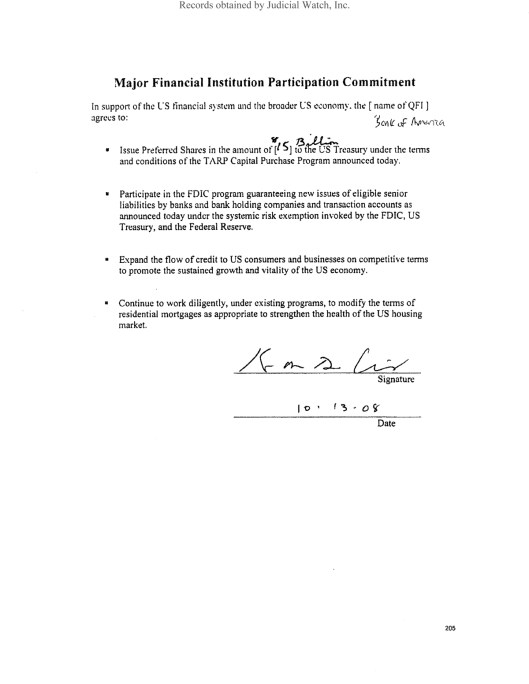
Judicial Watch filed a Freedom of Information Act request to obtain documents from the Treasury Department concerning the October 2008 bailout meeting with our country’s nine largest banks. Apparently, the bankers were made an offer they couldn’t refuse.

The critical meeting on October 16, 2008, included Hank Paulson, Ben Bernanke, Tim Geithner and the heads of the aforementioned banks, among others. The documents uncovered by Judicial Watch indicate that the Treasury Department gave the banks no choice but to take government funds.

One of the key sentences in the government’s talking points – “If a capital infusion is not appealing, you should be aware that your regulator will require it in any circumstance.” So there you have it.

The banks then literally filled in the blanks on a half sheet of paper and billions of dollars were offered up. The claim for Bank of America’s $15bn is shown below.

The quote that comes to mind when I see the heavy-handedness of this is from The Tragedy of King Richard The Third. After killing her husband (Edward, Prince of Wales), Richard makes a play for Lady Anne’s affections

Was ever woman in this humour woo’d?

Was ever woman in this humour won?   (Act I, ii, ln 229)

Treasury-ParticipationCommitment

← Older posts
Newer posts →

Recent Posts

  • The Right to be Heard June 11, 2025
  • Julius Caesar, a Case of Realpolitik April 5, 2025
  • “Against stupidity, the gods themselves fight in vain.” December 6, 2023
  • A Harrowing Tale of Trash September 15, 2023
  • The Rubbish of Martin v. Boise August 5, 2023

Pages

  • About Richard Watson
  • Photographs

Archives

Unknown's avatar

Enter your email address to subscribe to this blog and receive notifications of new posts by email.

Join 117 other subscribers

Blog at WordPress.com.

  • Subscribe Subscribed
    • Richard Watson
    • Already have a WordPress.com account? Log in now.
    • Richard Watson
    • Subscribe Subscribed
    • Sign up
    • Log in
    • Report this content
    • View site in Reader
    • Manage subscriptions
    • Collapse this bar
 

Loading Comments...