• Antarctica
  • Book Reviews
  • Economics and Taxation
  • Photographs
  • Political Commentary
  • Running
  • Science
  • Short Stories
  • Travel
  • About Richard Watson

Richard Watson

~ Commentary

Richard Watson

Category Archives: Economics and Taxation

Big Government May Soon Cash Your Paycheck

17 Thursday Feb 2011

Posted by Richard Watson in Economics and Taxation, Political Commentary

≈ Leave a comment

Rather astonishingly, the FY 2012 budget includes a proposal that would require W-2s to be reported on a quarterly basis, rather than annually.  To go along with this, the Obama administration has requested $13.3 billion to fund the IRS in FY 2012. This is a $1.1 billion increase from FY 2010.  Over the last few years, our government has passed laws which some see as an attempt to turn tax professionals from their traditional role of taxpayer advocate into IRS informant (for instance, disclosure requirements concerning uncertain tax positions). But don’t worry, CPAs still work for their clients rather than the government. Still, the IRS budget includes $17 million to increase oversight of tax return preparers. They are trying to keep the heat on the profession.

Since wage information is already collected quarterly (in the form of payroll tax returns), the only logical reason to require quarterly W-2s would be to…well, I can’t think of one. Perhaps the US is thinking that it would be best if your employer paid the IRS first, then deducted what it thought you should pay in tax, and finally remitted what ever paltry sum was left to you. After, of course, taking from your pay whatever you may owe on your credit card or mortgage. Because, afterall, we must keep the bankers happy with their bonuses while the rest of us continue to pay.


Being Economical with the Truth

02 Thursday Dec 2010

Posted by Richard Watson in Economics and Taxation

≈ Leave a comment

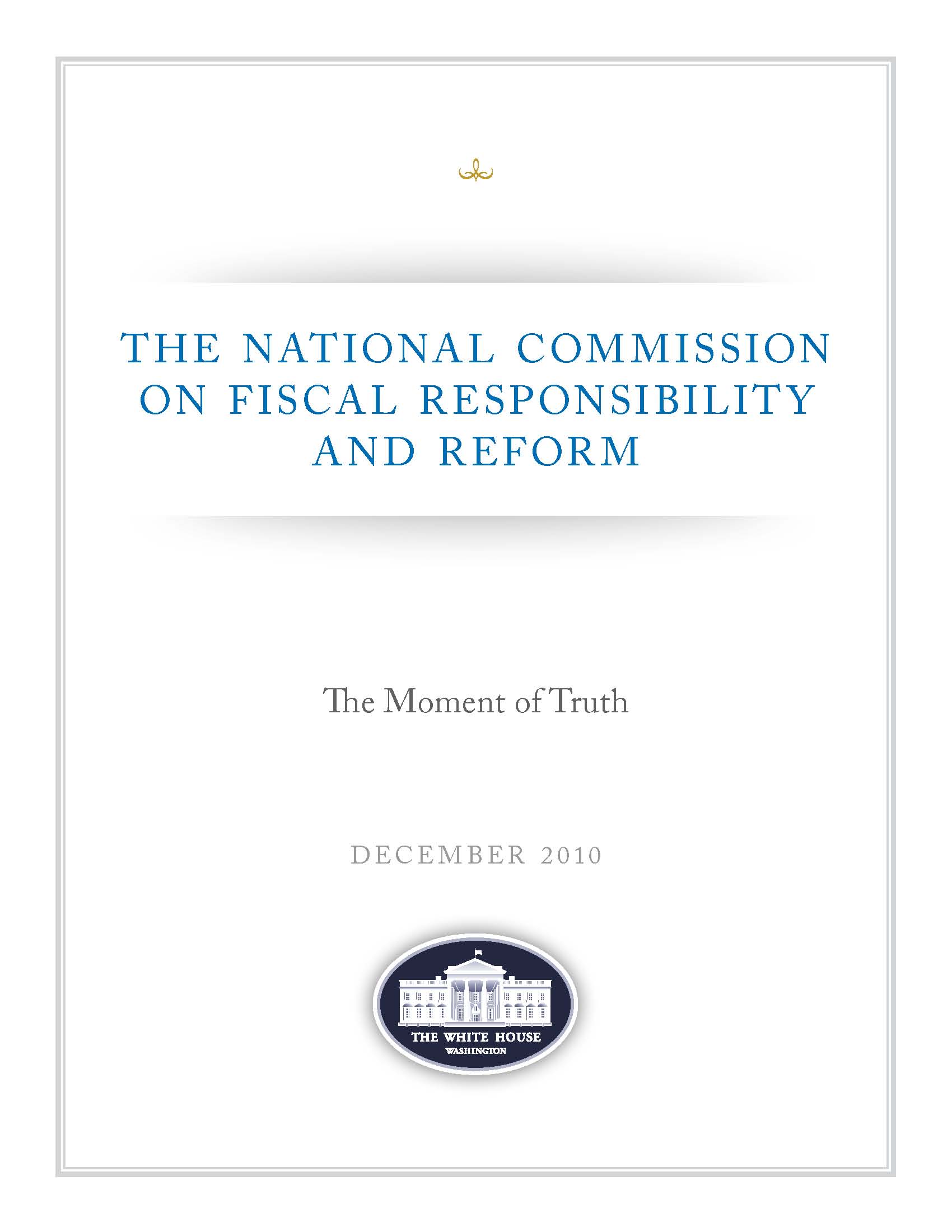
In Some Experiences of an Irish R.M., one of Mrs. Knox’s horses has gone missing and Major Yeates observes that her grandson, Flurry Knox. “…was not – to put it mildly – shrinking from that economy of truth that the situation required.” The President’s National Commission on Fiscal Responsibility and Reform is calling for a major tax overhaul in its delightfully titled report The Moment of Truth. The Commission is certainly not shrinking from its responsibilities.

The report proposes what is likely to be a massive tax cut for the very wealthy and a tax increase for the rest of us. Ideally, the Commission would like to see the highest individual tax rate set at 23%. It is currently 35%. The 35% rate applies to taxable incomes over $373,651. So, if your taxable income is $410,000, you would save $49,200 a year in income tax under the Commission’s proposals. Remember that prior to the Tax Reform Act of 1986 and the Reagan tax cuts, which were meant to simplify the tax code, the top individual tax rate was 50%.

When Irish Eyes are Smiling

In the eye of its economic storm, Ireland is stubbornly refusing to raise its corporate tax rate which sits unyieldingly at 12.5%, and has instead chosen to inflict economic pain on everyone else – with the exception of senior debt holders in Irish banks, who are being bailed out by taxpayers in the European Union. In solidarity with Ireland, our National Committee on Fiscal Responsibility and Reform (what George Orwell would have called the “Truth Commission”) would like to see the corporate income tax rate as low as 23%. The maximum corporate rate is currently 39%.

Meanwhile, the Commission is proposing that all itemized deductions for individuals be eliminated… More later once I have a chance to read through the report in detail.

Quote of the Month

30 Tuesday Nov 2010

Posted by Richard Watson in Economics and Taxation

≈ Leave a comment

In discussing British austerity measures which will cut government spending on civil services by one-third, Tony Blair’s former chief of staff, Jonathan Powell, is quoted in The Financial Times as saying that the coalition government is “…following the precepts of Machiavelli: you need to be really bold and inflict the pain very quickly.”

A Sunny Afternoon

25 Thursday Nov 2010

Posted by Richard Watson in Economics and Taxation

≈ Leave a comment

From the Kinks:

The tax man’s taken all my dough,
And left me in my stately home,
Blazing on a sunny afternoon.
And I can’t sail my yacht,
He’s taken everything I’ve got,
All I’ve got’s this sunny afternoon.

A Thieving Menace

11 Thursday Nov 2010

Posted by Richard Watson in Economics and Taxation, Political Commentary

≈ Leave a comment

The election is over, and now the bill has come due. The Federal Reserve has announced that it will be printing an extra $600 billion of new money under the guise of something called “Quantitative Easing 2,” a sequel which is indeed more frightening than the original. Federal Reserve Chairman Ben Bernake seems keen on inflating his way out of the growing pile of government debt, which is technically one method of defaulting. So now the dollar is sliding on foreign currency markets, and the World Bank is arguing that economies should adopt a modified gold standard for their currencies – which would be a “Bretton Woods 2.”

The founder and managing director of Pimco calls Quantitative Easing a “ponzi scheme.” I like to think of it as “a thieving menace” which comes from an article in The Economist about immigration issues in Europe, but applies here as well. Quantitative Easing is a process that starts with the Federal Reserve crediting its own bank account with money that is conjured out of nothing. Or, as Shakespeare would say, the Fed “…gives to airy nothing a local habitation, and a name.” Over the next eight months, the supply of money will increase by $600 billion.

But first, some background…

When the “Great Recession” began in December 2007, the government turned to Keynesian economic theory and went on a spending spree. The recession officially ended in June 2009, but I realize that is hard to believe. Like the latest fashion, politicians and economists were quick to quote Milton Friedman and Richard Nixon declaring “…we are all Keynesian now.” Friedman first used the phrase in 1965. In 1971, when Richard Nixon scrapped the original Bretton Woods, which was an agreement that regulated the international monetary system, and took the U.S. dollar off the gold standard, he said “I am now a Keynesian in economics.”

John Maynard Keynes was a British economist whose most significant work, The General Theory of Employment, Interest and Money, was published in 1936. Keynes felt that fiscal and monetary policies could be used by governments to mitigate the effects of economic recessions and depressions.

Using monetary policy, governments stimulate the economy through some combination of a reduction in interest rates or the printing of money. This can be thought of as controlling the supply of money. Fiscal policy involves spending and taxation. With fiscal policy, governments typically invest in infrastructure or modify tax law by increasing or decreasing the flow of money into government coffers. Therefore, each policy has a set of tools designed for a specific purpose, much like a formal table setting may have a dinner fork, a fish fork and a salad fork.

At the monetary policy table setting, Quantitative Easing is usually the last to be used. As such, it is the desert of monetary policy, although not very tasty. Which is a shame, because the main course of monetary policy (interest rates) was overcooked by the Fed. You’ll recall that the Federal Reserve kept lowering interest rates while the housing bubble inflated thanks to an almost paranoid aversion to inflation under Alan Greenspan (who served from 1987 to 2006). Thus, when the Great Recession began, interest rates were already at historical lows with nowhere to go. This firmly put us into something economists call a “liquidity trap” – a situation where monetary policy is mostly ineffective.

So how is the fiscal policy table setting looking? Our government has been tinkering with the menu for a number of years, causing the silverware to look a bit tarnished. Students of economics will realize that we have worked our way through the fiscal policy palate, upon which you can increase spending by issuing more debt or twiddle with income taxes. There has been a considerable amount of twiddling.

Recently, tax legislation has been masquerading as health care reform. The Internal Revenue Service is responsible for overseeing a significant portion of the Health Care Act, such as the administration of additional taxes and penalties on individuals and employers, determinations of various exemptions from those taxes and oversight of new information reporting requirements. It is estimated that the Act will generate $437 billion in new taxes, fees and penalties. This is an inflow of money into government coffers, and hence is off the fiscal policy menu, and is more a tax increase than health care reform.

What other surprises will appear on the fiscal policy menu in the coming months? The current row in Congress is over what to do with the expiring Bush tax cuts. If nothing is done, income taxes will rise in 2011 and provide even more money for government spending. This extra tax revenue will be needed because Quantitative Easing will increase the cost of servicing debt. As the United States dilutes the value of its currency, investors will demand higher interest rates on government debt to reflect a higher default risk and to compensate for the devalued dollar. This will increase the interest expense component of the federal budget, leaving less of the pie available for normal programs.

All the recent “stimulus” programs have been fiscal in nature, since they involve spending. Under George Bush, there was the Troubled Asset Relief Program (TARP). With Barack Obama, it has been the American Recovery and Reinvestment Act (ARRA). Consequently, the U.S. deficit has become alarming. As of July 2010, the “Debt held by the Public” was approximately 60% of Gross Domestic Product (GDP). When you add intra-governmental borrowing, such as from social security, the “Total Public Debt Outstanding” was approximately 93% of annual GDP (it was approximately 56% of GDP in 1990). This would be rather like running your personal credit card up to a balance equal to one year’s wages.

It appears to me, however, that we are not properly spending stimulus money. State governments are using stimulus dollars to fund budget shortfalls in providing the usual services. Driving around California, you notice signs advertising the use of stimulus money on various road projects. But the roads are merely being repaired. ARRA spending does not appear to be creating anything new, and this is a problem. As soon as the spending is withdrawn, the economy will suffer again because new self sustaining industries and technologies have not been created. Repairing infrastructure does create jobs. But only short term jobs.

Deficit spending during the Great Depression literally electrified the county through massive dam building programs. There was the Hoover Dam on the Colorado River, and in 1933, Congress passed legislation creating the Tennessee Valley Authority which provided electricity to homes and farms in what was a malarial, third-world, back corner of the United States. Also started during this period were the Bonneville and Grand Coulee Dams in Washington and Oregon, and the Shasta Dam in California.

The deficit spending during the Great Depression greatly improved the standard of living and created jobs that would last once the stimulus was withdrawn. This caused the U.S. to become a major economic power, and our increased industrial output (thanks to electricity and a little bit of oil) helped to win the Second World War. Such is the power of deficit spending when it is properly understood and rightly applied.

So what would I do to invigorate the economy? I’d go to Mars…

The last time the U.S. was the envy of the world, when we captured the imagination of its inhabitants and believed that anything was possible, it was when Neil Armstrong walked on the Moon. Although Kennedy was primarily taken to the decision because of Cold War considerations, it was all thrilling nonetheless.

For many reasons, we need to inspire the world again. The Apollo program created or improved many technologies that we cannot imagine living without today. The short list includes: flame resistant textiles, water purification technology, new lubricants, athletic footwear, heart monitors, solar panels, kidney dialysis machines, cordless power tools, and freeze dried food. OK, perhaps not this last one.

My point is that stimulus spending should be directed towards creating new industries and technologies that benefit lives and strengthens the economy. This is how deficit spending was directed in the Great Depression. A mission to Mars will force the country to overcome obstacles which are at present insurmountable. The solutions to the unique problems facing spaceflight to Mars are unlike those encountered when we journeyed to the Moon. As such, surmounting them will require innovative thinking that will result in radical new energy, medical, environmental, agricultural and computer technologies.

Let’s be bold and go to Mars. Otherwise, we’ll just be stuck with repairing all these roads again in another twenty years.


A Keynesian-Tocqueville Theory of Fiscal Policy

Alexis de Tocqueville, in On Democracy in America, talked about the “Doctrine of Self-Interest Properly Understood.” In describing this Doctrine, Tocqueville observed that “American moralists do not hold that a man should sacrifice himself for his fellow man because it is a great thing to do…such sacrifices are as necessary to the man who makes them as to the man who profits from them.” Since a democracy must balance the needs of the community with the needs of the individual, it is in the interest of the individual “…to sacrifice a portion of their time and wealth for the good of the state.”

So what does this have to do with economics? What I would like to propose is a Keynesian-Tocqueville theory of fiscal policy titled “deficit spending properly understood.”Under this theory, government spending is directed away from maintenance and repair and towards a goal that requires the development of new technologies by undertaking projects that are bold, fresh and impossible to achieve with current technologies.

For instance, aside from going to Mars, President Obama could make it the avowed policy of the United States to be off oil as an energy source by the end of the next decade.

From John F. Kennedy:

“We set sail on this new sea because there is new knowledge to be gained, and new rights to be won, and they must be won and used for the progress of all people. For space science, like nuclear science and all technology, has no conscience of its own. Whether it will become a force for good or ill depends on man, and only if the United States occupies a position of pre-eminence can we help decide whether this new ocean will be a sea of peace or a new terrifying theater of war…We choose to go to the moon. We choose to go to the moon in this decade and do the other things, not because they are easy, but because they are hard, because that goal will serve to organize and measure the best of our energies and skills, because that challenge is one that we are willing to accept, one we are unwilling to postpone, and one which we intend to win…”


Apollo 11

Begging a Penny

09 Thursday Sep 2010

Posted by Richard Watson in Economics and Taxation

≈ 1 Comment

The federal budget deficit was an estimated $1.265 trillion for the first 11 months of fiscal year 2010, the Congressional Budget Office reported on Sept. 7. Relative to the size of the economy, the deficit for the entire fiscal year will likely be the second-largest in the past 65 years, coming in at 9.1% of gross domestic product (GDP). Which just missed the record set by last year, when the deficit was 9.9% of GDP.

From Conrad Aiken:

And youth, that’s now so bravely spending,

Will beg a penny by and by.

L’addition

22 Sunday Aug 2010

Posted by Richard Watson in Economics and Taxation

≈ Leave a comment

This weekend’s Financial Times contained an interesting interview in its weekly “lunch with the FT” column. Adam Fergusson’s book When Money Dies is soon to be republished. The book was first published in the 1970s and discusses the hyperinflation of Weimar Germany in the 1920s.

His comment at the beginning of lunch provides wise advice to our budget challenged politicians:

“Milton Friedman said the most efficient way of spending money is to spend your own, and the least efficient way is to spend other people’s…If you go out to lunch and have to pay your own bill,you have what you want and can afford. If someone else is paying, you may as well have the lobster.”

Lugubrious Drollery…Doing God’s Work

26 Monday Apr 2010

Posted by Richard Watson in Economics and Taxation

≈ 2 Comments

As you know, the Securities and Exchange Commission (SEC) filed securities fraud charges against Goldman Sachs alleging that the company “…caused investor losses of more than $1bn….” The tale goes like this…

Goldman Sachs had a client, Paulson & Co., which wanted to bet against assets linked to sub-prime mortgages. So the question was, how could one create a product designed to fail? More importantly, who could you find to buy such a product?

The unfortunate bank which took the bet was IKB, described by The Economist as “…a German state bank with a seemingly inexhaustible capacity for self harm1.” Paulon & Co. ended up pocketing around $1bn from the wager, while IKB lost $150m. An insurance firm, ACA, lost a further $900m and went out of business. For these services, Goldman earned a $15m fee.

But what’s more shocking, is the National Public Radio report2 about the SEC stating that “…senior agency staffers spent hours surfing pornographic websites on government-issued computers while they were supposed to be policing the nation’s financial system… A senior attorney at the SEC’s Washington headquarters spent up to eight hours a day looking at and downloading pornography.” While largely ineffective against corporate greed, the SEC attorneys are at least masters of their domain.

This brings to mind a scene from Joseph Conrad’s The Heart of Darkness. During his cruise down the west coast of Africa, Marlow comes upon a French man-of-war which is indiscriminately firing it’s guns into the dense jungle. Shot after shot drops into foliage without a leaf stirring. The enemies, Marlow reports, were “…hidden out of sight somewhere.”

In the empty immensity of the earth, sky, and water, there she was, incomprehensible, firing into a continent…There was a touch of insanity in the proceeding, a sense of lugubrious drollery in the sight.

The Financial Times observed that Goldman Sachs chief executive Lloyd Blankfein once said that “Goldman Sachs did God’s work.”3 Of course, it was Enron’s Kenneth Lay who also said ” I did nothing criminal, and I also believe my God will get me through this.” And God obliged him.4

1. Greedy until proven guilty, April, 24, 2010.

2. GOP Ramps Up Attacks On SEC Over Porn Surfing, April 23, 2010.

3. SEC takes off the gloves on Goldman, April 17, 2010.

4. See earlier J’accuse…Lehman Brothers.

Trouble at the Mill

13 Tuesday Apr 2010

Posted by Richard Watson in Economics and Taxation

≈ 3 Comments

Today’s Financial Times reports that “Washington Mutual ramped up sales of high-risk mortgages to investors in the years before its collapse even though internal reports showed many of the loans were tainted by fraud…” (WaMu risky loans ‘riddled’ with fraud, April 13, 2010).

The exhibits released today by the United States Senate’s Permanent Subcommittee on Investigations (Wall Street and the Financial Crisis: The Role of High Risk Home Loans) is comprised of exactly 666 pages. So clearly, someone on the Committee has a sense of humor.

A sampling of the 666 page document reveals the following…

As early as 2003, a report to Washington Mutual’s board of directors authored by the Federal Deposit Insurance Corporation and the Department of Financial Institutions raised serious issues with WaMu’s affiliate Long Beach Mortgage Company. The heavily redacted report stated that “the culture, practices, and systems at Long Beach Mortgage Company are inconsistent with the lending activity of the bank…40% (109 of 271) of loans reviewed were considered unacceptable due to one or more critical errors.”

Two years later, in 2005, another internal WaMu memorandum noted that “…42% of the loans reviewed contained suspect activity or fraud, virtually all of it attributable to some sort of employee malfeasance…”

A further two years on, and yet another report – this time, a 2007 internal review addressed to the bank’s top management commented that “…71% of the loan sample contained information or discrepancies that raised the suspicion of fraud…”

It shouldn’t take a highly talented, bonus-bloated banker four years to figure out that there may have been a problem. During the period from 2003 to 2008, WaMu’s former chief executive, Kerry Killinger, received $103m in compensation.

Perhaps, as the numeration of today’s Senate report implies, you shouldn’t borrow money from the Devil, because after all, he’ll vanish in the end.


From The Grateful Dead’s Friend of the Devil…

Ran into the devil, babe, he loaned me twenty bills

I spent the night in Utah in a cave up in the hills.

Set out runnin’ but I take my time, a friend of the devil is a friend of mine,

If I get home before daylight, I just might get some sleep tonight.

I ran down to the levee but the devil caught me there

He took my twenty dollar bill and vanished in the air.

Repo Men

13 Saturday Mar 2010

Posted by Richard Watson in Economics and Taxation

≈ Leave a comment

In the 1984 film, Repo Man, actor Tracey Walter observed that “the life of a repo man is always intense.” The same could have been said of the life of a Repo Man at Lehman Brothers. Although instead of repossessing cars, the Lehman Repo Men hawked securities and deceived investors through the use of an accounting gimmick called “Repo 105.”

Repo 105 transactions were repurchase agreements. A repurchase agreement is a type of short term financing transaction where party “A” sells securities to party “B” in exchange for cash. Party “A” then agrees to repurchase the securities from “B” at a later date for a specific price. According to the court appointed bankruptcy Examiner “Lehman used the cash from the Repo 105 transaction[s] to pay down other liabilities, thereby reducing both the total liabilities and the total assets reported on its balance sheet and lowering its leverage ratios.” Had Lehman properly accounted for the transaction, a liability would have remained on the books indicating the obligation to repurchase the securities.

The essence of the Lehman subterfuge involved treating Repo 105 transactions as sales rather than financing transactions, which is how they must be reported according to U.S. accounting principles. But Lehman’s American Lawyers were of no help to the Repo Men. Lehman’s own accounting policies stated that “repos generally cannot be treated as sales in the United States because lawyers cannot provide a true sale opinion under U.S. law.” However, under English law, you can get such an opinion provided the buyer resides in a jurisdiction covered under English law. And this is exactly what Lehman Brothers did.

But there’s more. After recording the improper sale, Lehman continued to report income from the securities which were reported as sold – that is – Lehman Brothers reported income from assets it did not own. Even your normal, bonus loving banker can spot the flaw in that logic.

And where were the regulators? The Examiner’s report notes…

Although various Government agencies had information that raised serious questions about Lehman’s reported liquidity and about the sufficiency of its capital and liquidity to withstand stress scenarios, the agencies generally limited their activities to collecting data and monitoring.

Now remind me…the point of monitoring is what exactly?


And Then There Were Three…
 
Most damaging to Lehman Brother’s auditor, Ernst & Young (one of the “final four” large accounting firms), is the Examiner’s statement that “a trier of fact could find that Lehman’s use of tens of billions of dollars of Repo 105 transactions at quarter-end in late 2007 and early 2008 rendered the firm’s financial statements and related disclosures materially misleading.” Ernst & Young’s own work papers define materiality “as any item individually, or in the aggregate, that moves net leverage by 0.1 or more.” The Examiner reports that “Repo 105 moved net leverage not by tenths, but by whole points.” This is a textbook example of the case where an omitted disclosure causes financial statements to be materially misleading.

Will Lehman Brothers be Ernst & Young’s Waterloo like Enron was for Arthur Andersen?


The source of the information for this blog is the Report of Anton R. Valukas, Examiner, In re Lehman Brothers Holdings Inc., et al., for the United States Bankruptcy Court, Southern District of New York, dated March 11, 2010…and, of course, Repo Man.

← Older posts
Newer posts →

Recent Posts

  • The Right to be Heard June 11, 2025
  • Julius Caesar, a Case of Realpolitik April 5, 2025
  • “Against stupidity, the gods themselves fight in vain.” December 6, 2023
  • A Harrowing Tale of Trash September 15, 2023
  • The Rubbish of Martin v. Boise August 5, 2023

Pages

  • About Richard Watson
  • Photographs

Archives

Unknown's avatar

Enter your email address to subscribe to this blog and receive notifications of new posts by email.

Join 117 other subscribers

Blog at WordPress.com.

  • Subscribe Subscribed
    • Richard Watson
    • Already have a WordPress.com account? Log in now.
    • Richard Watson
    • Subscribe Subscribed
    • Sign up
    • Log in
    • Report this content
    • View site in Reader
    • Manage subscriptions
    • Collapse this bar
 

Loading Comments...