• Antarctica
  • Book Reviews
  • Economics and Taxation
  • Photographs
  • Political Commentary
  • Running
  • Science
  • Short Stories
  • Travel
  • About Richard Watson

Richard Watson

~ Commentary

Richard Watson

Author Archives: Richard Watson

Almost Skunked – American River 50 Mile Endurance Run

21 Monday Apr 2014

Posted by Richard Watson in Running

≈ 2 Comments

Tags

American River 50, AR 50, Running, Trail Running, Ultra Marathon

The line of runners was being held up by a skunk. Our fearless cat from Kauai had recently tangled with a skunk and had come out on the wrong end of things. He required a good dousing with Skunk Odor Remover followed by a vigorous bath. This thought was on my mind as I was somewhere along the last ten miles of the American River 50 on Saturday, April 5, 2014.

Kekoa from Kauai

In the later stages of an ultra, you tend to swap places in the line with the same runners. You come to know them as they pass you and then you later pass them as walk breaks are taken. The process is repeated a number of times – somewhat like the instructions on Skunk Odor Remover – rinse and repeat.

Stopped ahead on the single track trail were two runners with whom I had been keeping company. They were pointing at something just ahead in the middle of the trail, and there was an odd smell. With a precipitous drop to our right and a steep slope to the left covered with poison oak, there wasn’t anyway to get around the skunk which had its back to us – tail up.

AR-50-1

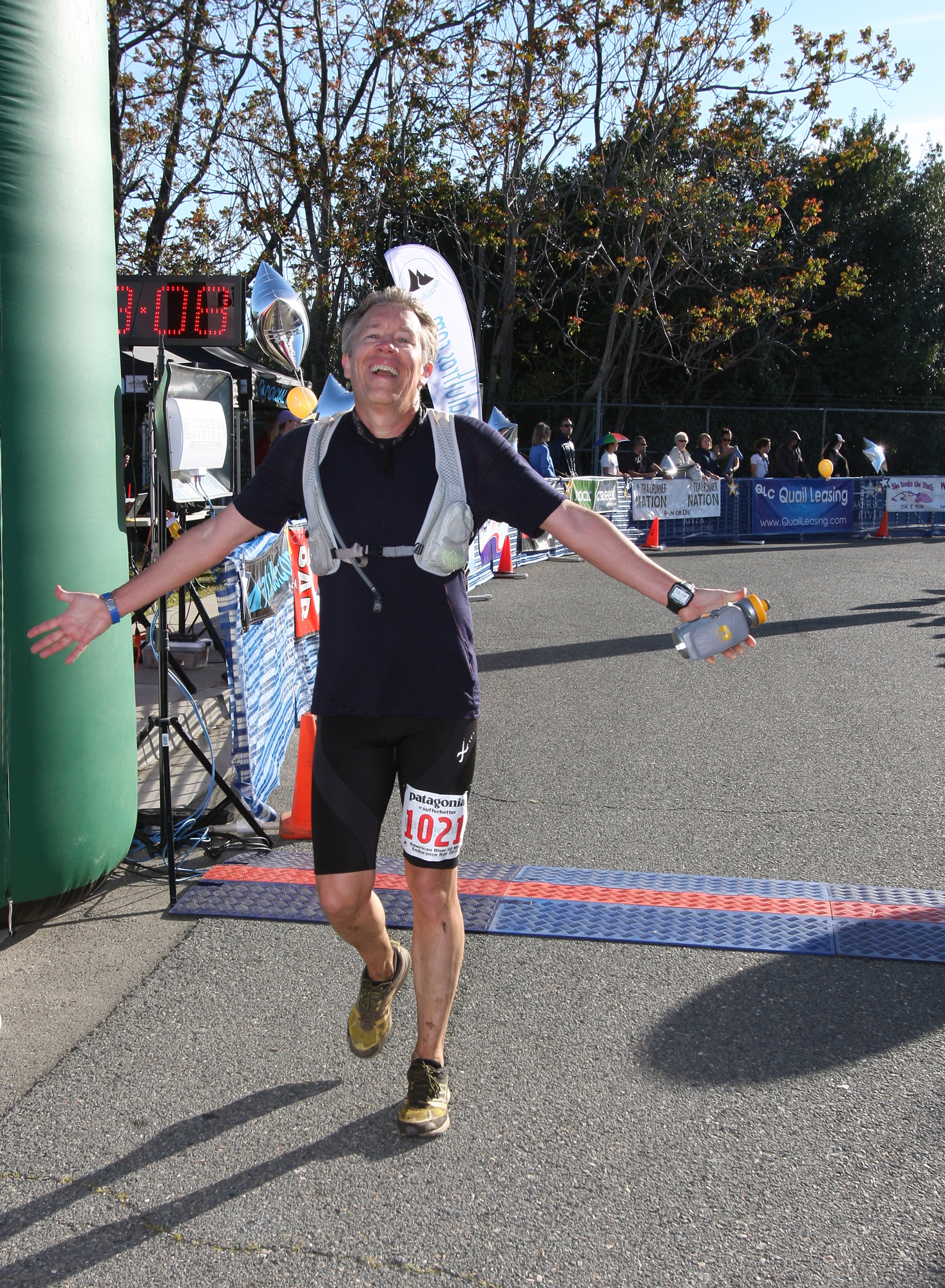
What it feels like to finish sans skunk.

“Throw something at it,” was suggested by a voice from the group that was now piling up behind us.

“Don’t kill it!” was appended to the first request by another.

The lead runner tossed a small rock in the direction of Pepé Le Pew who moved to the side of the trail but still with tail up ready to fire.

“It’s unusual for them to be out at this time. Perhaps he is ill.”

Great…now we have to deal with a rabid skunk.

One of the two runners ahead of me uttered an expletive and started to run up the left bank.

“You’ll get poison oak!”

“I’m probably already covered with it.” True, leaves-of-three were vibrant along the trail all day.

As I was weighing the merits of poison oak versus skunk spray, the other front runner made a dash for it. I instantly decided to match his stride reasoning that the first runners past would confuse the skunk before action could be taken. This proved correct. And as far as I know, the rest of the pack came through unscathed.

It was another superb day on the trails. Perfect temperature, outstanding volunteers and flawless organization on the part of Race Director Julie Fingar. Several news articles repeated a remark that AR50 is now the largest 50-miler in the country. Well done!

P.S. Much to my surprise, I did not get poison oak on me…Next up, the Canyons 50k on May 3.

pepe le pew

Ushuaia

20 Sunday Apr 2014

Posted by Richard Watson in Antarctica, Travel

≈ 3 Comments

Tags

Ushuaia

The Dublin Irish Pub in Ushuaia is booked solid for a Saturday night, so the barkeep seats us next to “mi amigo,” takes our order of pizza and writes “dos gringos” on the tab.

IMG_0106

Words locked in a cage as art in the Maritime Museum.

“Es verdad,” he adds as I glance over his shoulder.

With the pizza, we get a complimentary serving of popcorn. So, although jet lagged in Argentina, I have my favorite comfort foods in a bar fashioned after my mother’s homeland in the southern-most city on Earth about to get on a Russian research vessel for an excursion run by a Canadian company among which there will be a significant contingent of students from Hong Kong.

But don’t tell Chile, because they’ll tell you the southern-most city is across the Beagle Channel at Puerto Williams. The Argentines scoff that Puerto Williams is merely a “town” and not deserving of respect. In actuality, it is primarily a naval base.

Ushuaia, located firmly and quite beautifully in Tierra del Fuego, is a border town. As the primary point of embarkation for Antarctica in this hemisphere, it is at that frontier where reality and dreams overlap. To scrabble along its sometimes rough or nonexistent sidewalks is to walk through a mining town of sorts. Here, they mine the unimaginable.

Many languages and peoples pass along San Martin, the main shopping artery, and all are trying to get somewhere. The ususal outfitters are here to provide the proper kit for your excursion. It may be to Patagonia, Chile, Tierra del Fuego National Park or Antarctica. To steam south out of the Beagle Channel is to embrace unthinkable landscapes and possibilities. The clarity of the air dares your imagination to see further.

As Apsley Cherry-Garrard wrote – “more than once in my short life I have been struck by the value of the man who is blind to what appears to be a common sense certainty: he achieves the impossible.”

Thousands of years ago, Antarctica was hypothesized to exist by the Greeks primarily for aesthetic reasons. In order to balance out the Earth, there must be “…a landmass in the south, acting as a counterpoise to known northern continents” (Mapping Antarctica, A Five Hundred Year Record of Discovery).

In fact, the name “Antarctica” comes from the Greek philosophers who knew the Earth to be spherical and used their math chops to reckon that there would be at least one day every year where the sun never set at 66° latitude and above.

Project this latitude to the celestial sphere and you intersect the constellation Arkikos – the great bear. Which is serendipitous, because there are polar bears in the Arctic but not in the ant-Arkticus (from whence Antarctica). Imagine the philosophers’ embarrassment had it been the other way around.

9-sign-in-ushuaia

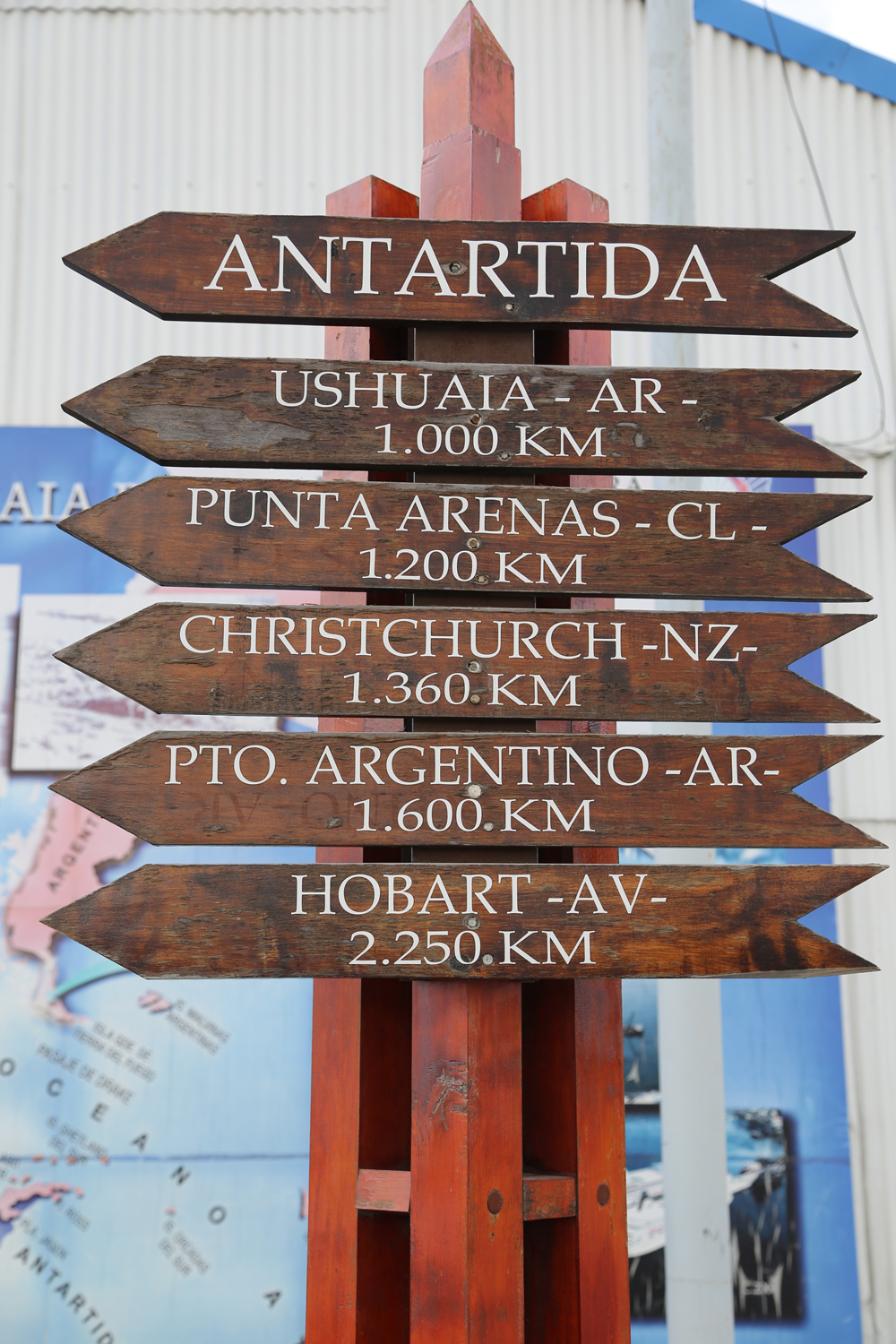
The sign at the harbor.

James Cook famously circumnavigated Antarctica in 1772-1774, and would have discovered the continent had he not turned north on January 30, 1774 to resupply his ship in Tahiti. Like the Greeks, he hypothesized the existence of land, because from where else did all these icebergs come? He described the area as “… a country doomed by nature never once to feel the warmth of the sun’s rays, but to lie forever buried under everlasting snow and ice.” It fell to the Russian, Thaddeus von Bellingshausen, to actually sight the continent in 1820. Some two weeks later, Edward Bransfield and William Smith, had a clear sighting of the Antarctic Peninsula. There are some who feel that Bellingshausen merely sighted ice, but from the coordinates listed in his meticulous log book it is possible to sight the continent…whatever. The game was on.

Ushuaia itself is not without its gems. But like any mining town, they must be sought out. The Maritime Museum is worth a visit. The site is part art gallery and part historical artefact. The prison for this region was transferred to Ushuaia in 1902 for “humanitarian” reasons, and construction was completed by the prisoners themselves in 1920. One wing remains extant, and it is clear that this was a hard life. Less clear as to what a “humanitarian” reason might be.

5-ushuaia

Mailbox in Ushuaia.

Another gem is the Yamana Museum – small but informative. These unfortunate people, like so many, did not survive their encounter with the Western World. They are a reminder that well-meaning intentions can have disastrous and unforseen consequences – whether Tierra Del Fuego, Afghanistan or planet Earth.

There is perspective you gain at the southern tip of the world when you leave behind the connectivity, noise and chaos of modern life, as well as insight into the future of the planet, which I hope to make clearer as this travelogue continues…

See Part I, The Antarctic Peninsula

Next up Part III, The Drake Passage

 Antarctic Links

Ice-Mound

The Antarctic Peninsula

23 Sunday Mar 2014

Posted by Richard Watson in Antarctica, Travel

≈ 3 Comments

Tags

Antarctia Peninsula, Usuhaia

Neko-Harbor

Neko Harbor on the Antarctic Peninsula

It has been said that there is a condition where the ice gets into your blood. Charles Neider talked of it in Edge of the World.

Read even the early explorers of Antarctica, such as Charles Wilkes and James Clark Ross, and you will understand that Antarctica can become an addiction…Even while you’re there the place sometimes seems like a fantastic dream. After you’ve left it you want to return to make sure it really happened to you, in all its grandeur, rarity, purity and beauty.

Scott expressed it somewhat differently when his team made it to the South Pole only to find they had been beaten to the prize by the great Norwegian Roald Amundsen.

Good God this is an awful place.

Apsley Cherry-Garrard, a member of Scott’s Terra Nova expedition, wrote of the return of the Antarctic spring that…

 God sent his daylight to scatter the nightmares of the darkness.

And then there was the Australian Douglas Mawson who reflected on his travails.

We dwelt on the fringe of an unspanned continent, where the chill breath of a vast polar wilderness quickening to the rushing might of eternal blizzards, surged to the sea. We had discovered an accursed country. We had found the Home of the Blizzard.

In 1913, Scott lay dying in his tent on the Ross Ice Shelf while Mawson struggled with his own demons on the other side of the continent. Mawson had the misfortune of choosing Cape Denison as the site for his base. This cape is probably the windiest spot at sea level on the planet. During an eight month period, the average monthly wind speed never dropped below 49 mph. One month recorded an average of 60.7 mph. On the day he landed, the skies were relatively calm and “the sun shone gloriously in a blue sky…”

So yes, I have ice in my blood. I have become so afflicted and am enthralled with stories of polar exploration. Antarctica is a place where superlatives are not equal to the task of describing the experience. No language can impart the humbling thrill of seeing the sheer mountains of the Antarctic Peninsula rise five thousand feet out of the ocean – like whales breaching up into the clouds. Or of seeing animals and marine life unafraid of human beings and glaciers draining a continent of ice spilling out onto the water to become sculpted icebergs. And of course, penguins…many, many penguins.

D-Gentoo4

Gentoo penguins on Cuverville Island.

Debbie and I were fortunate enough to travel to the Antarctic Peninsula this past December with OneOcean Expeditions. It was a journey that exceeded our expectations on many levels. There is not much in the world these days about which that can be said. But then Antarctica is probably the closet you can get to leaving the planet without actually doing so.

This mere travelogue is my homage. I shall update it in installments until we end where we begin, in Ushuaia, Argentina, near the southern tip of Tierra Del Fuego.

2-Port-of-Ushuaia

The port of Ushuaia.

So to borrow from Shakespeare’s apology at the beginning of Henry V (“O for a Muse of fire, that would ascend the brightest heaven of invention…”)

But pardon, and gentles all,
The flat unraised spirits that have dared
On this unworthy scaffold to bring forth
So great an object…

See Part II, Ushuaia

Antarctic Links

Way Too Cool, It’s the Real Thing

22 Saturday Mar 2014

Posted by Richard Watson in Running

≈ Leave a comment

Tags

Goat Hill, Running, Way Too Cool 50k

123617-05-529

On my way to Goat Hill on the Auburn Lake Trail.

“I don’t usually drink coke, but man…this tastes unbelievable.”

I can tell you that this was said to me by a comrade in ultra running at the Auburn Lake Trails aid station, 21.1 miles into my second running of Way Too Cool 50k on Saturday, March 8, 2014. At nine minutes past noon, to be precise.

The runner was enjoying his refreshing beverage. After all, Coca-Cola Revives and Sustains, according to its 1905 advertising slogan.

Now, ordinarily, I’d be right there with him on this. I love coke and have been a two to three can a day man. But back in June, it seemed to me that my weight should have been somewhat less than the figure indicated on the scale…what with all this running.

Contrary to popular belief, us runners do need to watch what we put in our bodies. And all that daily sugar was just so many empty calories adding to the tally. So I resolved in June to give up sodas for awhile – just cold turkey it. I had no plan on how long this would last, but at 12:09 on Way Too Cool Saturday, it had been just over nine months…

So as I was draining the contents of my water bottle and inhaling one-half of an orange (these taste unbelievable as well), I glanced back at the table that was covered with cups of coke, The Pause that Refreshes. All I had to do was back up a few steps, and they were mine for the taking. No one would notice, and no questions would be asked.

In fact, I recalled that at my first running of the Dick Collins Fire Trails, I asked for more coke and was handed the bottle to finish off. Talk about The Best Friend Thirst Ever Had! Since You Can’t Beat the Real Thing, you can understand my dilemma.

123617-12-067

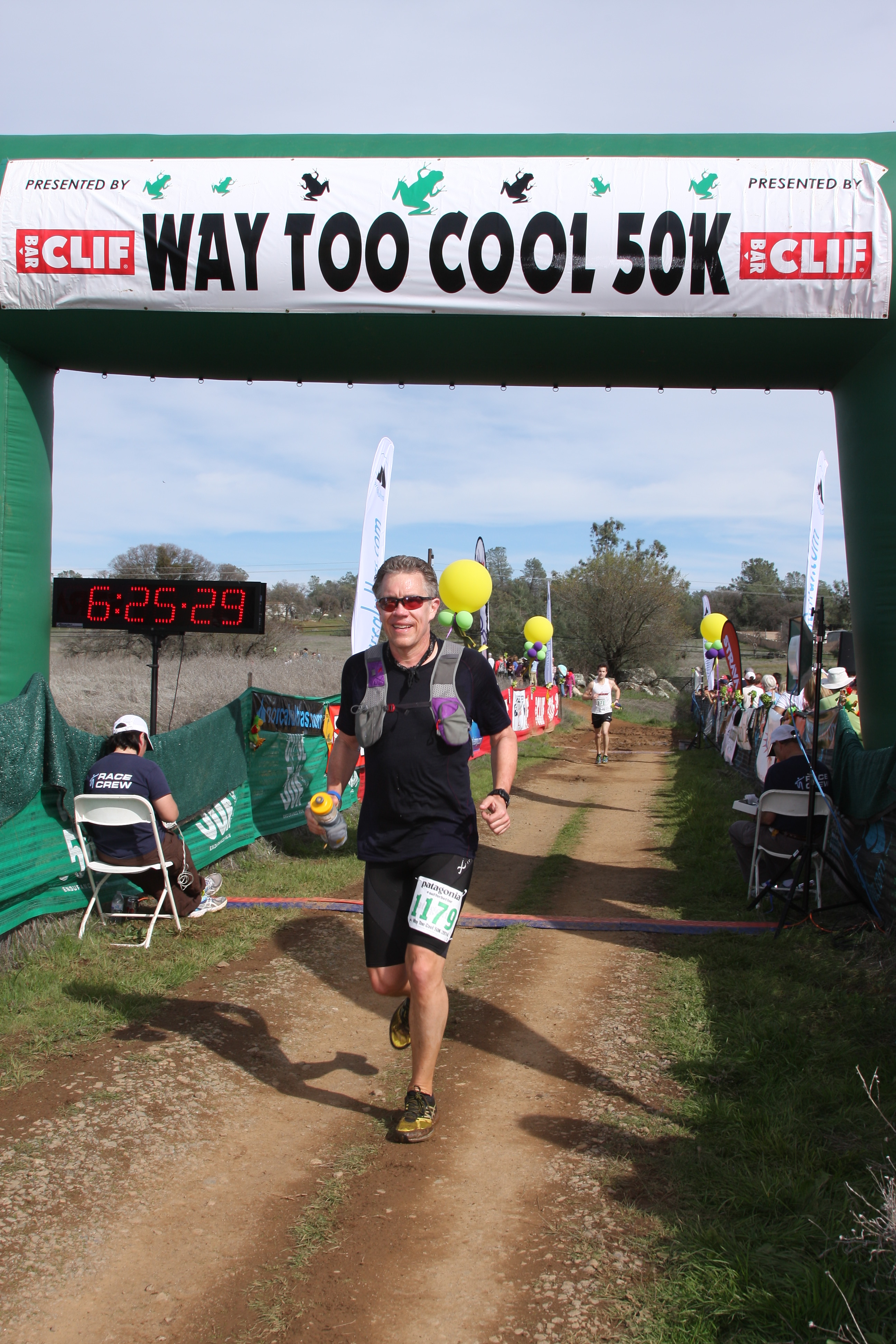
The finish.

So what did I do? I don’t mind telling you that I experienced a moment of doubt. What were all these cups for, if not for drinking? But the call of the trails beckoned, and the leaves of the trees rustled in the wind while a lone eagle soared on the thermals, or perhaps it was a scrub jay…or maybe a squirrel in the bushes. So I refrained from partaking of that Ice Cold Sunshine and began to make my way toward my old nemesis – Goat Hill – that 20% grade that feels much longer than a quarter mile.

When I finished, I had knocked ten minutes off last year’s time. But I did have the celebrated frog cupcake. Because after all, one is entitled to some indulgences.

Signature WTC Frog Cupcake

Coke

A Foggy Morning in Castro Valley – Dick Collins Firetrails 50

25 Friday Oct 2013

Posted by Richard Watson in Running

≈ 1 Comment

Tags

Dick Collins Fire Trails 50

Castro Valley
October 12, 2013

My goal was to finish before dark this year, and I am pleased to report this was accomplished. Twenty-six minutes were knocked off last year’s time, and this with walking the last six miles due to a nagging tight spot in my hip. But goals are just way points that get checked off an arbitrary list…usually they lie somewhere in the near future, then are briefly in the present moment, and finally consigned to the past. To stay in the present moment is richer and more fulfilling. It is to become open to the unexpected without preconceptions.

There are blissful moments of solitude in an ultra, wonderful encounters with wildlife and nature, and genuinely respectful encounters with new friends. It is that experience of shared endurance that perhaps inspired C.S. Lewis to write – “Friendship is born at that moment when one person says to another: ‘What! You too?’” And these small revelations are what continue to draw me in.

You see, I am, by trade, an accountant and not naturally a people person. I am sometimes mystified by them, even though I am one of the tribe. But share a bit a trail with someone, and I become a better person. It was my great pleasure that day to share some of the Firetrails at various times with two people, and my world has expanded a bit for the better because of it.

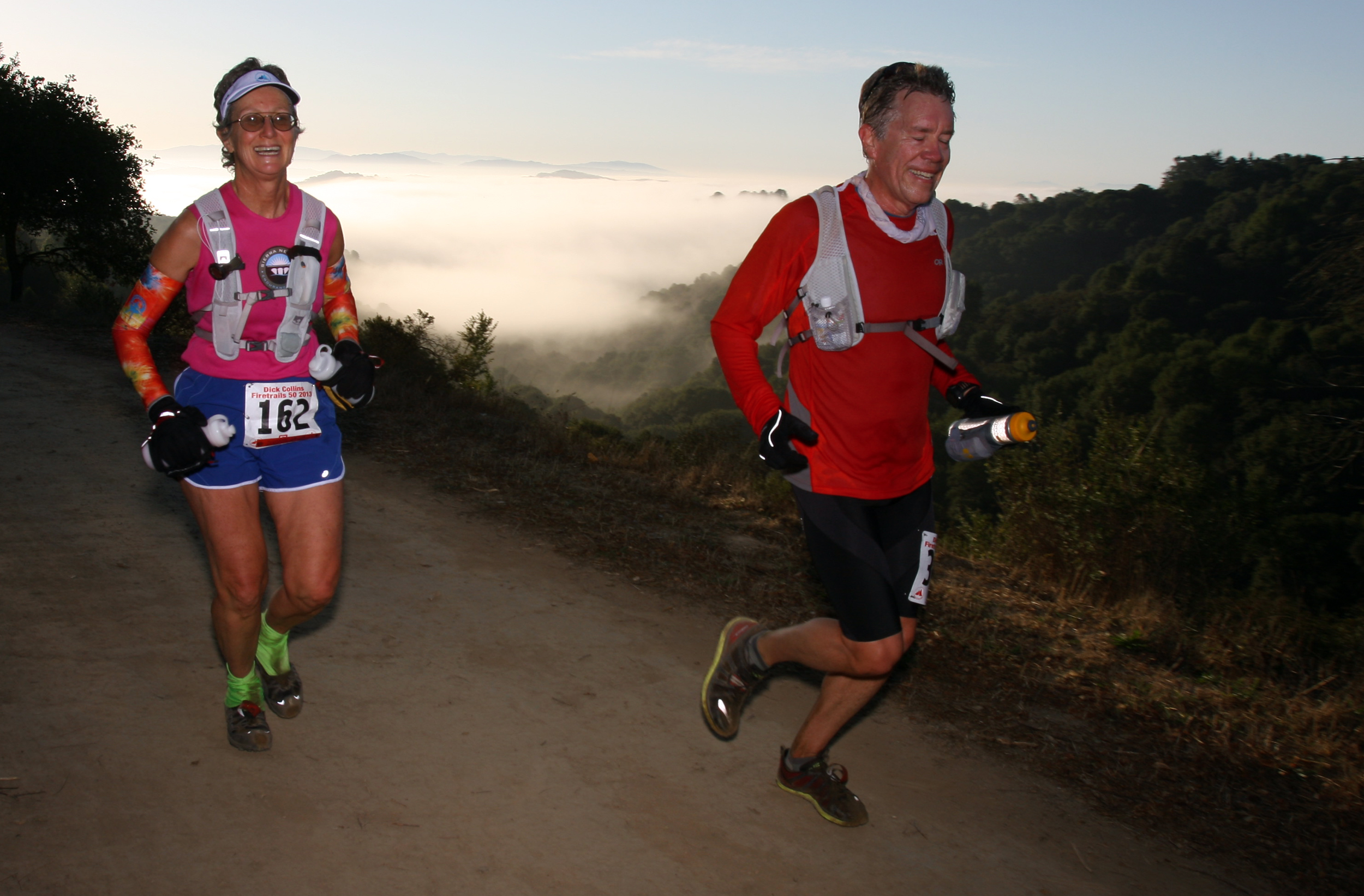
Sanborn Hodgkins and I shared parts of the first half of the run to the turnaround at Tilden Park. We talked of people who inspire us. She mentioned a friend who had completed Arch to Arc, which I had not heard of before that moment. It is perhaps the most demanding triathlon, beginning at the Marble Arch in London where one begins an 87-mile run to Dover; waits for the tides to be just right; then swims the English Channel; and, after toweling off in Calais, hopping on a bike and peddling to the Arc de Triomphe in Paris. Sanborn will be running her first 100-miler at Rio Del Lago in November. Best of luck!

My secret is to sleep-run the part of a race (evidenced by closed eyes). With Sanborn Hodgkins jut above the morning fog.

My secret is to sleep-run the first part of a race (evidenced by closed eyes). With Sanborn Hodgkins just above the morning fog.

On the return to Lake Chabot, Jim Austreng and I traded places at various times, until we both decided to walk the last six miles to the finish. Jim, who has an impressive running resume of thirty ultras, including three Western States finishes, was good company as well. The hours passed quickly in stimulating conversation as he regaled me with stories of time spent in Afghanistan working with the Army Corp of Engineers.

So, like the trail runs I have come to enjoy, when you can be breathlessly surprised by the view just around the corner, or when you are out on a run in the mountains with a friend, never seeing another soul for four hours, this sport has surprised me.

…………………….

I am again in debt to the wonderful staff of Fleet Feet in Sacramento. The list keeps expanding, but special thanks this time to Bob Halpenny (with whom I shared those four hours) for introducing me to one of the Western States’ canyons and setting me a new challenge: Michigan Bluff to Devil’s Thumb and back again.

I could of course not do this without the loving support of my wife, who I occasionally regale with wildlife reports whenever I have been on a long run.

“I will run like a madman to the west all night until I begin to fall asleep; then I will walk back, being careful to correct for the tilt of the earth, the force of Coriolis, reading my breviary by the precise arrowlight of stars, assured of my destination…You will always know this: others have made it.” Barry Lopez – Desert Notes

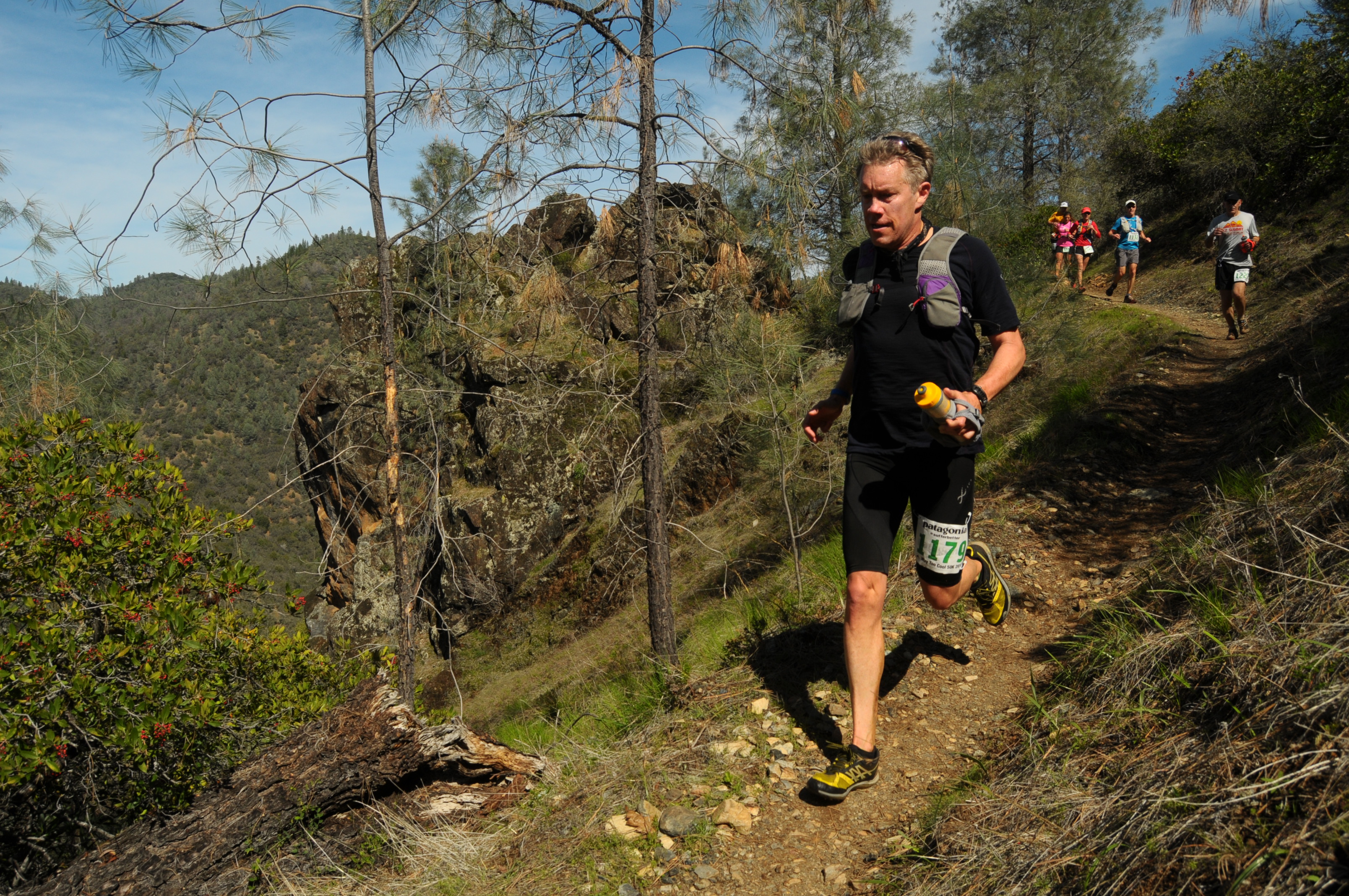
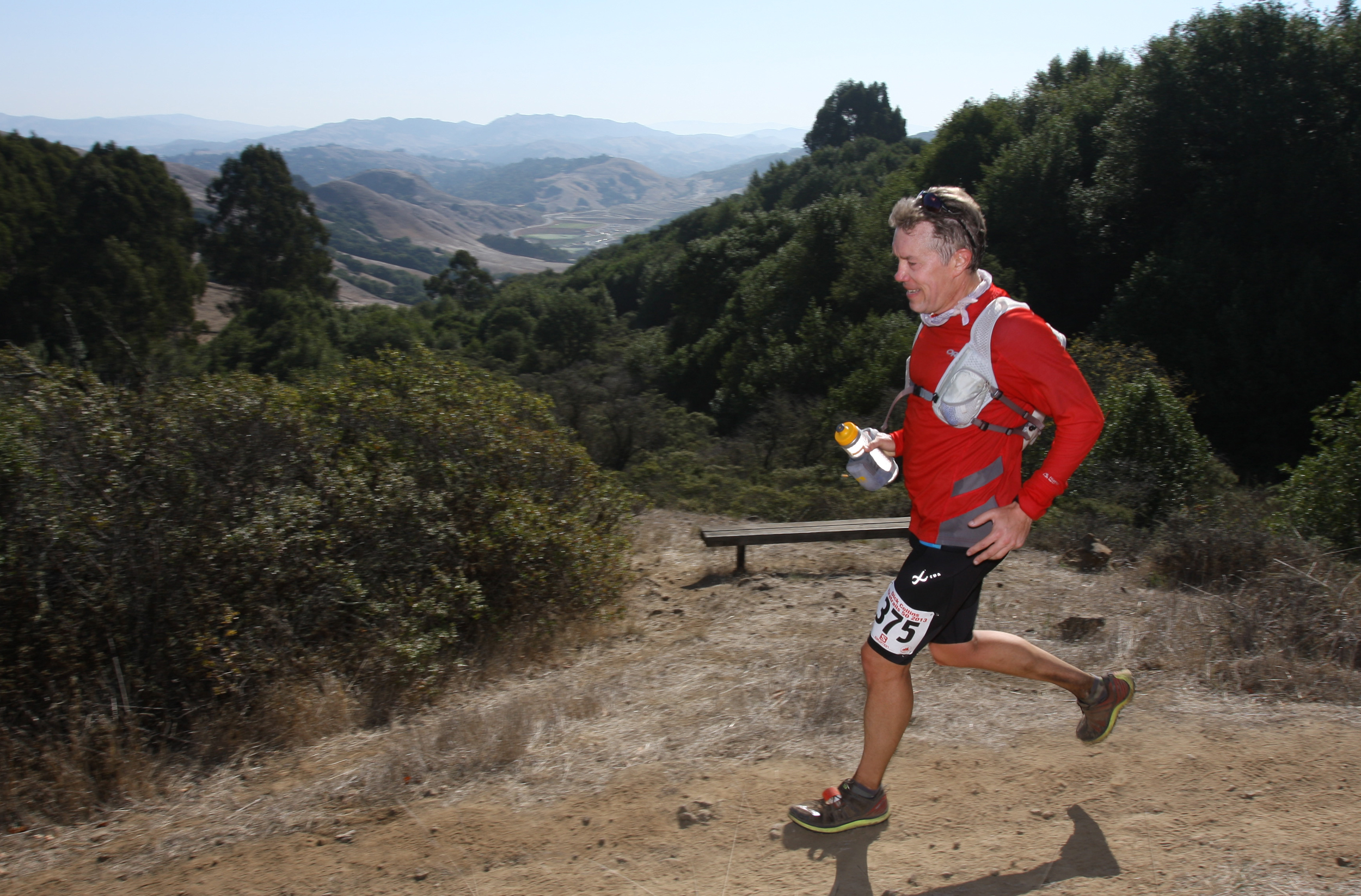
Beginning a downhill stretch.

Beginning a downhill stretch.

We are such stuff

27 Thursday Jun 2013

Posted by Richard Watson in Running

≈ 1 Comment

….in dreaming,

The clouds methought would open and show riches

Ready to drop upon me; that, when I wak’d

I cried to dream again.

– William Shakespeare, The Tempest

My dream was slipping away as consciousness intruded upon the restful warmth of sleep. You know that feeling you sometimes have at dawn? The room begins to glow with the sunrise, and your mind slowly stirs. You waver between the comfort of a dream and the awakening routines of morning. Well, in my case, something was licking my cheek.

It was as if a shaggy, slightly moist towel was dragging across my face. Odd dream this…just the sensation of a good scrubbing, steadily increasing in pressure. Feeling like I ought to be getting on with the day, I opened my eyes and saw nothing but deep blue sky.

I don’t know about you, but when I wake, I usually see a ceiling, or perhaps the wall if I have been sleeping on my side. So the view of a cloudless, cerulean sky was mysterious.

My left eye sensed movement, and when I turned to look, the damp towel revealed itself to be a tongue connected to a medium sized dog. Like a Saint Bernard engaged in an alpine rescue, this dog was doing his canine best to rouse the spirit in me.

Then a voice spoke from out of the sky, or slightly stage right in relation to the dog…

“Are you alright?” Readers of my other running reports will recognize this as a frequent question and theme.

“I’m not sure,” seemed the proper assessment, since I was on my back lying on scattered pebbles at the top of a river levy on a beautiful summer day.

“Would you like me to call an ambulance?”

“Sounds like a good idea.”

That was on August 17, 2006, the first time I passed out while running (yes, there was a second time). I had no idea that almost seven years later, at 5:50 AM on April 6, 2013, I would be standing towards the back of the pack at the start of the American River 50 Mile Endurance Run, ready to begin my fourth fifty-mile run.

But here I was on a warm Sacramento morning. The excitement buzzed through the crowd as old stalwarts greeted each other and strangers made new acquaintances. There was Bob Halpenny, who was looking for Richard Hunter, a tremendously accomplished visually impaired athlete, whom Bob would be pacing over the second half of the course (please do read Richard’s inspiring account of his day here).

Another runner standing at my side served in the first Gulf War and told me he took up running to conquer the disabling headaches he suffered from an explosion which left shrapnel in his skull. The running worked better than all the medicine the VA had given him. He was hoping to finish by the cutoff time.

And then I remembered a woman I spoke with at last year’s AR 50. She ran in remembrance of her child who had been lost to cancer. Her tears of sadness at the memory were indistinguishable from her tears of joy at the finish. How do you begin to answer the daughter who met her at the end of the run and asked “why are you crying Mommy?”

“Mommy just accomplished something that was very hard” – an answer that worked on many levels.

My journey to this spot was relatively easy by comparison and has been guided by the most compassionate group of people you could hope for – the indispensably marvelous staff of Fleet Feet on J Street.

Perhaps I’ll plot the map of this adventure in another blog and take you around the  hidden shoals and exposed reefs of this ocean. But in truth, I fear it may be somewhat boring. The beginning is what matters. You draw the contours of your own map, and your destination is never certain. Only when you look back can you see that there has been a path. Which is deceptive, because the swells and storms that have brought you here can only be ridden, not conquered. They have their own mind and cannot be bent to your will.

We stumble, and we sometimes fall. We may even lose consciousness. But we also accomplish the worthwhile which tends to be hard. Such things are neither good nor bad. They are the stuff of life and are not to be feared. For in losing consciousness, we also dream.

We are such stuff

As dreams are made on, and our little life

Is rounded with a sleep.

– The Tempest

rw114235-04-409

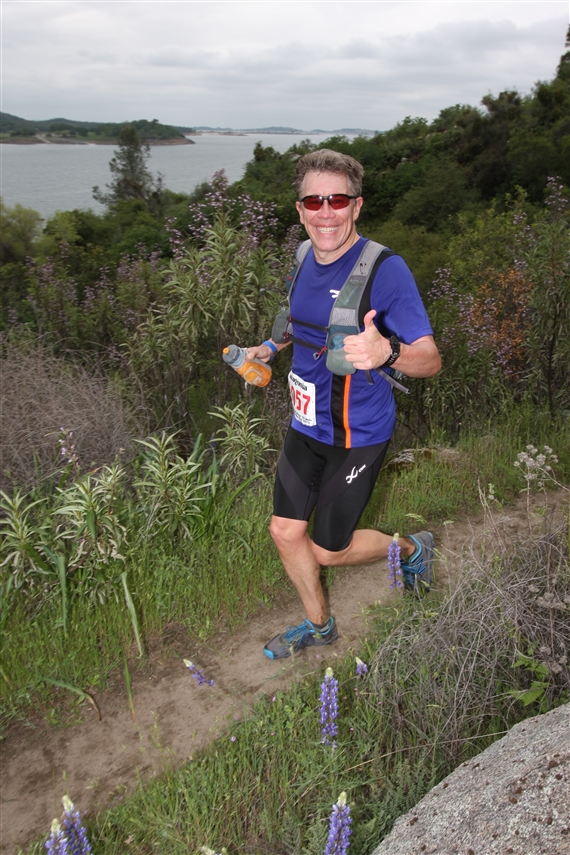
Managing enthusiasm for the photographer.

…………………..

Although my time was similar to last year at 10 hours, 30 minutes, I surprisingly finished in the middle of the pack placing 417 out of 836 finishers. Next up – a rematch with the Dick Collins Fire Trails 50 on October 12, 2013, where the goal is to finish before the sun sets.

Dreams

That 70’s Show

14 Friday Jun 2013

Posted by Richard Watson in Political Commentary

≈ Leave a comment

So, national intelligence chief James Clapper lied under oath to the U.S. Senate back in March when he said that the U.S government does not collect information on millions of Americans. Today’s Financial Times (Intelligence chief under scrutiny) reports that he qualified his answer by adding “not wittingly.” Perhaps he should have said “nit-wittingly.”

The FT quotes Clapper as saying he gave the answer “he considered to be ‘the least truthful.'” The Irish call this being economical with the truth. Lawyers call it equivocation.

One of the many jobs Clapper held prior to being tapped to be director of national intelligence, a post created after 9/11, was a stint with the Geospatial Intelligence Agency. Those who prefer an Orwellian bent to their paranoia will note that Geospatial is almost an anagram for Gestapo. But I digress…

As the Obama administration “pivots” towards Nixon (illegal bombings of countries we are not at war with, going to China, domestic spying on U.S. citizens, using the IRS to muck with your enemies, and health care reform – remember it was Ted Kenndey who helped defeat Nixon’s proposals for comprehensive and universal health care), and with the administration’s intent to ramp up the war in Syria, you have to wonder if the Nobel Foundation is thinking of asking for their Peace Prize back. Although Henry Kissinger was also a recipient of the Peace Prize, so perhaps the Swedish definition of “peace” loses something in translation to English.

Just as Richard Nixon had his Daniel Ellsberg, Barack Obama has his Edward Snowden. Ellsberg worked for the RAND Corporation and leaked the famous Pentagon Papers. Snowden worked for Booz Allen Hamilton and now resides in Hong Kong. His fame is as yet undecided, but he leaked what may one day be called the Prism Papers.

To stretch the 70’s analogy further, we even have hunger strikers. Although it was actually in 1980 that IRA members began their hunger strikes at the notorious Maze Prison in Northern Ireland. Detainees at the notorious Guantanamo have been on hunger strikes since 2005 (different detainees at different times, obviously). But now the world hardly takes notice.

Allow me one more digression here, because words matter. The British called the IRA paramilitary prisoners “internees,” as if they were gaining valuable on the job experience. Which in a way they were. The U.S. calls the prisoners at Guantanamo “detainees,” as if one is temporarily inconvenienced. Like when the Captain of the airplane comes on speaker and says your flight will be slightly delayed while they offload some luggage, for something like ten years.

But to close this rant, I would like to repeat the language used by a very different and much wiser Supreme Court than the current incarnation. From its ruling on the publication of the Pentagon Papers, 403 U.S. 713 (1971):

…the Executive Branch seems to have forgotten the essential purpose and history of the First Amendment. When the Constitution was adopted, many people strongly opposed it because the document contained no Bill of Rights to safeguard certain basic freedoms. They especially feared that the new powers granted to a central government might be interpreted to permit the government to curtail freedom of religion, press, assembly, and speech..The Bill of Rights changed the original Constitution into a new charter under which no branch of government could abridge the people’s freedoms…

The word “security” is a broad, vague generality whose contours should not be invoked to abrogate the fundamental law embodied in the First Amendment. The guarding of military and diplomatic secrets at the expense of informed representative government provides no real security for our Republic…The greater the importance of safeguarding the community from incitements to the overthrow of our institutions by force and violence, the more imperative is the need to preserve inviolate the constitutional rights of free speech, free press and free assembly in order to maintain the opportunity for free political discussion…Therein lies the security of the Republic, the very foundation of constitutional government.

upper class twit

Upper class twits or nitwits?

A Duck Walks Into a Starbucks…

08 Saturday Jun 2013

Posted by Richard Watson in Economics and Taxation

≈ Leave a comment

A man walks into a Starbucks and orders a Double Irish with a Dutch Sandwich and proceeds to open his Apple MacBook Pro and Googles “a man walks into a bar jokes…”

A rabbi, a priest, and a Lutheran minister walk into a bar. The bartender looks up and says, “Is this some kind of joke?”

Not really…it is more an elaborate multinational tax strategy that allowed Google to avoid $2 billion in tax in 2011 by moving income to a subsidiary in Bermuda; Apple to avoid paying tax on $44 billion in income; and GE to hold $108 billion in offshore profits, among others. And all because the U.S. Treasury Department wished to simplify the tax code back in 1996 with something called “check the box.” Simplicity, however, can be overwhelmed with complexity.

“Check the box” seems an innocent enough phrase. The idea is that U.S. firms can decide how to classify a subsidiary for tax purposes. Like a magic trick, a company checks a box on a form and makes a subsidiary disappear – as if it never existed. In tax parlance, the subsidiary becomes a “disregarded entity.”

After setting up the “check the box” rule, the Treasury realized it had a problem, because there was an increase in cross-border financing. The Commerce Department estimates that U.S. companies keep some $1.8 trillion in earnings abroad.

Here is where simplicity gets complex…

A Double Irish requires two Irish corporations. The first company, which we’ll call “Pat,” is tax resident in Ireland – that is, Pat pays Irish income tax. Pat pays a second Irish company, which we’ll call “Mike,” a royalty for the use of intellectual property. This allows Pat to reduce its Irish tax bill for the expense of the royalty payment to Mike. This is why so many software companies love the Double Irish. Software is considered intellectual property.

The second Irish company, Mike, owns Pat and is not tax resident in Ireland (under Irish tax law, a company is tax resident where its central management and control is located, not where it is incorporated). Mike actually collects the royalties in someplace like Bermuda, which has no corporate income tax. Plus, Mike usually charges Pat above-market rates.

A guy walks into a bar. The guy behind him ducks.

This is where “check the box” reenters the picture. If Mike makes an entity classification election for Pat to be “disregarded” by checking the box, the payments between Pat and Mike are ignored for U.S. tax purposes – as if they never existed. Of course, if money is repatriated back to the U.S. it will be taxed. Before being hauled before the U.S. Senate to explain themselves, Apple was lobbying Congress to allow tax free repatriation of overseas funds.

The final item on the lunch buffet is the Dutch Sandwich. Because as you know, without bread, the sandwich falls apart. To avoid Irish withholding tax, a Dutch subsidiary is used because Ireland does not levy withholding on royalty receipts from European Union members. So, the money starts off on the books in the Netherlands, flows through Ireland and then on to Bermuda. A rather nice, virtually tax-free holiday.

There are approximately 1,000 multinationals with operations in Ireland.

A man walks into a bar and orders a drink, then discovers he has to go to the bathroom. To stop anyone stealing his drink he puts a note on it saying, ‘I spat in this beer.’ When he returns he finds another note saying, ‘So did I!’

ducks

A duck walks into a bar…

Bomb Ponds

10 Friday May 2013

Posted by Richard Watson in Political Commentary

≈ Leave a comment

Tags

Bomb Ponds, Cambodia

28_var2009246d3460

Vandy Rattana

One of the exhibits we viewed at the Asia Society Museum while in New York was Vandy Rattana’s Bomb Ponds.

Between 1965 and 1973, the United States conducted illegal bombings of Cambodia and Laos, countries with which we were not at war. The bombings, eventually code named “Operation Menu,” began under President Johnson and escalated under President Nixon and Secretary of State Kissinger. The full extent of the bombings was not known until the year 2000, when the official documents were declassified.

Some forty years on, the bombings are still painfully remembered in Cambodia. It is hard to erase the memory of 110,000 tons of bombs carpeting the landscape. Many of the bomb craters still exist and become filled with water during the rains – hence the name “bomb ponds.”

The modern equivalent of the U.S. bombings of Indochina can be found in President Obama’s use of drones, which are used to bomb countries with which we are not at war. Despite how drones are sanitized for the U.S. public as some sort of video game, if the act of bombing foreign countries we are not at war with was illegal in 1970, it must still be illegal today. After all, it makes no difference whether the bomb that kills you is dropped from a B-52 or a drone. Or do, in fact, the ends justify the means? That is dangerous logic.

What will the “bomb ponds” in the Middle East look like in 2050, and how will the United States, President Obama and Secretary of State Clinton be remembered in this region forty years from now?

From the Season of Cambodia:

A poignant series of photographs and a one-channel video by Vandy Rattana exploring the U.S. bombing of Cambodia during the Vietnam War. The serenity of Vandy’s images belies the violent history of the landscape, while his video highlights the resilience of the Cambodian people. Bomb Ponds also brings attention to the lack of documentation of these unwarranted acts of violence undertaken by U.S. government.

That Way Madness Lies

23 Tuesday Apr 2013

Posted by Richard Watson in Political Commentary

≈ 1 Comment

Of comfort no man speak;
Let’s talk of graves, of worms, and epitaphs;
Make dust our paper, and with rainy eyes
Write sorrow on the bosom of the earth;
…let us sit upon the ground
And tell sad stories of the death of kings
– William Shakespeare, Richard II

The last line in this speech from Richard II might just as well be updated to read:

    …let us sit upon the ground and tell sad stories of the death of children.

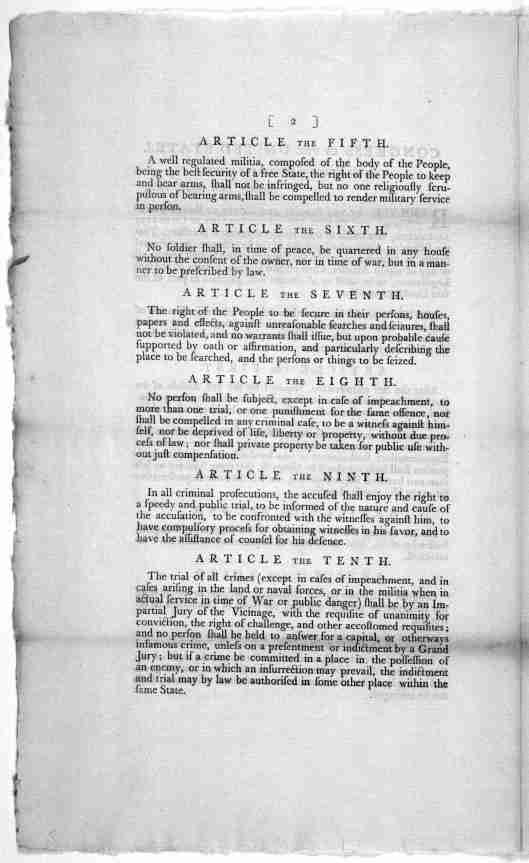
The Second Amendment to the United States Constitution can only be properly understood within the context of its time. From 1791, here is that brief sentence which has caused inestimable sorrow to be written “on the bosom of the earth” for far too long:

A well regulated militia, being necessary to the security of a free state, the right of the people to keep and bear arms, shall not be infringed.

Least you buy the National Riffle Association’s “guns don’t kill people…” argument, consider this. On the very same day as the Newtown shootings, the following occured in China’s Henan province:

 …Min Yongjun burst into a classroom and hacked away at 23 children, severing ears and fingers. But in Newtown, Connecticut, the little ones suffered even worse. After a ten-minute rampage 20 of them were dead, as were six teachers and the killer himself. The American was armed with a semi-automatic rifle with an extended magazine and two semi-automatic handguns. Every country has its madmen, but Min was armed only with a knife, so none of his victims died. – The Economist, Newtown’s Horror, December 22, 2012.

Another argument put forth by the National Rifle Association is that if you outlaw guns, only criminals will have guns. But criminals, after all, have lots of things they are not supposed to have. By this logic, whatever a criminal possesses, so may you. Is this not how a child thinks when it sees a toy in the hands of another?

The NRA’s thinking comes right out of Thomas Paine’s Thoughts On Defensive War (1775):

The balance of power is the scale of peace. The same balance would be preserved were all the world destitute of arms, for all would be alike; but since some will not others dare not lay them aside. And while a single nation refuses to lay them down, it is proper that all should keep them up. Horrid mischief would ensue were one half the world deprived of the use of them; for while avarice and ambition have a place in the heart of man, the weak will become a prey to the strong. The history of every age and nation establishes these truths, and facts need but little arguments when they prove themselves.

But “horrid mischief” results from the unrestrained proliferation of weapons which often fall into the wrong hands. And the “balance of power” argument falls apart in the context of an arms race when weapons become increasingly destructive – think of the Cold War phrase “Mutually Assured Destruction.” Shakespeare had a phrase for that as well “… that way madness lies; let me shun that; No more of that.” – King Lear.

So what are we to make of the Second Amendment? The Library of Congress notes that:

Amending the federal Constitution to include a bill of rights was the essential political compromise in the creation of the United States government. Even though Federalists believed that individual rights were fully protected by state and common law, they knew that Anti-Federalists would never embrace the new Constitution until amendments protecting specific rights were adopted.

In his The Annotated U.S. Constitution and Declaration of Independence, Jack Rakove explains:

The [second] amendment originated in Anti-Federalist concerns that Congress might misuse its power of “organizing, arming, and disciplining the Militia” to neglect it entirely. The militia might be disarmed, George Mason warned the Virginia ratification convention, not by federal confiscation of private firearms, but simply by Congress’s failure to keep militiamen adequately equipped…That neglect, in turn, would make it easier for the “standing army” Congress would control to trample the reserved rights of citizens and states.

This view can be seen in Anti-Federalist No. 25, which observed that:

The liberties of a people are in danger from a large standing army, not only because the rulers may employ them for the purposes of supporting themselves in any usurpations of power, which they may see proper to exercise; but there is great hazard, that an army will subvert the forms of the government, under whose authority, they are raised, and establish one [rule], according to the pleasure of their leader.

But the fear of standing armies was also echoed in Federalist No. 29, where Alexander Hamilton commented:

If a well-regulated militia be the most natural defense of a free country, it ought certainly to be under the regulation and at the disposal of that body which is constituted the guardian of the national security. If standing armies are dangerous to liberty, an efficacious power over the militia, in the body to whose care the protection of the State is committed, ought, as far as possible, to take away the inducement and the pretext to such unfriendly institutions.

Note that the Federalist position emphasized the regulated aspect of the militia. As a transitive verb, regulate means to “control with reference to some standard or purpose” (Oxford English Dictionary) – as in regulation. This important word found its way into the Second Amendment as a qualifier seen in the phrase “a well-regulated militia.” Thus, gun control is constitutional and to argue the point otherwise is to advocate an unconstitutional position.

The distinction between a “militia” and a “standing army” is also critical. A “standing” or “professional” army is what most nations have today – such as the United States Armed Forces, consisting of the Army, Navy, Marine Corps, Air Force, and Coast Guard. This is precisely what the Founding Fathers feared. To counter the threat that a “standing army” would be used by a government to oppress its people, the right to bear arms was considered necessary so that the people could form “militias” to counter this threat. I’ll leave you to figure out whether such a “militia” would pose more than a moderate nuisance to a modern army. Although come to think of it, the militias in Iraq and Afghanistan have had some success in fighting the United States and the Soviet Union.

If you honestly believe that you need guns to protect yourself from the government, which strikes me as slightly treasonous, then you really must have a surface to air missile. Because if the government decides to come after you, they will send in the drones in first. Good luck to you in that case.

The historical context of the militia is further examined in Alan Ryan’s recent book On Politics:

The “well-regulated militia” spoken of in the Second Amendment to the U.S. Constitution was a Roman militia; the modern army of professional soldiers recruited from the poorest members of society was what the Romans wished to escape…Soldiers provided their own armor and weapons and, in appropriate cases, horses. They were supposed to be self-sufficient, and although they received pay, their subsistence was deducted from it. Rome resembled Greek states in which the upper classes formed the hoplite, heavy-armed infantry…

The French Revolution…invented the modern conception of the nation under arms…Whereas the rebellious Americans thought in terms of raising local militias, the French revolutionaries inherited the monarchy’s standing army and made it the cutting edge of revolutionary change throughout mainland Europe.

The independent freeholder, keeping and bearing his own arms and ready to serve in a militia, was a modernized and Anglicized version of the ideal citizen of Sparta and republican Rome…Once it was clear that an effective army could be had by other means without succumbing to the ambitions of mercenary leaders, the obsession with the armed freeholder became part of the politics of nostalgia, visible in Rousseau’s Discourse on Political Economy, and audible in American politics ever since Jefferson. The modern British or U.S. Army is not a “well-regulated militia…”

The Second Amendment is an anachronism. It belongs to a different time, and as originally intended is no longer relevant in the 21st century. It was written when a gun was a rifled musket, and both militia men and government troops were armed with the same weapons. The match was relatively even. Now, governments have fighter jets, nuclear submarines and weapons, cruise missiles, drones and satellites. The match can never again be close to even, and the law must change to reflect the fact that the Second Amendment’s “well regulated militia”  is no longer an effective deterrent to a modern “standing army.” Even Thomas Paine felt that “…every generation has an indefeasible natural right to decide for itself what form of government to live under…” (Alan Ryan, On Politics).

It continues to be a great tragedy that the lack of any form of gun control “…is justified by the age-old (ie, barbarous) eighteenth-century right granted to every American to bear arms with which to defend himself against Red Indians and King George..” (The Economist, American president Ronald Reagan is shot, April 4, 1981).

Although in the interest of full disclosure, you should know that The Economist is an English publication…and they still seem a little touchy about our treatment of poor King George.

………………………………..

In Flanders fields the poppies blow
Between the crosses, row on row
That mark our place; and in the sky
The larks, still bravely singing, fly
Scarce heard amid the guns below.

-John McCrae, 1915
second amendment image 1

← Older posts
Newer posts →

Recent Posts

  • The Right to be Heard June 11, 2025
  • Julius Caesar, a Case of Realpolitik April 5, 2025
  • “Against stupidity, the gods themselves fight in vain.” December 6, 2023
  • A Harrowing Tale of Trash September 15, 2023
  • The Rubbish of Martin v. Boise August 5, 2023

Pages

  • About Richard Watson
  • Photographs

Archives

Unknown's avatar

Enter your email address to subscribe to this blog and receive notifications of new posts by email.

Join 117 other subscribers

Blog at WordPress.com.

  • Subscribe Subscribed
    • Richard Watson
    • Already have a WordPress.com account? Log in now.
    • Richard Watson
    • Subscribe Subscribed
    • Sign up
    • Log in
    • Report this content
    • View site in Reader
    • Manage subscriptions
    • Collapse this bar
 

Loading Comments...