• Antarctica
  • Book Reviews
  • Economics and Taxation
  • Photographs
  • Political Commentary
  • Running
  • Science
  • Short Stories
  • Travel
  • About Richard Watson

Richard Watson

~ Commentary

Richard Watson

Tag Archives: Antarctica

All that Glitters is not Gold

13 Tuesday Dec 2016

Posted by Richard Watson in Antarctica

≈ 2 Comments

Tags

Antarctica

[another from the Antarctic course series]

Three days in an Antarctic blizzard on Mount Erebus with just a sleeping bag was good training for what would follow later in his life. Sir Raymond Edward Priestley was an expedition geologist with both Shackleton and Scott in the Antarctic – first with the Boss on the Nimrod expedition from 1907-1909, and then with Scott on the Terra Nova expedition from 1910-1913.
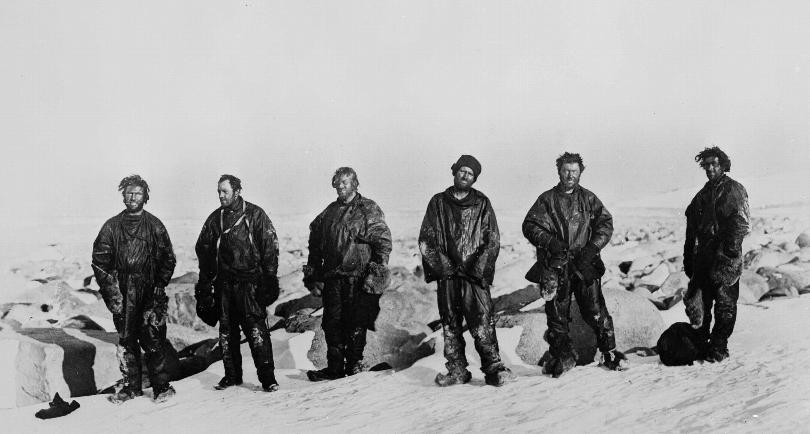
7-6_after_six_men_on_ice

The Northern Party after their long winter in the ice cave From left: Dickason, Campbell, Abbott, Priestley, Levick and Browning.

Although not particularly distinguished academically, Shackleton related that he choose the 20-year old Priestley for Nimrod because “…I can manage that fellow.” That, and Priestley had the correct answer to Shackleton’s question “would you know gold if you saw it?” The Boss always had an eye on the expedition finances. The interview with Shackleton had been arranged by Priestley’s brother. Priestley was in his second year at University College, Bristol, when his brother inquired whether he had an interest in Antarctica. “I’d do anywhere to get out of this damned place.”

There is no great geologic discovery that can be attributed directly to Priestley. From his attitude at Bristol, one would not expect much in the way of original science. Admittedly, he was “…not so hot in school.” And yet…His geology schooling would be in the field among the outcrops, rocks and glaciers of Antarctica. Strictly hands-on lithology. Edgeworth David would be his tutor.

In science, one stands on the shoulders of giants to see a little bit further. Such is the nature of Priestley’s contribution to the science of geology. From an inauspicious beginning, he would add to the geological survey of the Ferrar Glacier and further the understanding of the geology of Southern Victoria Land by publishing a monograph with David (Antarctic Horst of South Victoria Land). During sledging on Mount Erebus, he identified raised beaches and observed eruptions. It was while on Erebus that Priestley survived one of many blizzards, in this case, with just his sleeping bag. The full geological results of the work from the Nimrod expedition would be published with David in The Heart of the Antarctic.
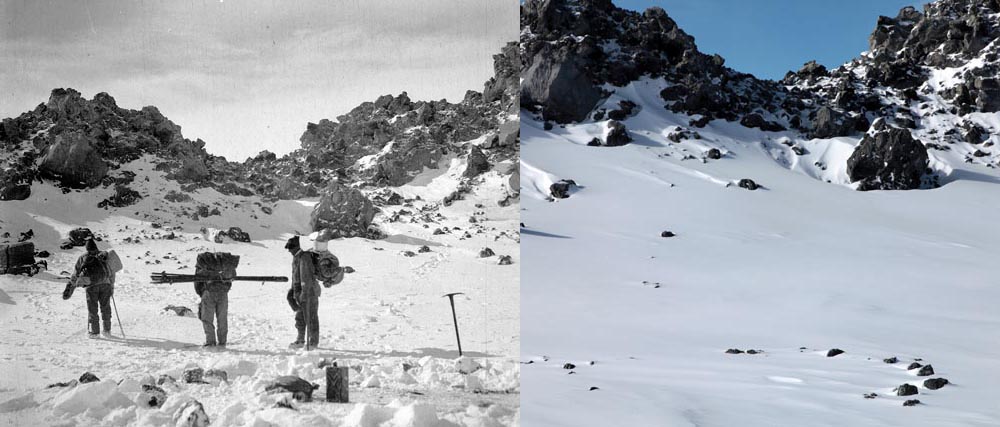
erebus-historic-camp-modern-old

Camp on Mount Erebus. 1912 and 2012. Credit: Picture Library, Scott Polar Research Institute, University of Cambridge.

But it was his experience wintering in an ice cave with the Northern Party of Scott’s Terra Nova expedition on Inexpressible Island, in what Vivian Fuchs called “a story of human endurance which has rarely been equaled,” that puts Priestley in the same league as Amundsen, Scott and Shackleton. Cherry-Garrard would add his own wisdom to Priestley’s tale in a summation that is concise and packed with relevance to a twenty-first century audience. “The necessaries of civilization were luxuries to us: and as Priestley found under circumstances to which our life at Hut Point was a Sunday School treat, the luxuries of civilization satisfy only those wants which they themselves create.”

Priestley published an account of the Northen Party’s expedition in Antarctic Adventure: Scott’s Northern Party. At times, his writing is the equal of Scott or Cherry-Garrard:

“I think the coldest thing I ever remember to have seen was the aurora which met our eyes when we tumbled out of our tent that morning to fetch the primus and cooker. It looked absolutely the essence of frigidity, and I know well enough now what I shall mean in the future when I speak of a cold light. A single arch of brilliant greenish-grey, like the curved blade of an immense scimitar flashing in moonlight, stretched across the sky from south to north.”
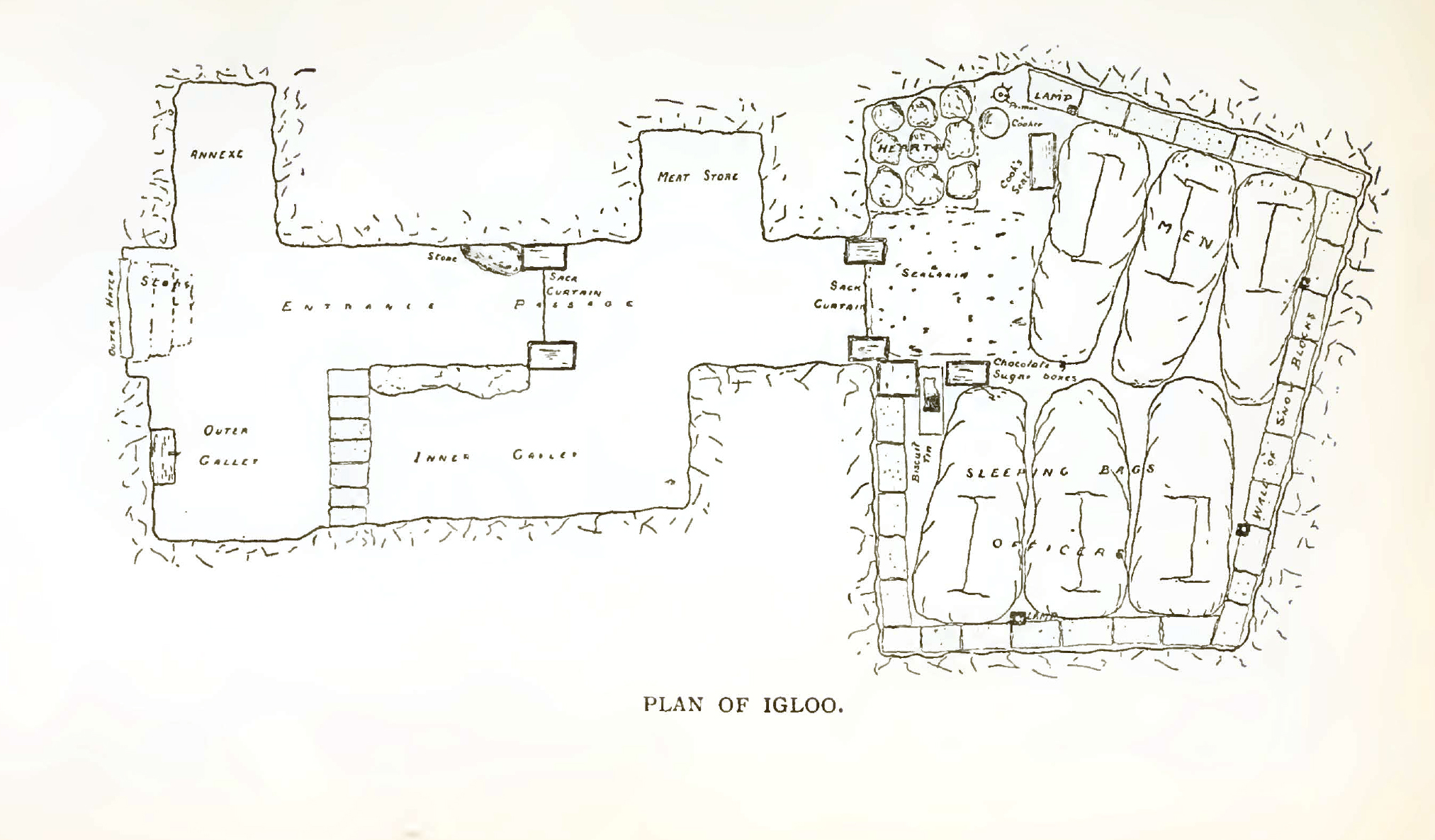
igloo

Plan of the Snow Cave – Priestley.

After his dark Antarctic winters, “…the Winter of the world with perishing great darkness” (Wilfred Owen) closed in on Priestley as the lights went out in Europe. Like many men from Shackelton’s Endurance expedition, Priestley served in World War One. He received the Military Cross for his involvement in taking the Riqueval Bridge on the Hindenburg Line (a German defensive position) in Northern France in 1918. On one-day, nearly one-million shells were fired during a twenty-four hour period. To Priestley, it must have seemed like the katabatic winds of Antarctica were shredding his tent once more, and that perhaps he was back on Erebus with just a sleeping bag.

After the war, he helped create the Scott Polar Research Institute in 1920, and followed that with the distinguished academic career he initially abandoned when he made his “Easting down” with Shackleton in 1907.

Priestley meet Roald Amundsen onboard the Fram in January 1911 when Terra Nova sailed into the Bay of Whales. Thus, he speaks with some authority when he compares the three great explorers of the Heroic age in what is perhaps the best analysis ever written, made all the more poignant for its brevity. “For scientific discovery, give me Scott; for speed and efficiency of travel, give me Amundsen; but when you are in a hopeless situation, when you are seeing no way out, get down on your knees and pray for Shackleton.”

Though his science was not necessarily geologic gold, he can most certainly be considered one of the geologic glitterati.

antarcticadventu00prie_0009

The Really Deep Challenge

13 Tuesday Dec 2016

Posted by Richard Watson in Antarctica, Climate Change

≈ Leave a comment

Tags

Antarctica, Climate Change

[the following is from a paper I wrote for an Antarctic course last spring]

“Airborne platforms…are ideal for ice-shelf cavity exploration due to their…operational insensitivity to crevasses (compared to surface-based data acquisition) …” (Southern Ocean Observing System). This is the scientific way of explaining that whereas people can fall into crevasses, airplanes generally do not. The challenge for scientists has always been one of translation. How to take meaning-laden, complex words and concepts and, without losing the gist, set them in a context for public consumption and discussion. Newton had it easy. Although the inspiration was brilliant, his expository was simple. The apple fell from the tree.

tae

The Crossing of Antartica (Thames & Hudson)/George Lowe, Huw Lewis Jones, the 1957/58 Commonwealth Trans-Antarctic Expedition.

Modern scientists have a harder challenge. Not only is the science more complex and difficult to understand, but the reality television mentality of many politicians and policy makers has promoted a culture that embraces ignorance. Witness Anderson Cooper’s comment to Donald Trump at a recent “debate” – “that’s the argument of a five year-old.” Such is the milieu in which the Challenge is set.

New Zealand is getting it right with its Deep South Challenge. Accepting that climate changes, the idea is to “adapt, manage risk and thrive in a changing climate.” To do so, and arrive at correct and economically viable decisions, a multi-disciplinary approach involving a positive feedback loop consisting of the public, educators, scientists and policy makers helps inform the science. For instance, what do civil engineers and architects need to know about extreme weather events when planning infrastructure; how do farmers manage crops in the face of more frequent droughts; how should tax and insurance policies be designed to benefit those communities most at risk to sea level rise so that the larger public good is not abused? This is the ground-truthing of public policy – using societal concerns and issues to prove the value of the science.

The Deep South Challenge has developed various engagement strategies to ensure that the science done in the Antarctic “…remains focused on and directed by societal needs.” Through lectures, seminars, briefing sessions and technical workshops, the Challenge responds “…to the most important national-scale issues.” Open and continuous communication is achieved by the use of online media, science festivals and public workshops among other tools. In this way, scientific priorities and research programs are established which lead back to the ground, or ice, in Antarctica.

antarctic_comp-0500

Antarctic sea ice. NASA.

Data and observations gathered on and around the continent help in the development of an earth system model which allows better management of climate risks. Climate observations in Antarctica help improve atmospheric models which in turn provide more reliable and precise weather forecasting. This allows the constituents of the Challenge to more effectively determine and plan for the impact of climate change on the economy and infrastructure. For instance, infrastructure decisions are improved by adding the stressors and risks associated with climate change to existing tectonic based models. It is well enough to understand what happens when the earth shakes, but you also need to know what energetic storms laden with heavy rain, wind, snowfall and resultant flooding can do to the roads.

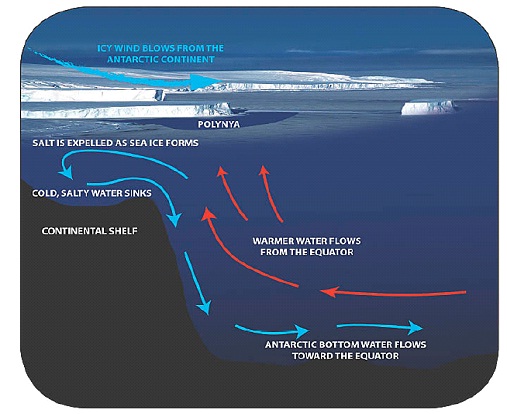
Extreme weather events can be seen as beginning in Antarctica. In situ work on ice-shelf cavities, as an example, feed directly back into weather models and test the validity and predictive value of the computer programs. Ice sheets lose mass at their boundaries which are generally where ice meets water along the leading edge and underneath the sheet itself – the cavity. As warm water enters the cavity, the sheets thin and are more vulnerable to fracture. But unlike a dental cavity, you can’t X-ray an ice sheet cavity. Gravitational measurements taken from aircraft, and ship based radio echo sounding and magnetic data help to map the relevant geography. This complex interaction of water and ice is the beginning of a deep river that cascades off the continental shelf and drives global ocean currents. So it is important to understand this interaction and to have models that predict what is observed on the ice.

Models must also explain the apparent inconsistencies that are so often picked up and paraded in public by politicians and talk show hosts. If global warming exists, why has the extent of winter sea ice around Antarctica been increasing? Recent extreme winters on the east coast of the United States have been used by politicians as evidence that global warming does not exist, and a significant portion of the population follows along.

There was a brief time when science captured the imagination of the world. From that moment when man walked on the moon, an entire generation was motivated to achieve the astounding. The benefits of the science, research and education that flowed from the Apollo missions can still be seen today in medicine, communications and computer and earth sciences. Because of its global impact, the next wave of imagination can be stimulated by Antarctic science.

watercirculationantarctica_zpsf3bce891

Water circulation – Antarctica.

Wilhelmina Bay

16 Sunday Nov 2014

Posted by Richard Watson in Antarctica, Travel

≈ 1 Comment

Tags

Antarctia Peninsula, Antarctica, Wilhelmina Bay

There are few things that take my breath away in this world. Such rare and precious moments of utter astonishment and joy are the highlights of life. As singular events, they may be different for each person. Yet that feeling in your heart, perhaps an involuntary shudder in your body, a sharp in-breath, a gasp and an electrifying buzz heightening all your senses, will be familiar.

For me, I can list the following events: watching the sunrise warm the sands of the Namibian desert from the top of a one-thousand foot dune; seeing elephants appear like apparitions right out of the forest while on a Kenyan game walk; my first sight of the Antarctic Peninsula; watching Pete Townshend slash away at his guitar; that still, silent stare of a deer I encounter while on a quiet trail run; the incomprehensible number of stars you can see in a truly dark sky; astronauts walking on the Moon; and, anytime I see a whale in its natural habitat.

Whilemina-4

John Rodsted scouting for whales in Wilhelmina Bay.

The Southern Ocean is a special place for whales, and Wilhelmina Bay is a favorite gathering spot on the Antarctic Peninsula. We will go looking for them today, but that will be in the afternoon. This morning’s adventure takes place on Orne Island.

I am ready to go and have slept well during the night. Debbie spent the evening sleeping under the pink twilight on Ronge Island, choosing the camping option. Whereas I needed some solid slumber and chose the gentle rocking motion of the ship. Debbie appears around six in the morning, glowing in the warm light shining through the softly opened door. The cabin is dark, but great contentment is expressed in her face, and I realize the experience far out-shined any lack of sleep. We swap places for now, and I head off at the first announcement of breakfast.

Whilhemina-2

In flight.

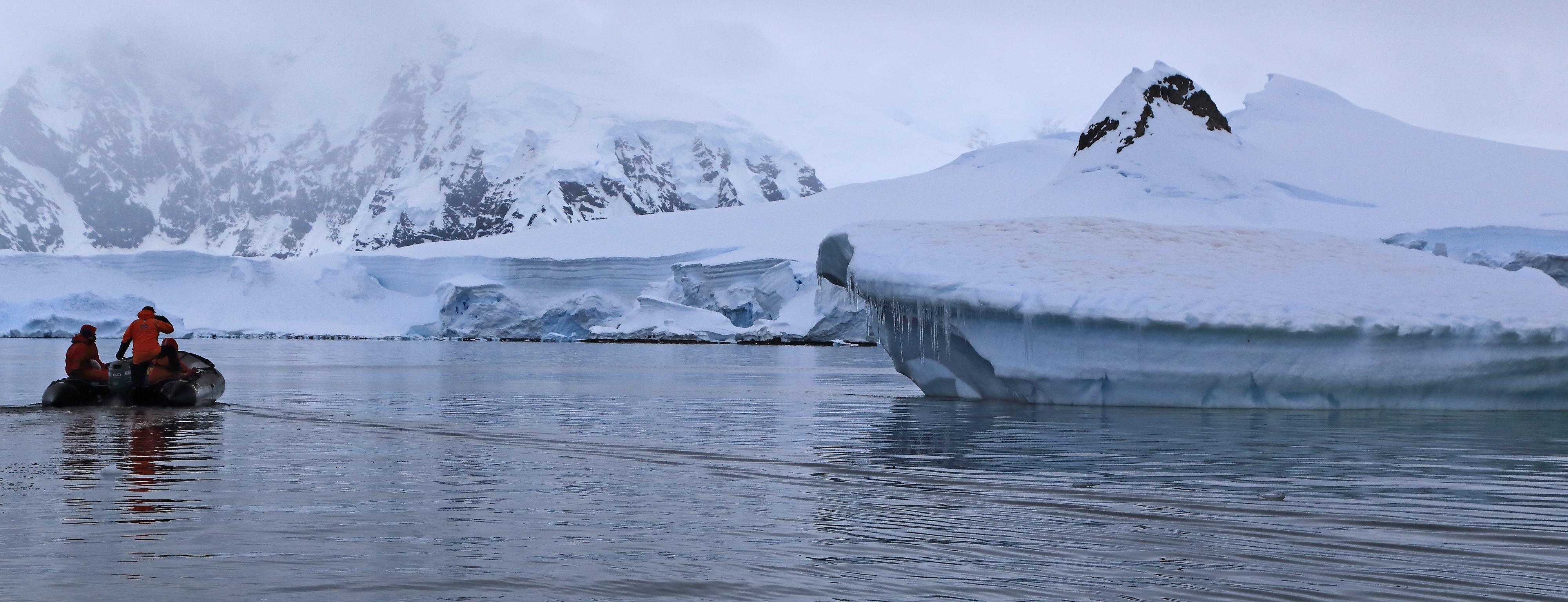
As we zodiac towards Orne, some detours are made to investigate icebergs which catch our fancy. There is fleeting magic in their shapes and colorful blue tints. Next week, they will look different. Not one of them is the same.

Icebergs are tersely classified by height and shape, the shorter ones having the most imaginative names such as growler and bergy bits – those which barely show at the water’s surface. The largest icebergs are called, well…just very large. Most striking are the blue bergs. A deeply blue berg has been some time in the making as most of the air bubbles have been compressed out of the ice. Blue light cannot penetrate their denseness. Technically, the darker color results because the blue wavelengths are not absorbed by ice that is free of trapped air. These higher frequency wavelengths are therefore scattered back into your eyes which perceive a deeply soothing shade of blue (Glaciers & Glaciation).

Whilemina-1

Bigger than a bergy bit.

On arrival at Orne, Chad is at the landing site and gives us the lay of the land. He sketches out the safe hiking boundaries and reports that the toboggan run is open near the peak of the island. From my vantage point halfway up the slope, it looks like you can slide all the way into the Errera Channel. This is also chinstrap penguin country.

89-chinstrap

A chinstrap on Orne Island.

On return to the Ioffe, I rejoin Debbie. After lunch we embark in the zodiac and begin looking for whales in Wilhelmina Bay. Katabatic winds can slam down from seven-thousand feet above the bay and whip the water into a frenzy. But today it is merely overcast. Mette is piloting, and binoculars are scanning the horizon. We stop to admire some Antarctic Terns as they gracefully alight on top of an iceberg.

Off to starboard, we spot the ephemeral spout that is the sign post of a whale exhaling upon its return to the surface, warm breath condensing into a mist when it hits the cold Antarctic air. If you are close enough, the fishy smell of so many krill informs as to a whale’s principal diet. Whales like to eat krill. If you are a blue whale, during the Antarctic summer, you might graze on four tons of krill a day (Antarctica, Global Science from a Frozen Continent).

93-hiking-Orne

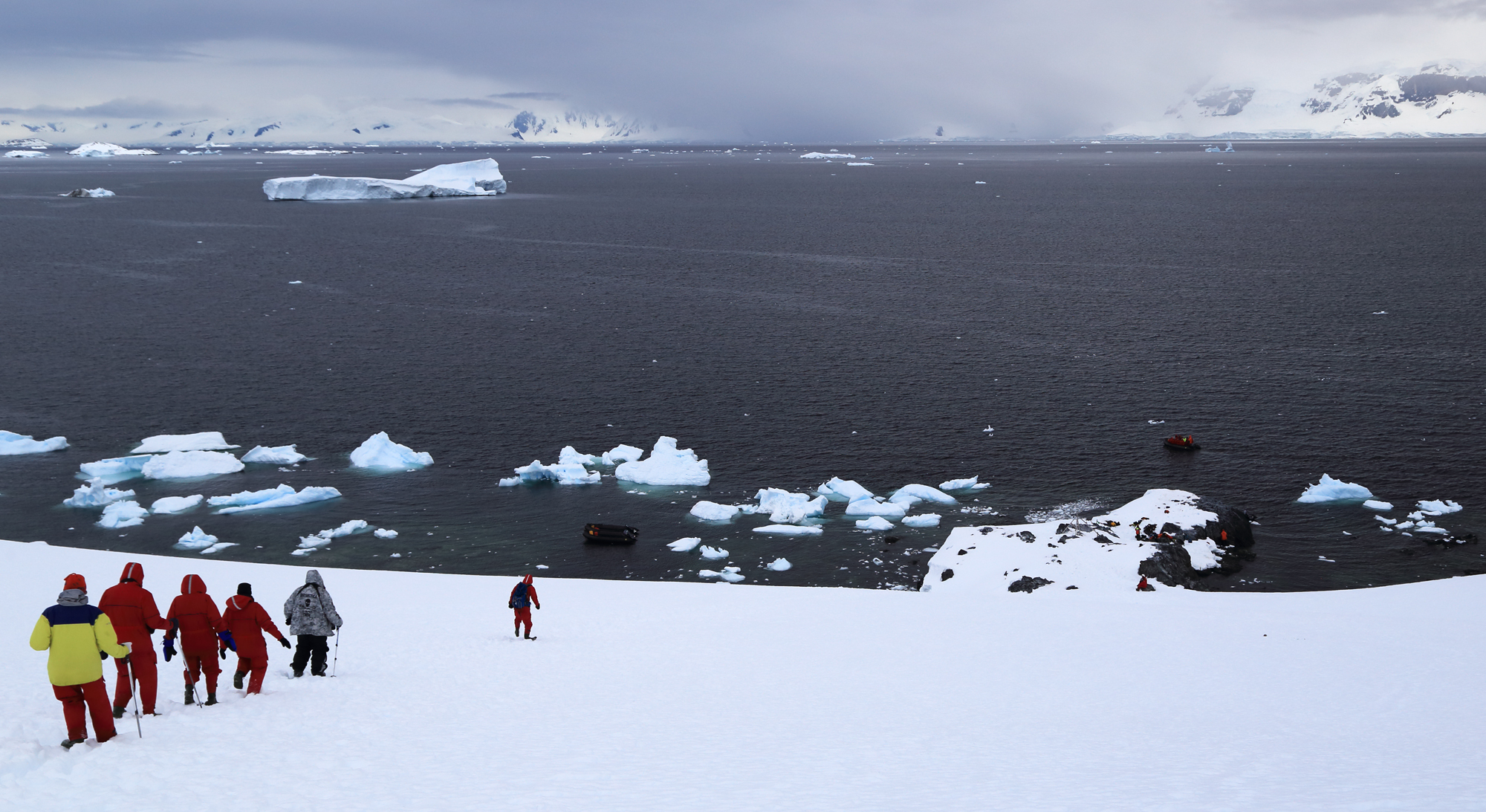
Hiking to the landing site on Orne Island.

Such creatures are remarkably graceful. Gliding through waters, grouped in pairs in an elegant, almost silent dance, there is a moment before they dive deep when their backs arch and their magnificent flukes rise out of the water. There is that gasp that takes your breath away. Each fluke is like a finger print, and individual whales can be identified by their unique pattern.

In a similar manner, the dorsal fin of an orca can be used for identification. It is now known that some whales live to be over one-hundred years. The prosaically named J2 was seen last May off the coast of British Columbia and is believed to be 103 years old. This grandmother was still swimming with her pod at that time.

Seeing whales unhindered in these fantastic waters, it is easy to forget that during the years of commercial slaughter, perhaps 1.3 million whales were killed in the Southern Ocean. Even though whales have had some 40-years of protection in these waters, blue whale populations are still estimated at only 15% of the numbers that existed before humans came to Antarctica.

These figures do not include the genocide that occurred in the Arctic. Beginning in the early 1600s from Svalbard to the Greenland Sea, then on to Baffin Bay and finally the waters of the Southern Ocean around Antarctica, these gentle mammals were almost brought to extinction in the 20th century.

Barry Lopez talks about “the carnage of wealth” when describing the devastation caused by the whaling trade. The skin of a whale “…is so sensitive to touch that at a bird’s footfall a whale asleep at the surface will start wildly. The fiery pain of a harpoon strike can hardly be imagined.”

And now, whales are again threatened by countries that harvest krill. Should this important food source fail, further stress would be added to the survival of whale populations. Countries such as Japan and the United States have even gone so far as to try and enlist the help of the U.S. Internal Revenue Service in an attempt to silence the important work done by nonprofit groups such as Sea Shepherd, which call attention to these issues. Thanks to Wikileaks, we know that the U.S. representative to the International Whaling Commission conspired with the Japanese in 2009 to attempt the revocation of Sea Shepherd’s tax exempt status.

91-chinstrap

A lone chinstrap climbs a slope on Orne Island.

What a grim world it would be if whales were to become extinct. If those stars I mentioned at the beginning of this piece are not to weep, and are to remain bright, we must remember that it is important to walk softly on the Earth, to respect and cherish all life, and to remember that we are stewards of the planet.

One Ocean Expeditions mentioned that after taking this voyage, we would become ambassadors for Antarctica. Perhaps in going to Antarctica, we also become ambassadors for the planet.

See Part V, Almirante Brown

See Part VII, Neko Harbour

Antarctic Links

“The history of the human race is a continual struggle from darkness into light. It is, therefore, to no purpose to discuss the use of knowledge; man wants to know, and when he ceases to do so, is no longer a man.” – Fridtjof Nansen

Almirante Brown

04 Saturday Oct 2014

Posted by Richard Watson in Antarctica, Travel

≈ 2 Comments

Tags

Almirante Brown, Antarctia Peninsula, Antarctica

“From here you can walk to the South Pole.” Although it is perhaps 1,700 miles as the skua files. Noah Strycker, author, ornithologist and Associate Editor of Birding magazine, who once spent three months with 300,000 penguins at Cape Crozier, is showing us the sights. We are perched with Noah on a ridge some two-hundred feet above an infrequently used Argentine base at Paradise Bay.

Looking to the west and dominating the foreground, clouds blanket Bryde Island. Its humpbacked peaks seem poised to dive into the sea. Lemaire Island is to the right, and the Ioffe is docked in the shadows of clouds over Paradise Bay. Wiencke Island is visible beyond the strait – its nearly five-thousand foot peak stands bright and clear above a strata of clouds. The rocks speak of long extinct volcanoes.

Interspersed with the geography tour, Noah has been delightfully regaling us with bird stories. In his latest book, The Thing with Feathers, The Surprising Lives of Birds and What They Reveal About Being Human, he writes that “penguins untied my shoelaces, hesitatingly preened the sides of my sleek pants, and fell in line behind me in a drawn-out game of follow-the leader.” It is impossible to watch a penguin and feel anything but complete joy.

Brown-1

View of Paradise Bay from above Almirante Brown Station.

But the charred edges of the station below tell a story that is other than joyful. The name of the Argentine base is Almirante Brown Station. The original base was constructed in 1951 and burned in 1984, allegedly by a member of the scientific staff who did not wish to “winter over.” From the very first expedition to spend an entire winter in Antarctica, the long Antarctic night has had a reputation of pulling minds into dark corners.

When Adrien de Gerlache’s Belgica stuck fast in the ice in 1898, the bosun refused to work, fearing that other crew members were plotting to kill him. He was like a “wild creature” in a cage. The expedition’s doctor wrote that “…we are at this moment as tired of each other’s company as we are of the cold monotony of the black night…”

Brown-2

Walking towards the landing site.

During Sir Ranulph Fiennes’ 1980 crossing of the Antarctic continent, base commander Ginnie Fiennes “…heard babies crying in the darkness and someone whispering incoherently from close behind her.” She told her husband “…there’s something there…” when of course there was not (The Third Man Factor, John Geiger).

The Boss himself (Ernest Shackelton) spoke of a presence while crossing South Georgia with Worsley and Crean – “…during that long and racking march of thirty-six hours over the unnamed mountains and glaciers of South Georgia it seemed to me often that we were four, not three.” Shackelton wrote about the experience that “…there is much that can never be told…we had pierced the veneer of outside things.”

This very same glittering, blue and white landscape that is now before me does not reconcile with such ancient impulses and fears. And yet, my sense is that these experiences are part of the draw of this cruelly beautiful landscape. It is unsettling to be stripped of the familiar references and distractions of civilization – to have no compass.

Brown-3

There is a scarcity of landing sites. Those that are safe, cling to the shore with a narrow margin.

I find these feelings accompany me at night when I am alone in the desert, since our overly bright cities shield us from the empty immensity of the universe. I lose my bearing and become lost in the stars. Enveloped by blackness so dark, I become fearful of what I might see should a light suddenly illuminate the unknown. And when the full moon is at my back casting shadows, its seemingly imperceptible gravitation tug is like an unrelenting and unshakeable presence just out of sight.

Antarctica is technically a desert. So it is without surprise that I revisit these most wondrous and strange friends here. Some people uncover great religions in deserts. I discover little bits of myself in their vast emptiness. I begin to appreciate my imperfections, and my demons soften when light shines through the cracks. That is of course, the purpose of cracks and of perhaps Antarctica – to let the daylight in upon darkness (Leonard Cohen) – whether those cracks be personal, or those that threaten the very survival of humans on this planet.

The greatest obstacle to living is expectancy, which hangs upon tomorrow and loses today… The whole future lies in uncertainty: live immediately.

– Lucius Seneca (ca. 4 BCE – 65 CE)

Part IV – Lemaire Channel

Antarctic Links

See Part VI – Wilhemina Bay

Antarctic Links

10 Wednesday Sep 2014

Posted by Richard Watson in Antarctica

≈ 4 Comments

Tags

Antarctia Peninsula, Antarctic Websites, Antarctica

The following is a list of various websites of interest concerning Antarctica. It is meant to accompany the chronicles of our Antarctic Peninsula trip in 2013 and serve as a reference source for additional information.

Part I, The Antarctic Peninsula

Part II, Ushuaia

Part III, The Drake Passage

Part IV, Lemaire Channel

Part V, Almirante Brown

Part VI, Wilhelmina Bay

Part VII, Neko Harbour

Part VIII, Deception Island (coming soon)

Part IX, Rounding the Horn (coming soon)

Part X, Return to Buenos Aires (coming soon)

42-lemaire

Morning in the Lemaire Channel.

Amundsen-Scott South Pole Station. A nice blog on the happenings at the South Pole.

Antarctic Fox. An often humorous account of a trip to the Antarctic Peninsula.

The Antarctic Heritage Trust. The people who conserve expedition bases left by explorers.

The Antarctic Heritage Trust. This is the UK version with includes the lively Port Lockroy blog.

The Antarctican Society. A U.S. based non-profit devoted to educational issues.

Australia’s center of Antarctic and Southern Ocean climate change research which studies climate change impacts in Australia and the Pacific.

The Antarctic Sun. News from the United States Antarctic Program.

Australia’s Antarctic Division.

Antarctica New Zealand. Scott Base – the other base on Ross Island.

The British Antarctic Survey. Maps, books and more.

Byrd Polar Research Center. Looking at what happens when things get cold.

Cool Antarctica. A nice discussion on extreme weather clothing.

Council of Managers of National Antarctic Programs. Coordinating scientific research on the continent.

Field Manual for the United States Antarctic Program. In case you would like to learn how to build a snow shelter.

Gateway Antarctica. New Zealand’s center for study and research.

International Association of Antarctic Tour Operators. IAATO is the rule setting body for responsible tourism.

Possible landing sites on the Antarctic Peninsula.

Mariners Weather Log. Though not specifically about Antarctica – news and information about worldwide weather events and phenomena.

National Science Foundation Division of Polar Programs.

New Zealand Cluster Munition Coalition. Important work done by Antarctic guides in between polar seasons.

Noah Stryker. Birder extraordinaire and author who once spent three months with three-hundred thousand penguins at Cape Crozier.

The Oates Collection. All about the man who went outside and has been some time.

OneOcean Expeditions. The people to see about visiting Antarctica.

Operation Ice Bridge. Building a record of the Earth’s changing ice.

Antarctic Place Names. Provides a useful interactive map.

The Polar Conservation Organization. Dedicated to a sustainable future.

The Scientific Committee on Antarctic Research. All the latest cutting edge stuff.

Scott Polar Research Institute. Research in both the north and south.

Sea Sheppard. Though not an Antarctic site, this group does important work addressing the destruction of habitat and slaughter of wildlife in the the world’s oceans.

South Georgia Heritage Trust.

South Pole. Presenting a history of Antarctic exploration.

From NASA’s Earth Observatory – a discussion of the West Antarctic ice sheet.

Brown-1

Bryde Island in Paradise Bay.

Recent Posts

  • The Right to be Heard June 11, 2025
  • Julius Caesar, a Case of Realpolitik April 5, 2025
  • “Against stupidity, the gods themselves fight in vain.” December 6, 2023
  • A Harrowing Tale of Trash September 15, 2023
  • The Rubbish of Martin v. Boise August 5, 2023

Pages

  • About Richard Watson
  • Photographs

Archives

Unknown's avatar

Enter your email address to subscribe to this blog and receive notifications of new posts by email.

Join 117 other subscribers

Blog at WordPress.com.

  • Subscribe Subscribed
    • Richard Watson
    • Already have a WordPress.com account? Log in now.
    • Richard Watson
    • Subscribe Subscribed
    • Sign up
    • Log in
    • Report this content
    • View site in Reader
    • Manage subscriptions
    • Collapse this bar
 

Loading Comments...