• Antarctica
  • Book Reviews
  • Economics and Taxation
  • Photographs
  • Political Commentary
  • Running
  • Science
  • Short Stories
  • Travel
  • About Richard Watson

Richard Watson

~ Commentary

Richard Watson

Author Archives: Richard Watson

The Pyongyang Kings

19 Friday Apr 2013

Posted by Richard Watson in Political Commentary

≈ Leave a comment

Tags

Kim Jong-un, North Korea, Sacramento Kings

Breaking News – The Sacramento Kings:

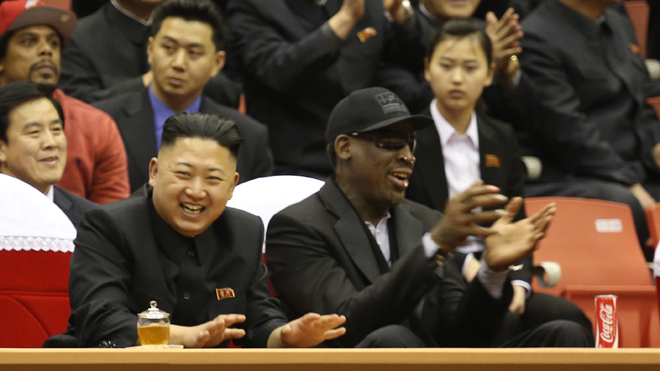
In a surprise announcement, the NBA has revealed that the Sacramento Kings will be moving to Pyongyang, North Korea.

Earlier in the year, Dennis Rodman visited the Supreme Leader Kim Jong-un in the hermit kingdom. Those in the west were initially puzzled by Rodman’s trip, the purpose of which has now been acknowledged to conduct secret negotiations regarding the sale of the Kings.

Secretary of State John Kerry likened Rodman’s North Korean mission to Henry Kissinger’s clandestine talks with Beijing in the 1970s which paved the way for President Richard Nixon to visit China and meet with Chairman Mao.

Questions immediately arose about North Korea’s menacing nuclear threats. Dennis Rodman noted that Kim Jong-un likes to have “a bit of fun,” and is really “a great guy to hang out with.” Others suggest that the perceived threats by the west are merely the result of cultural misunderstandings.

“We know how you Americans like your wars,” stated an anonymous source from the Korean Social Democratic Party.

As to the purchase price, sources within the City of Sacramento remain tight lipped. It is well known that North Korea is short of hard currency. But a spokesperson for the North Korean Government stated that Pyongyang has reached an understanding with Sacramento that will allow the Capitol of California to keep the proceeds from parking concessions in Pyongyang over the next ten years. Analysts have estimated that this deal is worth upwards of thousands of dollars a year.

Korean watchers in the west now realize why references to Communism were removed from North Korea’s constitution in 2009. “It simply wouldn’t do to have “Kings” as part of the name of the basketball team of a communist nation,” according to the U.S. State Department.

Dennis Rodman is expected to return to the hermit kingdom later this year.

Kim Jong Un, Dennis Rodman

Way Too Cool

25 Monday Mar 2013

Posted by Richard Watson in Running

≈ 2 Comments

Tags

Running, Way Too Cool 50k

March 9, 2013

So there I was at the side of the trail about mile fives into the 31.2 mile run with my hands on my knees, choking on an electrolyte capsule. I tried to inhale, and for one moment I couldn’t breathe. The only thing that went into my lungs was salt. Well, should this happen to you, you’ll find that the body rebels and somewhat forcefully and involuntarily tries to get everything out – as it should.

What may look to some like vomiting, is really more an expulsion of the contents of the lungs. Which in my case included a partial gelatinous capsule and some white foam caused by all the salt. The look was not unlike a mad dog frothing at the mouth.

And what flashed through my mind in that instant? Two things. The first was that I didn’t wish to keep Debbie waiting at the finish, so I had better get on with things and start moving again. The second was that runners going past me must be thinking that it’s a bit early in the race to be throwing up. A runner stopped to see that I was alright. I thanked him and explained that a capsule had gone down the wrong pipe. Of all the things that could go amiss during a run which one tries to anticipate and prepare for, this wasn’t even on the list.

Thankfully, the moment passed, as they all do. When I could breathe again, it was a glorious feeling. But for the rest of the day, every in-breath tasted of salt – and not like the fresh salt laden ocean spray that one delights in at the beach. Whenever I took a really deep breath, I felt as if the other half of the capsule was stuck somewhere, and I would start to gag.

111246-06-312

Making a splash at Way Too Cool and looking slightly distressed.

Despite all that, it was a brilliant day and the course was gorgeous. The weather ideal. Ultra running is about carrying on in spite of things. So if misfortune strikes…well so what…the journey must continue.

Way Too Cool 50k starts on the 8.6 mile Olmstead Loop Trail which crosses two creeks. The American River Canyon Hikes guide explains that the trail was named for Dan Olmstead in 1993, who “was a local avid mountain biker and hiker.”

From Olmstead, it is a swift downhill to the Highway 49 crossing and the Quarry Road Trail which follows the middle fork of the American River for about six miles. Gold was pulled from the river here in the 1850s. Before then, the Paiute and Washoe tribes used these trails. Tucked away behind some rocks at just after one mile on the Quarry Trail is the gated entrance to what is left of Hawver Cave. From this cave in the early 1900s, Dr. J. Hawver recovered fossilized human remains dated at 10,000 years old along with the remains of a saber-toothed cat. So these are well traveled trails.

But the descendants of saber-tooth cats still call these woods home. After Quarry Trail, the run heads uphill to the Auburn Lake Trail which is where the Auburn Lake would have been had the Auburn Dam been built. I was running behind a gentleman who had a few years on me. He asked if I wished to pass, but I told him that I was just trying to keep up. Then we passed a bench alongside the trail to which he pointed. He asked if I knew the story. It was near this spot in 1994 that accomplished ultra runner Barbara Schoener was tragically killed by a cougar. The bench is a monument to her memory. I reflected on this for some time.

And then we came to goat hill. You’ve seen goats. And no doubt you’ve seen goats on hills. At least you could hear the cow bells ringing from the top announcing the next aid station. Hope amidst goats! I had to stop twice to catch my breath, and I’m sure a moan came from my mouth at one point.

“I’ve learned to love that sound,” came a voice from behind.

“What, the moaning or the cow bells?” was my response.

“The cow bells!” was his Pavlovian answer. Like Pavlov’s dogs, distance runners begin to salivate at the sound of cow bells.

But we also salivate at the thought of the special frog cupcakes awaiting us at the finish. My official time was 6:25, placing 581 out of 853 finishers.

Signature WTC Frog Cupcake
Immense thanks must again go to my adoring and supportive wife, who, although she doesn’t quite understand why someone would willingly run 50k or 50 miles, nevertheless encourages these endeavors. She could have slept in that morning, but drove me up to Cool. And more importantly, back to Sacramento later that day.

Next up is the American River 50 on April 6, where I plan to carefully swallow everything I put in my mouth.

Show Me a Hero

12 Saturday Jan 2013

Posted by Richard Watson in Political Commentary

≈ 1 Comment

Tags

School Shootings, Schools, Teachers

The word “hero” is often overused. But with yet another school shooting, this time at Taft Union High School, a teacher once more stood in the line of fire and saved the lives of children. At Sandy Hook Elementary School, some teachers spilled blood and gave their lives so that their precious charges could live. F. Scott Fitzgerald wrote “Show me a hero and I will write you a tragedy.” It is a dishonorable tragedy that our nation continues to undervalue its teachers.

During a strike by Chicago teachers, Mitt Romney accused teachers in that city of turning their backs on “hundreds of thousands of children relying on the city’s public schools to provide them a safe place to receive a strong education.” Teachers in Wisconsin were disgracefully demonized and accused of being greedy by a media and public not knowing the meaning of that word “hero,” while trillions of dollars continued to pour into banks. Governor Brown, in a thinly disguised act of extortion, threatened to further gut funding for California schools unless the public paid more money into state coffers in the form of higher taxes. And, it continues to be a great shame in California that we pay more money to incarcerate than to teach.

As a country, we must honor our teachers. Visit any school in the nation on any day and you will see that they are worthy of this respect. To not treat them so is to denigrate those who, in the words of Lincoln, “gave the last full measure of devotion.”

Winston Churchill was talking about the Battle of Britain when he gave one of his most famous speeches. He may well have been talking about Columbine, Newtown or Taft, when on August 20, 1940, he said the following:

“The gratitude of every home in our island, in our Empire, and indeed throughout the world…goes out to the British airmen who, undaunted by odds, unwearied in their constant challenge and mortal danger, are turning the tide of the world…Never in the field of human conflict was so much owed by so many to so few.”

IMG_0309

Plucking the Goose

17 Monday Dec 2012

Posted by Richard Watson in Economics and Taxation

≈ Leave a comment

Tags

Taxes and the Economy, Taxing the Rich

Jean-Baptiste Colbert, France’s Minister of Finances from 1665 to 1683, allegedly said that “the art of taxation consists in so plucking the goose as to obtain the largest amount of feathers with the least possible amount of squawking.” A contentious report, initially withdrawn, has been reissued by the Congressional Research Service. The report, Taxes and the Economy: An Economic Analysis of the Top Tax Rates Since 1945, (Taxes and the Economy) looks at what, if any, impact a reduction in income tax rates has on the economy and concludes “…the reduction in the top tax rates have had little association with saving, investment, or productivity growth. However, the top tax rate reductions appear to be associated with the increasing concentration of income at the top of the income distribution.” The usual suspects have criticized the report’s findings.

The Tax Foundation has cited two flaws. The first is that “it takes one to five years for a reduction in the tax on capital income to generate all the associated…” benefits to the economy. Thus, we should see a five year lag between the initiation of a tax cut and a bump to economic output – which makes sense.

The second problem the Tax Foundation lists was that the study “…does not hold other factors constant. Shifts in monetary policy, changes in other taxes, regulatory actions, even weather-related effects on the economy can have significant impacts on the measured growth rate in a given year.” Which is also true, but is likely impossible to conclusively quantify. I could use this very argument against those who claim that tax cuts stimulate the economy.

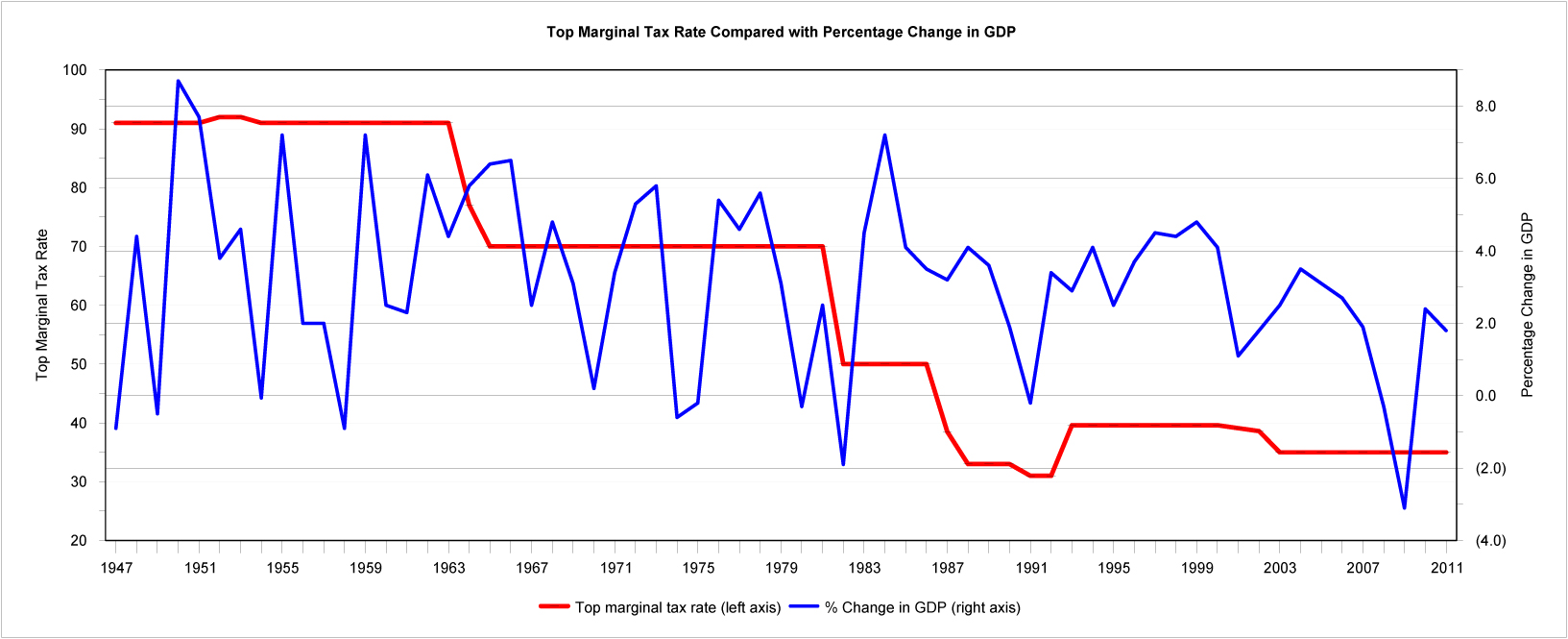
Hence, the graph shown below which compares the top marginal tax rate since the end of the Second World War (red line) with the annual percentage change in U.S. Gross Domestic Product (blue line). What you see is that the economy is cyclical and tends to expand or contract annually within a certain range. But what you also see is the long term decline in the top U.S. marginal individual income tax rate.

graph

If there is a correlation between tax cuts and economic expansion, it does not appear to last very long or to be the primary driver of economic growth. Perhaps the only conclusion you can reach is that tax cuts do not greatly influence economic expansions since “[s]hifts in monetary policy, changes in other taxes, regulatory actions, even weather-related effects on the economy can have significant impacts on the measured growth rate in a given year” – The Tax Foundation.

…………

The Congressional Research Service is a public policy research arm of the United States Congress. As a legislative branch agency within the Library of Congress, CRS works primarily and directly for Members of Congress, their Committees and staff on a confidential, nonpartisan basis.

…………

The Technical Details

Data on marginal income tax rates comes from Tax Analysts. Historical GDP comes from the Bureau of Economic Analysis (BEA). The chart in this blog uses chain-type estimates for GDP since they provide the best available method for comparing the level of a given series at two points in time. Chained-dollar estimates are obtained by multiplying the chain-type quantity index for an aggregate by its value in current dollars in the reference year (currently 2005) and dividing by 100. For analysis of changes over time in an aggregate or in a component, the percentage changes calculated from the chained-dollar estimates and the chain-type quantity indexes are the same. Thus, chained-dollar estimates can be used to compute “real” (i.e., inflation-adjusted) rates of growth.

The BEA is an agency of the Department of Commerce and produces economic accounts statistics that enable government and business decision-makers, researchers, and the American public to follow and understand the performance of the economy.

Cliff Notes, Part II – Tea Time

14 Friday Dec 2012

Posted by Richard Watson in Economics and Taxation

≈ 1 Comment

Tags

Deficit, Federal Budget, Federal Debt, Federal Spending, Fiscal Cliff

For some historical context, see Part I of this blog, Putting the Kettle On.

As I was working on the numbers for this blog, the most shocking statistic I came across concerned the annual federal budget. Only five out of the last fifty years have shown a budget surplus, and three of those years were under Clinton. The other forty-five years ran budget deficits. The highest surplus was in the year 2000 when government coffers were $236 billion to the good. So the logical question in any financial analysis of the United States is what did Clinton do right, and why has it gone so wrong in just ten years? But first, some Cliff Notes…

The Cliffs of Washington

There is a cliff, whose high and bending head
Looks fearfully in the confined deep;
Bring me to the very brim of it…
– William Shakespeare, King Lear

The Economist has estimated that the combination of tax increases and spending cuts that automatically go into effect on January 1, 2013, should no agreement be reached by Congress to extend Bush era tax cuts or postpone spending cuts, is worth up to 5% of Gross Domestic Product (GDP). The growth of United States’ economy is slowing and is expected to be as little as 1% in the fourth quarter of 2012. This sets the stage for a possible 4% contraction in the economy in the first quarter of 2013. The Journal of Accountancy observes that…

Rarely has there been such a major difference between the laws in effect one year and the next. The maximum income tax rates next year could be as high as 43.4% on ordinary income (44.6% if the potential impact of reinstated limitations on itemized deductions is taken into account) and 23.8% on long term capital gains (or 25% if itemized deduction limitations are factored in). In addition, unless Congress acts, millions of additional taxpayers will be liable for the alternative minimum income tax (AMT) for 2012 because the most recent AMT patch expired at the end of 2011. Further, the current 2% payroll tax holiday is scheduled to expire at the end of this year…In addition to the new 3.8% Medicare surtax on net investment income, starting in 2013 a new 0.9% Medicare surtax will apply to wages and self-employment income of taxpayers with MAGI [modified adjusted gross income] in excess of…threshold amounts.

This is what Ben Bernake, the chairman of the Federal Reserve, has called a fiscal cliff. It is not a sheer cliff, but you can expect the ride to get bumpy. But really, it has been all downhill since the year 2000. Rather than heading off a cliff, we are charging into a valley in the Crimean peninsula. You know the bit by Tennyson (which doesn’t end well):

‘Forward, the Light Brigade!’
Was there a man dismayed?
Not though the soldier knew
Some one had blundered:
Theirs not to make reply,
Theirs not to reason why,
Theirs but to do and die,
Into the valley of Death
Rode the six hundred.

So I thought the thing to do was to take a look at the numbers and try to figure out what changed since Bill Clinton ran the show in 2000 when the Republicans were just a bunch of sex-obsessed obstructionists. You remember Kenneth Star?

Methodology
I obtained various spreadsheets from the Office of Management and Budget and combined them into an historical record of federal receipts and expenditures for the last fifty years. Those intrepid enough to wade though the detail can download the spreadsheet here – US Budget – and browse the data using Excel. Perhaps you will discover your own interesting observations. I also gathered some figures from the U.S. Census Bureau and tried to correlate population trends with changes in the federal budget. Data concerning revenue primarily comes from the Internal Revenue Service (IRS).  Another good source of tax data is Tax Analysts’ Tax History Project. They have a delightful section from where you can download presidential tax returns going back to Franklin Roosevelt.

Often, you’ll see historical figures adjusted for inflation. But I do not do this. I am taking what I call a “household” approach to looking at the data. You have money coming in, and money going out. As you take in more, you can spend more. But when times are lean, you need to scale back. To me, percentage comparisons are more revealing – except for this one figure to keep in mind – between 2000 and 2010, inflation accounts for a 26% increase in costs. What cost $100 in 2000, now costs $126.

My federal debt figures include debt held by the public and debt held by federal government accounts. Sometimes the media just uses the public debt figure.

My findings are presented in no particular order. They are observations, some of which bear closer scrutiny and analysis, but perhaps they point to a solution when taken as a whole.

The Findings – Revenue
First off, the “one-percent.”

In 2010, 135 million individual income tax returns were filed with the IRS reporting adjusted gross income (AGI) of $8.0 trillion on which $949 billion in income tax was paid to the government. Most (47.4% in 2011) of the revenue the government takes in comes from individual income taxes. Only 7.9% of total income came from corporate taxes in 2011. In 1962, corporations contributed 20.6% of the total and individuals accounted for 45.7%. This tells you all you need to know about what has happened with corporate income taxes over the years. The lowest contribution from corporate taxes over the past fifty years was under Obama in 2009 – just 6.6%.

There were 1.4 million tax returns comprising the top 1% of individual taxpayers in 2010. These lucky few paid $355 billion in income tax, which was 37% of the total individual income taxes paid that year. The average tax rate for those in the top 1% was 23%. The highest of any income category. If your 2010 AGI was greater than $370,000 you were in the 1% club. An AGI of $162,000 put you in the top 5%. Since the 2011 budget deficit was $1.3 trillion, you could double the taxes paid by the top 1%, and it would only cover 27% of what was needed that year to balance the budget. The implication of this is that spending cuts must be the primary contributor to balancing the budget.

By contrast, Mitt Romney’s 47% (or 50% to be precise) numbered 67.5 million tax returns in 2010 and paid $22 million in income tax which was just 2.4% of the total individual income tax collected by the government. The average tax rate for this group was 2.3%. You were in this group if your AGI was less than $34,000.

The Findings – Expenses
On the expense side, the Federal budget is divided into approximately twenty categories known as budget functions. The top five budget functions, representing 80% of all expenditures in 2011, were: Social Security (20.3%), Defense (19.6%) Income Security (16.6%), Medicare (13.5%) and Health (10.3%).

The nature of expenditures under Social Security, Defense and Medicare are clear. The Income Security budget function includes a range of programs that provide cash or near-cash assistance (e.g., housing, nutrition, and energy assistance) to low-income persons, and benefits to certain retirees, persons with disabilities, and the unemployed. Housing assistance programs account for the largest share of discretionary funding in this function. Major federal entitlement programs in this function include unemployment insurance, trade adjustment assistance income support, food stamps, Temporary Assistance to Needy Families, foster care, and Supplemental Security Income. Federal and other retirement and disability programs comprise approximately one third of the funds in this function.

The Health budget function includes direct health care services programs. Other health programs in this function fund anti-bioterrorism activities, national biomedical research, protecting the health of the general population and workers in their places of employment, providing health services for under-served populations, and promoting training for the health care workforce. Some of the agencies funded in this function include the National Institutes of Health, Centers for Disease Control and Prevention, Health Resources and Services Administration, and the Food and Drug Administration. The major mandatory programs in this function are Medicaid, the State Children’s Health Insurance Program, federal and retirees’ health benefits, and health care for Medicare-eligible military retirees.

So, since 80% of all spending can be grouped into five categories, how has each category fared from 2000  to 2010? The category experiencing the largest percentage increase in expenditures was Income Security. This category increased by 145%. As noted above, inflation over roughly the same period would have caused costs to rise by just 26%. Within the Income Security category, unemployment compensation was up a staggering 596% and food and nutrition assistance rose by 193%. Presumably, these increases have something to do with the Great Recession. This implies that a return to Clinton era levels of expenditure, once the economy improves, is not unreasonable.

The second highest increase in expenditures was seen in national defense which rose by 136%. Although it may surprise you to know that as a percentage of total government expenditures, the highest  level of spending on national defense was during the Kennedy administration when defense accounted for 49% of the budget in 1962 – think Cold War. Now, defense represents 19.6% (2011) of the federal budget. The lowest level of defense spending in the last fifty years was during the Clinton administration (16.1% in 1999). Clearly, this figure can come down as the wars in Iraq and Afghanistan wind down. The Clinton era level is again not unreasonable.

Medicare came just behind defense with an increase of 129% over ten years. Most of the spending in this category consists of payments for Medicare benefits. Since 1960, the median age of the U.S. population has risen from 29.5 to 37.2 years. As a percentage of the total population, those aged 65 and over have increased from 9% to 13%. By 2050, the projection is that this age bracket will represent 20% of the population. Is there a correlation between the increase in Medicare payments and the aging population?

Since 2000, the number of people aged 65 and older rose by 15%. I previously noted that inflation can account for an increase of 26% in expenses. These two factors get us nowhere near 129%. There appears to be a problem with cost control, and this is the main problem with health care reform. The entire industry must be redesigned – but not by Congress. We have Medicare, Medicaid and now Obamacare, with fifty separate state insurance exchanges soon to be in operation. Think of the cost savings and efficiency that could be achieved by putting everyone under one system. But this is a subject for another blog…

Social Security increased by 73% over ten years which seems mild compared to the other increases. But there is this question about solvency. Historically, payments coming into the Social Security trust funds have exceeded the benefits paid out. Which is a good thing. But the problem is, the government has been borrowing from these surpluses to help fund budget deficits. As of 2011, nearly $2.7 trillion has been borrowed from the trust fund to use for other purposes. Payroll taxes fund Social Security. But payroll taxes are only levied on the first $113,700 (in 2013) of annual wages. One solution to improving the solvency of Social Security is to increase the wage base upon which the tax is levied.

The final category comprising 80% of all expenditures is Health. This budget category rose by 139%, but I place it fifth, because it only represents 10.3% of total expenditures. The comments regarding cost control under Medicare are applicable here.

The Debt
National debt figures are usually presented as a percentage of GDP. This makes sense, and is what banks do, or at least are supposed to do, when they give you a mortgage. Banks determine what percentage your mortgage payment represents to your total income in order to get an indicator of your ability to pay your debts. It is the same with governments. The credit worthiness of a nation can be determined by its debt to GDP percentage, its prospects for growth, the efficiency and fairness of its tax system and the interest rate it has to pay on new debt.

Greece, for example, is a terrible credit risk. Its economy is in depression. There are no prospects for growth, its citizens have made an art form out of tax evasion and it has high borrowing costs. Yet, the European Central Bank continues to lend it money. Spain is headed in the direction of Greece as is Italy – although Mario Monti has done an admirable job of addressing some of Italy’s issues. But if Silvio Berlusconi gets back into power, they’ll be talking about rearranging deck chairs.

The United States has had the kind of luck with its national debt that even the Irish would envy. Interest rates on U.S. Government debt have been essentially zero after factoring in inflation. In fact, some issues from the Treasury have had negative real rates of interest. In other words, you have to pay the government interest for the privilege of lending it money, rather than the other way around. The U.S. is a good credit risk despite the fact that it has hit 100% of debt to GDP. We have been there before and have prospered since.

In 1946, just after World War II, U.S. debt was 121.7% of GDP. But, realizing that a war should be paid for and that debt should be paid down, the top marginal tax rate was set at 94%. Compare this rate with the current top rate of 35%, even though we are approaching a similar debt level to that of World War II. Historical experience suggests a top marginal rate of at least 50% if the debt is to be reduced. Wars cost money, and a combination of borrowing and high taxes helped foot the bill for World War II. Top tax rates were kept high after the War and only began to drop in 1964 under Johnson once the debt had declined to 39% of GDP. The top marginal tax rate was reduced further in 1982 to 50% under Reagan, and again five years later to 38.5%.

Conclusion
Like the cliff in King Lear, the fiscal cliff is imaginary. Taxes can increase and spending can be cut without ruinous consequences. The goal is to get to $1.3 trillion in a combination of spending cuts and tax increases based upon our current deficit.

On the revenue side, the rich do need to pay more. Since the end of World War II, they have seen an almost constant decline in their top marginal rate (see the next blog – Plucking the Goose). The goal should be to generate additional revenue of $350 billion from those with AGIs of $500,000 or higher. Obama’s $250,000 AGI figure sets the bar too low.

Similarly, corporations should pay their fair share of tax for the privilege of doing business in the U.S. Somehow, corporations have managed to convince national and local governments that they are blessed when a business locates in their domicile. It should be the other way around. Consider the benefits of doing business in the U.S. – a vast capital market, a somewhat impartial justice system, low levels of corruption, an educated workforce and so on. This should add another $100 billion to the tally.  That leaves $850 billion in spending cuts.

Taking defense back to Clinton era levels saves $330 billion after factoring in inflation. Assuming that increases in Income Security resulted from the Great Recession, a return to Clinton levels should cut perhaps $170 billion when the economy improves. Social Security should not be touched (since I would like to retire at some point), except that the wage base on which the tax is assessed can be adjusted upward as needed to address solvency. The government should also treat the Social Security trust fund as a true trust fund and not dip into it whenever they like to pay for other things. The big question is whether Medicare and Health services can be brought back to Clinton levels. If they can, this gives us the remaining $350 billion that is necessary to balance the budget.

It seems clear that all government health programs (Medicare, Medicaid, Obamacare) should be consolidated under one program. Cost control must also be a priority. The fiscal health of the country depends upon the health of its health care system.

Here’s to your good health in 2013! More later…
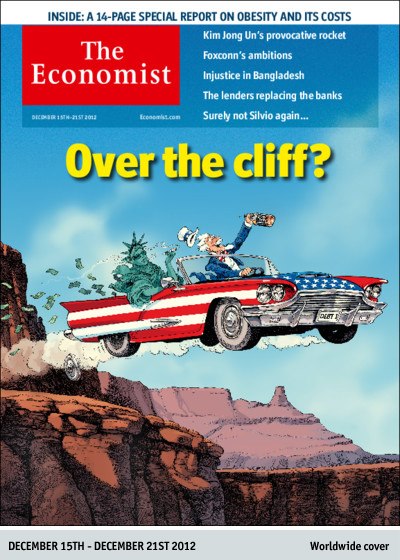
economist cover

Cliff Notes, Part I – Putting the Kettle On

14 Friday Dec 2012

Posted by Richard Watson in Economics and Taxation

≈ Leave a comment

Tags

Deficit, Federal Budget, Federal Debt, Federal Spending, Fiscal Cliff

This is a piece on taxation and expenditure in the United States. My goal is to provide you with an accountant’s view on the financial condition of our Government. We’ve heard from the politicians, economists and media outlets, but what can an accountant add to the fray? This will be a two-part blog, with the second part containing an analysis of the Federal budget.

This part is a circuitous and whimsical look at governments, taxes and accountancy.

Poets and Scholars
What kind of perspective can an accountant provide? Well…accountants, don’t you know, invented writing and are the original poets. Who better to turn drab columns of numbers into a coherent literary analysis? P.G. Wodehouse put it best when he observed that poets must have a firm grasp of accounting principles:

Poets, as a class, are business men. Shakespeare describes the poet’s eye as rolling in a fine frenzy from heaven to earth, from earth to heaven, and giving to airy nothing a local habitation and a name, but in practice you will find that one corner of that eye is generally glued on the royalty returns.

But surely I jest and gibe when I claim accountants invented writing?

The oldest discovered pieces of writing are found on clay tablets dating back to 3300 BCE. The hieroglyphic writings on these tablets were found in the tomb of the Egyptian King Scorpion and primarily represent tax records. In Georges Ifrah’s The Universal History of Numbers, it is noted that “[w]riting was invented by accountants faced with the task of noting economic transactions which, in the rapidly developing Sumerian society, had become too numerous and too complex to be merely entrusted to memory.” Surprisingly, over ninety percent of the known cuneiform documents from ancient Mesopotamia are about economic and tax matters. Symbols on these documents representing grain, animals and labor indicate settlement of business transactions or payment of taxes.

The World’s Second Oldest Profession
For millennia, taxes were assessed on the produce of the land and paid in kind. The income tax is a modern invention. Those without means paid taxes in the form of compulsory labor service. In A History of Taxation and Expenditure in the Western World, Carolyn Webber and Aaron Wildavsky observe that “[c]orvée, the mandatory contribution of personal labor to the state, was the earliest form of taxation for which economic records exist; indeed, in the ancient Egyptian language the word “labor” was a synonym for taxes.”

From Mesopotamia to Rome, kings, temple priests and governments outsourced the collection of taxes to prominent businessmen or elders who usually had some form of wealth. These “tax farmers” were responsible for paying the tax to the government whether or not they collected it from the citizens. You can imagine someone going from Palermo to Naples, collecting little brown envelopes….

However, throughout most of history, taxpayers received very little in exchange for their tax dollar, franc or pound sterling. Governments were not in the business of looking after the welfare of its citizens. It was Adam Smith, who in the Wealth of Nations (1776) wrote…

Wherever there is great property, there is great inequality…Civil government, so far as it is instituted for the security of property, is in reality instituted for the defence of the rich against the poor, or of those who have some property against those who have none at all.

Yet, some form of government is necessary, and debate about the proper role and function of government is nearly as old as, well, the invention of writing. Thomas Hobbes wrote that legitimate political power must be representative and based on the consent of the people. He imagined a world without government and in 1651 observed that:

In such condition, there is no place for industry; because the fruit thereof is uncertain: and consequently no culture of the earth; no navigation, nor use of the commodities that may be imported by sea; no commodious building; no instruments of moving, and removing, such things as require much force; no knowledge of the face of the earth; no account of time; no arts; no letters; no society; and which is worst of all, continual fear, and danger of violent death; and the life of man, solitary, poor, nasty, brutish, and short.

So, to keep us at our best, some form of government is necessary. The nature of society, and consequently its expectations from government, began to change during the Industrial Revolution (1750-1850). Prior to this time, mass poverty had been the norm. But as people broke their long connection with the land and moved to cities, a host of new demands were made on governments. From Webber and Wildavsky again:

Changes in patterns of life and work during the nineteenth century converted individual problems of personal welfare into social issues…In an environment of widening franchise, governments no longer served only to protect the rights of the wealthy: they began to take action to improve the lives of the poor…Pushed by continuing unrest associated with depression-induced unemployment, nineteenth-century legislatures slowly responded to reformers’ demands…

It took a bothersome colony some distance away from Hobbes’ native England to pick up on his “representation” theme. You could argue that the United States declared its independence as a result of a tax dispute. England needed funds to pay for troops stationed in its various colonies around the world, and the English Stamp Act of 1765 was designed to provide that revenue. It also started all the fuss about taxes in the colonies. Ben Franklin  reflected that the colonies would need to be represented in Parliament if they were to be taxed…but, since we were essentially good English men and women, it took a disagreement about tea in 1774 to really put the kettle on.

The United States was able to finance and win its Revolutionary War thanks to heavy lending from France. The French figured they could keep England bogged down in an overseas war (just like the Americans felt they could do to the Soviet Union in Afghanistan – sorry, I couldn’t resist) and not only provided credit but also ships and troops.

How did we repay France? We defaulted. According to Simon Johnson and James Kwak in White House Burning:

Less than six years after the Treaty of Paris ended the American Revolutionary War, the new nation was deeply in debt and already in default. The United States had missed interest payments owed to France for several years in succession, as well as principal payments due in 1787 and 1788.

So not only were the French no longer able to eat their cake, some of them got le guillotine and the rest got the French Revolution which began in 1789, to be followed by the Reign of Terror in 1793, and Napoleon in 1799.

With French funding no longer available, how did the U.S. pay for its government? Except for a short time during the Civil War, the United States derived its revenue almost entirely from tariffs on imports. One of the first federal income tax laws was signed by President Lincoln in 1862 to help finance the Civil War, but it was repealed several years later.

Income taxes did not become widely utilized until the early 1890s when several nations adopted various forms of income tax. Up until World War I, financial policies of most Western nations incorporated elements of taxation and expenditure that were holdovers from the nineteenth century: minimal government supported by a few low but productive indirect taxes; and small spending for welfare, defrayed from insurance funds and the proceeds of progressive income and inheritance taxes paid by the rich.

In the United States, the Wilson-Gorman Tariff Act of 1894 imposed the first peace time income tax which was equal to 2% of incomes greater than $4,000. This represented less than 10% of households at the time. The following year, the Supreme Court held the tax to be unconstitutional, because it violated the Constitution’s prohibition against unapportioned direct taxes.

But, since you can always change what you find disagreeable in the Constitution, and with war looming again, the ratification of the 16th Amendment to the U.S. Constitution in 1913 famously did away with the apportionment requirement:

The Congress shall have power to lay and collect taxes on incomes, from whatever source derived, without apportionment among the several States, and without regard to any census or enumeration.

This means that next year will be the 100th birthday of the modern income tax in the United States. Since that time, two World Wars, and a surge in global population from 1.6 billion in 1913 to a projected 7.0 billion in 2013, have created vast cradle-to-grave welfare societies with a dependency on governments never known before.

So how are we to avoid a Malthusian budgetary catastrophe? Read on in Part II – Tea Time.

…………………………….

Reverend Thomas Malthus felt that populations would continue to grow until they exhausted available resources at which point havoc and mayhem would sweep the land until population size reduced back to a sustainable level. I am of course, paraphrasing.

………………………………

Some accountancy from Monty Python –

…our experts describe you as an appallingly dull fellow, unimaginative, timid, lacking in initiative, spineless, easily dominated, no sense of humour, tedious company and irrepressibly drab and awful. And whereas in most professions these would be considerable drawbacks, in charted accountancy they are a positive boon.

unclsam1

The Sacred Trust of Civilization

16 Friday Nov 2012

Posted by Richard Watson in Political Commentary

≈ Leave a comment

Tags

arthur balfour, Middle East, sykes picot agreement

The sweep of history is long, and events that happened one-hundred or even thousands of years ago continue to have repercussions in the present. Particularly in the Middle East.

The year 2014 will mark the 100th anniversary of the beginning of World War I. That war caused the collapse of the Ottoman Empire. Realizing the territorial gains that were to be had in the dismemberment of Ottoman lands, both the French and British began negotiations to share in the spoils. As British Prime Minister Asquith put it, “if…we were to leave the other nations to scramble for Turkey without taking anything for ourselves, we should not be doing our duty.”

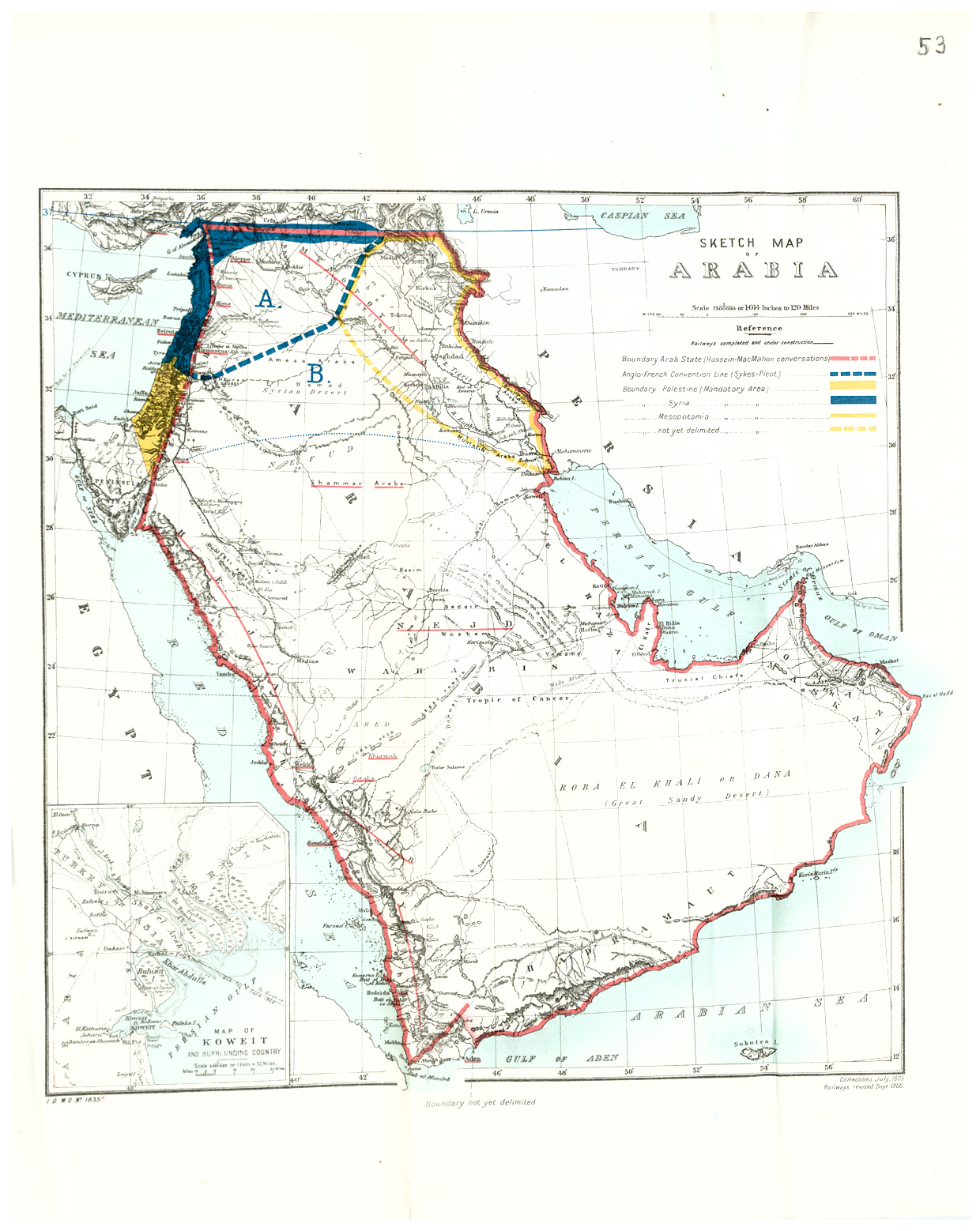
The outcome in 1916 of these secret negotiations was what has become known as the Sykes-Picot Agreement, which divided the Ottoman Empire into areas of British and French control. How were these areas of control determined? In a conversation with Arthur Balfour, Sir Mark Sykes, the British negotiator, traced his finger across a map and said “I should like to draw a line from the ‘e’ in Acre to the last ‘k’ in Kirkuk.” The map attached to the Agreement shows this literal “line in the sand” with the British sphere of control colored in red and the French sphere colored blue. The original red and blue states, if you will. But this carve up failed to take account of the various promises made to the Arabs.

1921 U.K. government map of the Middle East.

The failure of the Gallipoli landings caused the British to worry that the Turks might mount an attack on the Suez Canal which would have cut Britain off from its empire in India. The idea was hatched in 1915 to provoke an Arab uprising. Sir Henry McMahon, the British governor of Egypt, made entreaties to Sharif Husein of Mecca. If the Arabs would turn against the Turks, British aid would follow, and Britain would support the Sharif’s claim to a Middle Eastern empire. But in putting this support in writing, the British engaged in an act of deceit that is still remembered in the Arab world today. The key phrase in McMahon’s letter to Husein was “…we accept these limits of boundaries; and in regard to those provisions of the territories therein in which Great Britain is free to act without detriment to the interests of her ally France…” To compound the deceit, the second qualifying phrase was dropped from the Arabic translation.

But it was another promise that would make interests in the Middle East irreconcilable. The Balfour Declaration of November 1917 was addressed to Lord Rothschild and read as follows:

I have much pleasure in conveying to you, on behalf of His Majesty’s Government, the following declaration of sympathy with Jewish Zionist aspirations which has been submitted to, and approved by, the Cabinet.

“His Majesty’s Government view with favour the establishment in Palestine of a national home for the Jewish people, and will use their best endeavours to facilitate the achievement of this object, it being clearly understood that nothing shall be done which may prejudice the civil and religious rights of existing non-Jewish communities in Palestine, or the rights and political status enjoyed by Jews in any other country.” [the italics are mine]

I should be grateful if you would bring this declaration to the knowledge of the Zionist Federation.

Christopher Sykes, historian and son of Sir Mark Sykes, has said that “nobody knows why the Balfour Declaration was made.” But it was T.E. Lawrence who painted the broader picture – “I quite recognise that we may have to sell our small friends to pay for our big friends, or sell our future security in the Near East to pay for our present victory in Flanders.”

The Treaty of Versailles in 1919 officially ended World War I and also established the short-lived League of Nations. The League created a British Mandate for Palestine which began on September 11, 1922. Another date which has not been forgotten in the Arab world nor more recently in the Western world.


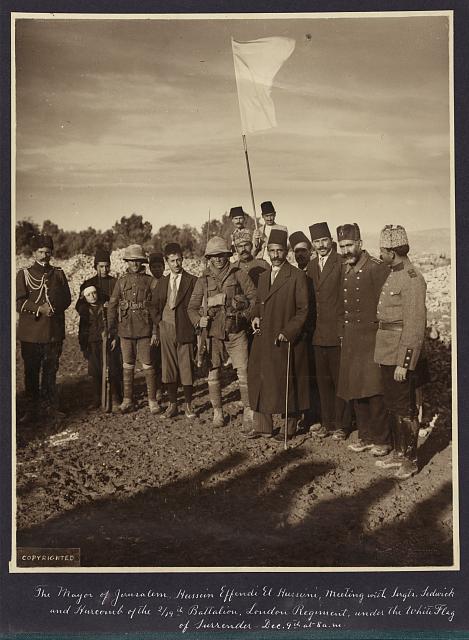
The surrender of Jerusalem by its mayor to British troops on December 9, 1917.

The Mandate for Palestine.


The Preamble of the Mandate was as follows:

Whereas the Principal Allied Powers have agreed, for the purpose of giving effect to the provisions of Article 22 of the Covenant of the League of Nations, to entrust to a Mandatory selected by the said Powers the administration of the territory of Palestine, which formerly belonged to the Turkish Empire, within such boundaries as may be fixed by them; and

Whereas the Principal Allied Powers have also agreed that the Mandatory should be responsible for putting into effect the declaration originally made on November 2nd, 1917 [the Balfour Declaration], by the Government of His Britannic Majesty, and adopted by the said Powers, in favor of the establishment in Palestine of a national home for the Jewish people, it being clearly understood that nothing should be done which might prejudice the civil and religious rights of existing non-Jewish communities in Palestine, or the rights and political status enjoyed by Jews in any other country… [the italics again are mine]

Article 22 of the Covenant of the League of Nations stated in part:

To those colonies and territories which as a consequence of the late war have ceased to be under the sovereignty of the States which formerly governed them and which are inhabited by peoples not yet able to stand by themselves under the strenuous conditions of the modern world, there should be applied the principle that the well-being and development of such peoples form a sacred trust of civilisation and that securities for the performance of this trust should be embodied in this Covenant. [italics mine]

The best method of giving practical effect to this principle is that the tutelage of such peoples should be entrusted to advanced nations who by reason of their resources, their experience or their geographical position can best undertake this responsibility, and who are willing to accept it, and that this tutelage should be exercised by them as Mandatories on behalf of the League.

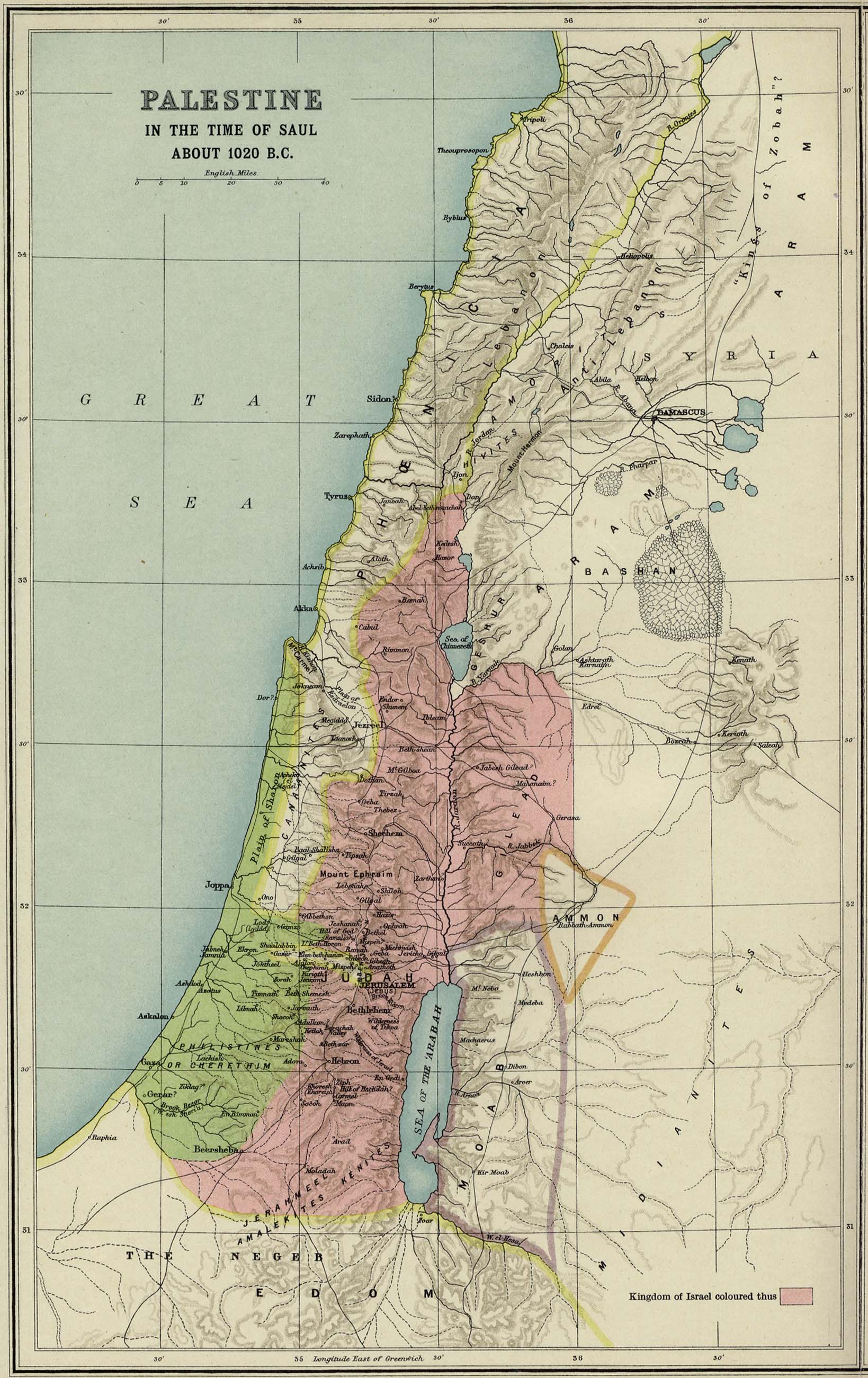
Map of the Middle East, circa 1020 BCE.

And what of events thousands of years ago in the Middle East? Sometime around 1100 BCE, God directed the Hebrew tribes coming out of Egypt to commit what today the United Nations would call Genocide against the indigenous Canaanites who had been living in the region since probably 2750 BCE.

Here is the word of God and his commandment to the Hebrews on what to do with the Canaanites – from Deuteronomy 7 and 20: “…you must utterly destroy them; you shall make no covenant with them, and show no mercy to them…you shall save alive nothing that breathes.”

Compare God’s words with the United Nation’s definition of Genocide in the Convention on the Prevention and Punishment of the Crime of Genocide:

…any of the following acts committed with intent to destroy, in whole or in part, a national, ethnical, racial or religious group, as such: (a) Killing members of the group; [my italics]

…………………………………………..

From Rudyard Kipling:

Take up the White Man’s burden –
The savage wars of peace –
Fill full the mouth of Famine
And bid the sickness cease;
And when your goal is nearest
The end for others sought,
Watch Sloth and heathen Folly
Bring all your hope to nought.

………………………………………….

The primary sources for this blog are two books I can highly recommend: A Line in the Sand, by James Barr, and Sowing the Wind, the Mismanagement of the Middle East 1900-1960, by John Keay.

Dick Collins Fire Trails 50

03 Saturday Nov 2012

Posted by Richard Watson in Running

≈ 1 Comment

Tags

Dick Collins Fire Trails 50, Fire Trails 50, Running, Trail Running, Ultra Marathon

 Saturday, October 13, 2012, Contra Costa

Somewhere along the Bridle Trail close to the half marathon mark. Photo courtesy of Pete Beck Photography.

“You should hate your pacer.”

Diane Forrest was explaining her philosophy, or art, of pacing as we were running somewhere along the last portion of the Dick Collins Fire Trails 50 mile run. She was telling me how she had unleashed a torrent of foul language at her pacer during the later stages of the Western States 100, when from behind us came a kind of proclamation.

“I am going to hurl.”

There was to be no argument with this defiant announcement. Although not a literal statement of fact, the emphatic challenge of this remark was – “I am going to walk for awhile. See if you can make me do otherwise.”

Diane was pacing Jennifer Blake over the last thirteen miles of the course, and Jennifer had clearly reached a moment when she needed to stop, dig deep, and summon her reserves. But the pacer is relentless. It’s the job.

Then my watch made a chirping sound.

“What’s that for?” – came Diane’s query, her ears missing nothing.

“That’s to remind me to eat,” was my response, although I made no effort to do anything of the kind.

“What have you been taking?” Diane inquired very reasonably.

“Usually a Gu… (awkward pause) …I suppose I ought to have one.”

You see, a pacer also thinks for you. After a time, there is no blood flowing to your brain, since your muscles are not very good at sharing. They tend to use every drop of it, leaving nothing for non-vital functions such as thought and digestion, which is a pity, because all that food you’ve been ingesting has not been digesting. Think of an air traffic controller with planes stacked up for miles attempting to land in foggy weather and you’ll have a sense of the resulting stomach nausea.

“What have you been taking for electrolytes?”

“Umm….doesn’t Gu have electrolytes?”

“You need more than that.” Digging into her pack, she handed me a few S! Caps.

“Let’s run to the next uphill!” And so it goes…

Perhaps most importantly, the pacer looks after you. It is a selfless act that is paradoxically usually not appreciated until well after the finish. But I was secretly elated to be running with Diane and Jennifer. They graciously let me tag along for the last six miles. To minimize the level abuse hurled (that word again!) in my direction, I resolved to wait until after we finished to tell Diane that I was having a good time. And, at the risk of revealing something that could be used against me during some future run, the truth is that pacers are Angels.

The day in the Bay Area was angelic as well – clear skies and moderate temperatures with beautiful views of San Francisco from the ridge line – what pilots might call “ceiling and unlimited visibility.” The Fire Trails course is an “out and back” run that winds through several East Bay regional parks. Over 50 miles the vertical ascent is 7,800 feet. Since you finish where you started, the descent is also 7,800 feet.

The most daunting hill in my mind occurs after leaving the Steam Trains aid station. Here, you begin a 1,500 foot descent to the turnaround four miles later at Tilden Park. This didn’t seem too bad on paper. But the thought rolling around my head as I carefully wound towards sea level was – I am going to have to come back up this hill. But another truth about ultra running is that most people power-walk the up hills. Perseverance and patience are the necessary skills.

The three of us persevered and finished after dark with our headlamps lighting the way. My official time was 12 hours 39 minutes – a rather nice day spent on the trail.

…………………

I would like to thank my wife who, since her leg was in cast (something to do with rescuing a cat from Kauai), was with me in spirit during the run, and my parents who let me park my weary body for the night in Vacaville.

Many thanks go to all the volunteers who are also Angels. At Sibley, I asked for two cups of coke and a wondrous volunteer handed me the bottle to finish. And thanks to Chuck Wilson, heir to the Dick Collins legacy, who volunteered at Steam Trains and filled my water bottle both times.

Lastly, to that efficacious pacer, Diane Forrest, you kept me going, and I am thankful. By the way, I also had a good time!

Ultra running makes me a better person in that I become more compassionate, thankful and understanding. At the beginning of each run, I have faith that the sun will set at the end of the day, and at that moment, I will find that I have finished the race.

The course.

Looking a bit stiff on a slight uphill just after Fish Ranch Road and about 20 miles. Photo courtesy of Pete Beck Photography.

The Finest Hour

28 Sunday Oct 2012

Posted by Richard Watson in Book Reviews

≈ 1 Comment

Tags

William Manchester, Winston Churchill

I am only one quarter of the way through William Manchester’s and Paul Reid’s riveting biography about Winston Churchill, The Last Lion. I find the read captivating and inspiring, particularly in its emphasis on Churchill’s use of language.

Churchill believed in using simple words and felt that thoughts should be compressed “…into a reasonable space…” He was able to capture feelings and emotions with brevity and a succinct turn of phrase that not only moved the commoners but also the aristocracy. His words said much more than what is literally written on the page.

Here are some of my favorites from among his lesser known quotes in just the first 234 pages:

  • On Prime Minister Stanley Baldwin: “Occasionally he stumbled over the truth, but hastily picked himself up and hurried on as if nothing had happened.”
  • On Socialism: “The Socialist dream is no longer Utopia but Queuetopia.”
  • On cooking (having never prepared a meal in his life): “I shall cook for myself. I can boil an egg. I’ve seen it done.”
  • On meeting the long haired, young and bearded code breaking geniuses at Bletchley with MI6 Chief Stewart Menzies: “Menzies, when I told you to leave no stone unturned, I didn’t mean you to take me quite so literally.”
  • On being handed a long report at the Admiralty House (Churchill’s instructions were that reports should fit on one piece of paper): “This report, by its very length, defends itself against scrutiny.”
  • On his lack of concern over being hit by a German bomb, Churchill quoted Henri Poincaré: “I take refuge beneath the impenetrable arch of probability.”
  • Upon being interrupted by cabinet ministers: “Tell them to go and bugger themselves. Tell them there is no need for them to carry out that instruction literally.”
  • When asked by Lord Moran whether he read the Bible: “Yes, I read it; but only out of curiosity.”
  • On Germany’s operation Sea Lion: “We are waiting for the long promised invasion. So are the fishes.”
  • The brevity of Churchill’s message to Field Marshall Archibald Wavell after the defeat of the Italian army at Sidi Barrani in North Africa: “St. Matthew, Chapter 7, Verse 7.” Which is “ask, and it shall be given to you; seek, and ye shall find; knock, and it shall be opened unto you.”
  • On Italy’s declaration of war: “People who go to Italy to look at ruins won’t have to go as far as Naples and Pompeii in the future.”

What was marvelous about the 2012 Olympics was its focus in the opening ceremony on the English language (and correspondingly the closing ceremony’s focus on music – particularly British rock and roll). The Last Lion drives the narrative along with the use of quotes from others. As these gems show, the British are masters of the literary craft.

  • C.P. Snow commenting on Winston’s famous drinking habits: “Churchill cannot be an alcoholic because no alcoholic could drink that much.”
  • His wife Clementine commenting on his habitual lateness for trains: “Winston is a sporting man. He likes to give the train a chance to get away.”
  • After the fall of France, news vendors chalked on their display boards: “We’re in the final – to be played on home ground.”
  • Wellington describing the Battle of Waterloo: “a close-run thing.”

More to come…

O’Romney’s Cake

16 Tuesday Oct 2012

Posted by Richard Watson in Economics and Taxation

≈ 1 Comment

Tags

JCT, Joint Committee on Taxation

The Joint Committee on Taxation (JCT) is a committee established by Congress with several duties. Among them are to make reports, studies and recommendations concerning taxes. They’ve recently run some numbers as part of an “experiment” to see how much the income tax rates could be reduced if they “broadened” the tax base. I thought I would pass the results along so you can be armed with some knowledge for tonight’s debate. That way, you can throw things at the TV screen when both Obama and Romney flub the figures.

It must be understood what is meant by “broadening” the tax base. This means increasing the amount of income that is taxed. This is usually done by getting rid of deductions and exclusions which causes the amount of tax you pay to increase, even though the rates remain the same. The JCT’s experiment eliminated ALL itemized deductions, repealed the Alternative Minimum Tax patch, taxed capital gains and dividends at ordinary income rates and assumed that individual tax rates will rise in 2013 (that is, if you are currently in the 25% tax bracket, you will be in the 28% tax bracket in 2013).

Republicans make the argument, which is true to a point, that you can broaden the tax base by lowering tax rates. This theory assumes that as more people are put to work and unemployment falls, more income is available to tax. Think of having a cake from which the government would like to eat. If the size of the cake remains the same, and the government takes a larger slice, that means less cake for you. However, if the size of the cake doubles and the government takes a smaller slice as a percentage of the total, it may be possible to increase the amount of revenue flowing to the government (mathematically, think 25% of $100 = $25 and 20% of $200 = $40).

The other phrase to keep in mind is “revenue neutral.” Proposed changes to tax law are revenue neutral if they neither increase nor decrease the total revenue flowing to the government. So, regardless of the size of the cake, the government’s piece is fixed and does not change.

The result of JCT’s experiment was that in order to keep proposed tax changes revenue neutral, you could only lower tax rates by 4% using the assumptions made in their report. Semantically, this allows me to say that I plan to lower your taxes by 4% and keep my proposed changes revenue neutral by broadening the tax base. What I have actually done is increase your taxes. How? Remember that next year your marginal rate automatically rises from 25% to 28%. A 4% reduction in the 28% rate drops you to 26.88%. Plus, you have just lost all your itemized deductions which means that more of your revenue is taxed at the higher 26.88%. N’est pas?

The lesson? A politician who talks about lowing tax rates without providing specific examples of how tax laws would change is planning on raising your taxes.

← Older posts
Newer posts →

Recent Posts

  • The Right to be Heard June 11, 2025
  • Julius Caesar, a Case of Realpolitik April 5, 2025
  • “Against stupidity, the gods themselves fight in vain.” December 6, 2023
  • A Harrowing Tale of Trash September 15, 2023
  • The Rubbish of Martin v. Boise August 5, 2023

Pages

  • About Richard Watson
  • Photographs

Archives

Unknown's avatar

Enter your email address to subscribe to this blog and receive notifications of new posts by email.

Join 117 other subscribers

Blog at WordPress.com.

  • Subscribe Subscribed
    • Richard Watson
    • Already have a WordPress.com account? Log in now.
    • Richard Watson
    • Subscribe Subscribed
    • Sign up
    • Log in
    • Report this content
    • View site in Reader
    • Manage subscriptions
    • Collapse this bar
 

Loading Comments...